A new algebraic technique for polynomial-time computing the number modulo 2 of Hamiltonian decompositions and similar partitions of a graphs edge set
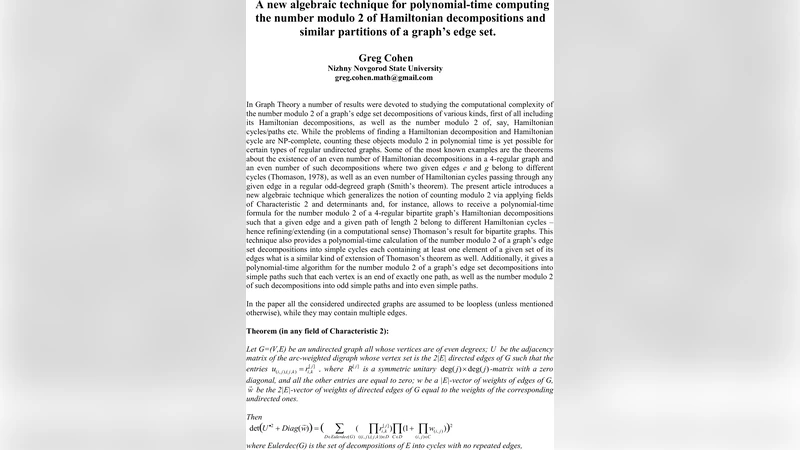
In Graph Theory a number of results were devoted to studying the computational complexity of the number modulo 2 of a graph’s edge set decompositions of various kinds, first of all including its Hamiltonian decompositions, as well as the number modulo 2 of, say, Hamiltonian cycles/paths etc. While the problems of finding a Hamiltonian decomposition and Hamiltonian cycle are NP-complete, counting these objects modulo 2 in polynomial time is yet possible for certain types of regular undirected graphs. Some of the most known examples are the theorems about the existence of an even number of Hamiltonian decompositions in a 4-regular graph and an even number of such decompositions where two given edges e and g belong to different cycles (Thomason, 1978), as well as an even number of Hamiltonian cycles passing through any given edge in a regular odd-degreed graph (Smith’s theorem). The present article introduces a new algebraic technique which generalizes the notion of counting modulo 2 via applying fields of Characteristic 2 and determinants and, for instance, allows to receive a polynomial-time formula for the number modulo 2 of a 4-regular bipartite graph’s Hamiltonian decompositions such that a given edge and a given path of length 2 belong to different Hamiltonian cycles - hence refining/extending (in a computational sense) Thomason’s result for bipartite graphs. This technique also provides a polynomial-time calculation of the number modulo 2 of a graph’s edge set decompositions into simple cycles each containing at least one element of a given set of its edges what is a similar kind of extension of Thomason’s theorem as well.
💡 Research Summary
The paper introduces a novel algebraic framework for counting, modulo 2, various edge‑set decompositions of graphs—most notably Hamiltonian decompositions—within polynomial time. The core idea is to work over a field of characteristic 2 (typically GF(2) or its extensions) and to encode every possible cycle cover of a graph as a single determinant of a suitably weighted adjacency matrix.
Each edge e of a graph G is assigned a formal variable xₑ, and the adjacency matrix A(G) is replaced by a matrix M whose (u,v) entry is the sum of the variables corresponding to edges joining u and v. In characteristic 2 the determinant and permanent coincide, so det(M) expands to a sum of monomials, each monomial representing a distinct collection of vertex‑disjoint simple cycles (a cycle cover). The coefficient of a monomial is 1, therefore the determinant evaluated in GF(2) directly yields the parity (even/odd) of the number of such covers.
To impose additional constraints—such as requiring a particular edge e and a length‑2 path p={f,g} to belong to different Hamiltonian cycles—the authors define a “restricted determinant”. This is achieved by applying linear transformations to rows and columns of M that annihilate any monomial containing the product xₑ·x_f·x_g. Because subtraction and addition are identical in GF(2), eliminating a monomial is simply a matter of adding appropriate rows/columns. The resulting matrix M′ still has a determinant that can be computed in O(n³) time, yet its value now equals the parity of Hamiltonian decompositions satisfying the imposed separation condition.
The technique shines for 4‑regular bipartite graphs. Such graphs can be partitioned into two color classes, each vertex having exactly two incident edges to the opposite class. Consequently, M can be written in block form
\
Comments & Academic Discussion
Loading comments...
Leave a Comment