Worldwide topology of the scientific subject profile: a macro approach on the country level
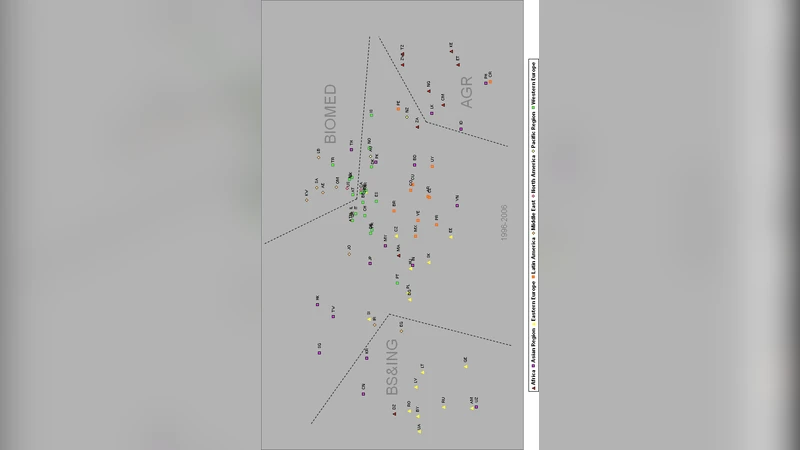
Models for the production of knowledge and systems of innovation and science are key elements for characterizing a country in view of its scientific thematic profile. With regard to scientific output and publication in journals of international visibility, the countries of the world may be classified into three main groups according to their thematic bias. This paper aims to classify the countries of the world in several broad groups, described in terms of behavioural models that attempt to sum up the characteristics of their systems of knowledge and innovation. We perceive three clusters in our analysis: 1) the biomedical cluster, 2) the basic science & engineering cluster, and 3) the agricultural cluster. The countries are conceptually associated with the clusters via Principal Component Analysis (PCA), and a Multidimensional Scaling (MDS) map with all the countries is presented.
💡 Research Summary
The paper presents a macro‑level classification of all world countries based on the thematic composition of their internationally visible scientific publications. Using bibliometric data drawn from major citation indexes (e.g., Scopus, Web of Science) covering roughly two decades, the authors first normalize the number of articles in each of 27 scientific fields by the total output of each country. A Principal Component Analysis (PCA) on this normalized matrix reveals two dominant dimensions: the first component captures a “biomedical” orientation (high loadings on medicine, life sciences, and health‑related fields), while the second reflects a “basic science and engineering” orientation (high loadings on physics, chemistry, engineering, and related disciplines).
Applying K‑means clustering to the scores on these two components, the silhouette analysis indicates that three clusters best represent the data structure. The clusters are interpreted as:
-
Biomedical Cluster – Predominantly high‑income economies such as the United States, United Kingdom, Germany, France, and Japan. These nations allocate a large share of their research output to medical and life‑science journals (often exceeding 30 % of total publications) and typically have substantial R&D budgets focused on health‑care, pharmaceuticals, and biotechnology.
-
Basic Science & Engineering Cluster – Includes emerging and middle‑income powers like China, Russia, India, Brazil, and South Korea. Their publication profiles are dominated by physics, chemistry, and engineering, reflecting strong manufacturing bases, large research infrastructures, and policies that emphasize technological development.
-
Agricultural Cluster – Consists mainly of low‑ and lower‑middle‑income countries (e.g., Kenya, Uganda, Vietnam, the Philippines). A significant portion of their scientific output (often >20 %) is devoted to agriculture, food science, and related applied fields, mirroring national priorities around food security and rural development.
To visualize the global topology, the authors employ Multidimensional Scaling (MDS) to produce a two‑dimensional map where each country’s position reflects its proximity to the three thematic axes. The map shows clear geographic and economic gradients: countries in the biomedical cluster are clustered in North America, Western Europe, and parts of East Asia; the basic‑science cluster spans East Asia, Eastern Europe, and parts of Latin America; the agricultural cluster occupies much of Sub‑Saharan Africa and Southeast Asia. Transitional cases (e.g., Brazil) appear between clusters, indicating mixed research portfolios.
The discussion links these patterns to national innovation systems, suggesting that the identified clusters correspond to distinct behavioral models of knowledge production: health‑centric economies, technology‑centric economies, and agriculture‑centric economies. Policy implications are drawn: countries wishing to shift toward a higher‑value biomedical sector may need to increase health‑related R&D funding and foster university‑industry collaborations, whereas those aiming to boost engineering output should invest in large‑scale research facilities and STEM education.
Limitations are acknowledged, including potential bias from the coverage of international journals (which under‑represents local or non‑English publications), the static nature of the analysis (no temporal dynamics), and the fixed field taxonomy. The authors propose future work that incorporates longitudinal data, regression models linking cluster membership to macro‑economic variables (e.g., GDP per capita, R&D intensity), and network analyses of international co‑authorship to capture cross‑cluster collaborations.
In sum, the study offers a concise, data‑driven framework for categorizing nations according to their scientific subject profiles, providing policymakers, scholars, and research managers with a macro‑level map that can guide strategic decisions on research investment, international partnership, and innovation policy.