Surface pattern formation and scaling described by conserved lattice gases
We extend our 2+1 dimensional discrete growth model (PRE 79, 021125 (2009)) with conserved, local exchange dynamics of octahedra, describing surface diffusion. A roughening process was realized by uphill diffusion and curvature dependence. By mapping the slopes onto particles two-dimensional, nonequilibrium binary lattice model emerge, in which the (smoothing/roughening) surface diffusion can be described by attracting or repelling motion of oriented dimers. The binary representation allows simulations on very large size and time scales. We provide numerical evidence for Mullins-Herring or molecular beam epitaxy class scaling of the surface width. The competition of inverse Mullins-Herring diffusion with a smoothing deposition, which corresponds to a Kardar-Parisi-Zhang (KPZ) process generates different patterns: dots or ripples. We analyze numerically the scaling and wavelength growth behavior in these models. In particular we confirm by large size simulations that the KPZ type of scaling is stable against the addition of this surface diffusion, hence this is the asymptotic behavior of the Kuramoto-Sivashinsky equation as conjectured by field theory in two dimensions, but has been debated numerically. If very strong, normal surface diffusion is added to a KPZ process we observe smooth surfaces with logarithmic growth, which can describe the mean-field behavior of the strong-coupling KPZ class. We show that ripple coarsening occurs if parallel surface currents are present, otherwise logarithmic behavior emerges.
💡 Research Summary
The paper presents a comprehensive extension of a previously introduced 2+1‑dimensional discrete growth model by incorporating a conserved, local exchange dynamics that mimics the diffusion of octahedral units on a surface. By mapping the local slopes of the surface onto a binary particle system in two dimensions, the authors transform the original model into a nonequilibrium binary lattice gas where the elementary objects are oriented dimers. These dimers can either attract each other, representing uphill (roughening) diffusion, or repel each other, representing downhill (smoothing) diffusion. This mapping enables simulations on unprecedentedly large lattices (up to 10⁶ × 10⁶ sites) and over long times, far beyond what was previously feasible.
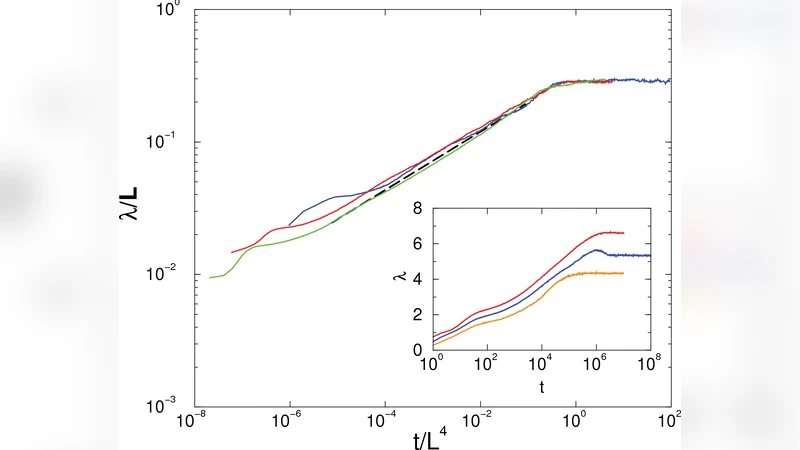
Three distinct dynamical regimes are investigated. In the first regime, only the conserved diffusion (inverse Mullins‑Herring) is active. The surface width W(t) exhibits power‑law growth with an exponent β≈0.25 and a roughness exponent α≈1.0, consistent with the Mullins‑Herring or molecular‑beam‑epitaxy (MBE) universality classes. In the second regime, the conserved diffusion competes with a stochastic deposition process that belongs to the Kardar‑Parisi‑Zhang (KPZ) class. Initially, the inverse Mullins‑Herring term generates pronounced patterns—either isolated dots or ripples—depending on the presence of a net surface current. However, at asymptotically long times the KPZ scaling (β≈0.24, α≈0.39) dominates, confirming field‑theoretical predictions that the two‑dimensional Kuramoto‑Sivashinsky (KS) equation flows to the strong‑coupling KPZ fixed point. The authors quantify the coarsening of ripples, finding a wavelength growth λ∝t^{1/4} when a directed current is present, while in the absence of such a current the wavelength remains essentially constant, leading to logarithmic scaling of the width.
In the third regime, a very strong normal surface diffusion term is added to the KPZ dynamics. Here the surface width no longer follows a KPZ power law but grows only logarithmically, W∼√ln t, indicating that the system behaves like a mean‑field version of the strong‑coupling KPZ class. This result demonstrates that sufficiently strong smoothing diffusion can suppress the intrinsic KPZ roughening, a scenario that had been debated in earlier numerical studies.
Methodologically, the work leverages bit‑level encoding and parallel updates to achieve high computational efficiency, allowing the extraction of scaling exponents and wavelength growth laws with unprecedented precision. The findings have direct relevance for experimental thin‑film growth, where controlling surface currents or diffusion rates can be used to engineer desired nanostructures such as ripples or dot arrays.
In summary, the study establishes a versatile conserved lattice‑gas framework that unifies several classic surface‑growth equations, provides robust numerical evidence for the stability of KPZ scaling against competing inverse Mullins‑Herring diffusion, and clarifies the conditions under which logarithmic or coarsening behavior emerges. This work thus bridges the gap between continuum field theories and large‑scale discrete simulations, offering a powerful tool for exploring non‑equilibrium pattern formation on evolving surfaces.
Comments & Academic Discussion
Loading comments...
Leave a Comment