Many applied time-dependent problems are characterized by an additive representation of the problem operator. Additive schemes are constructed using such a splitting and associated with the transition to a new time level on the basis of the solution of more simple problems for the individual operators in the additive decomposition. We consider a new class of additive schemes for problems with additive representation of the operator at the time derivative. In this paper we construct and study the vector operator-difference schemes, which are characterized by a transition from one initial the evolution equation to a system of such equations.
Deep Dive into On a new class of additive (splitting) operator-difference schemes.
Many applied time-dependent problems are characterized by an additive representation of the problem operator. Additive schemes are constructed using such a splitting and associated with the transition to a new time level on the basis of the solution of more simple problems for the individual operators in the additive decomposition. We consider a new class of additive schemes for problems with additive representation of the operator at the time derivative. In this paper we construct and study the vector operator-difference schemes, which are characterized by a transition from one initial the evolution equation to a system of such equations.
For the approximate solution of multidimensional unsteady problems of mathematical physics there are widely used different classes of additive schemes (splitting schemes) [5,8,17]. Beginning with the pioneering works [2,6] the most simple way to construct additive schemes is in the splitting of the problem operator on the sum of two operators with a more simple structure -alternating direction methods, factorized schemes, predictor-corrector schemes etc. [12].
In the more general case of multicomponent splitting, classes of unconditionally stable operator-difference schemes are based on the concept of summarized approximation. In this way, we can construct the classic locally one-dimensional schemes (componentwise splitting schemes) [5,8], additively-averaged locally onedimensional schemes [3,12].
A new class of unconditionally stable schemes -vector additive schemes (multicomponent alternating direction method schemes) is actively developed (see, eg, [1,14]). They belong to a class of full approximation schemes -each intermediate problem approximates the original one. The most simple additive full approximation schemes are based on the principle of regularization of operator-difference schemes. Improving the quality of operator-difference schemes is achieved using additive or multiplicative perturbations of operators of the scheme [7]. Regularized additive schemes for evolutionary equations of the first and second order are constructed for equations as well as systems of equations [13,15]. Both the standard schemes of splitting with respect to separate directions (locally-onedimensional schemes), splitting with respect to physical processes and regionally-additive schemes based on domain decomposition for constructing parallel algorithms for transient problems of mathematical physics [4,10,16].
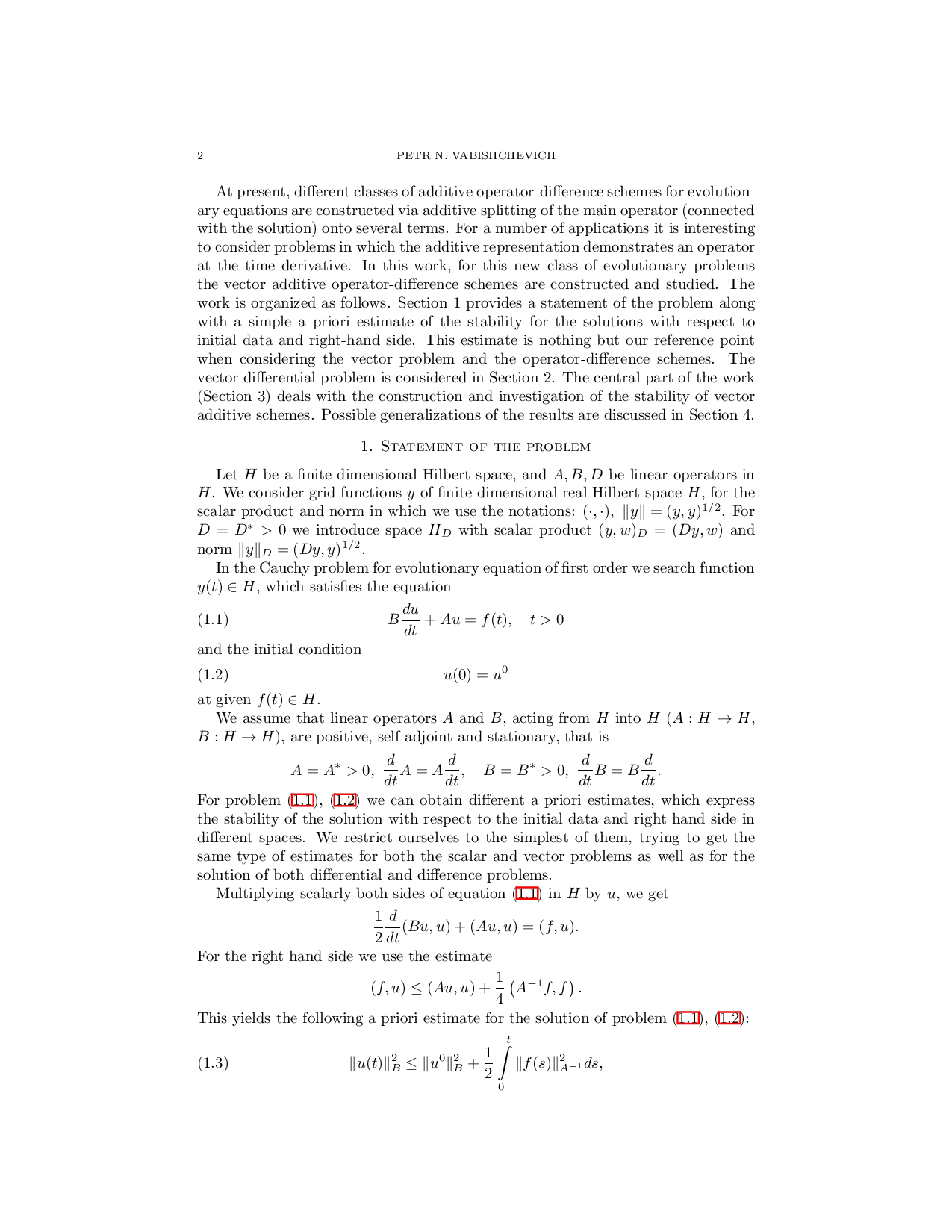
At present, different classes of additive operator-difference schemes for evolutionary equations are constructed via additive splitting of the main operator (connected with the solution) onto several terms. For a number of applications it is interesting to consider problems in which the additive representation demonstrates an operator at the time derivative. In this work, for this new class of evolutionary problems the vector additive operator-difference schemes are constructed and studied. The work is organized as follows. Section 1 provides a statement of the problem along with a simple a priori estimate of the stability for the solutions with respect to initial data and right-hand side. This estimate is nothing but our reference point when considering the vector problem and the operator-difference schemes. The vector differential problem is considered in Section 2. The central part of the work (Section 3) deals with the construction and investigation of the stability of vector additive schemes. Possible generalizations of the results are discussed in Section 4.
Let H be a finite-dimensional Hilbert space, and A, B, D be linear operators in H. We consider grid functions y of finite-dimensional real Hilbert space H, for the scalar product and norm in which we use the notations: (•, •), y = (y, y) 1/2 . For D = D * > 0 we introduce space H D with scalar product (y, w) D = (Dy, w) and norm y D = (Dy, y) 1/2 .
In the Cauchy problem for evolutionary equation of first order we search function y(t) ∈ H, which satisfies the equation
and the initial condition
We assume that linear operators A and B, acting from H into H (A : H → H, B : H → H), are positive, self-adjoint and stationary, that is
For problem (1.1), (1.2) we can obtain different a priori estimates, which express the stability of the solution with respect to the initial data and right hand side in different spaces. We restrict ourselves to the simplest of them, trying to get the same type of estimates for both the scalar and vector problems as well as for the solution of both differential and difference problems.
Multiplying scalarly both sides of equation (1.1) in H by u, we get 1 2
For the right hand side we use the estimate
This yields the following a priori estimate for the solution of problem (1.1), (1.2):
which expresses the stability of the solution with respect to the initial data and right hand side. Standard additive difference schemes are characterized by decomposition (splitting) of the operator A onto the sum of operators of a simpler structure. For example, we assume that for operator A we have the following additive representation:
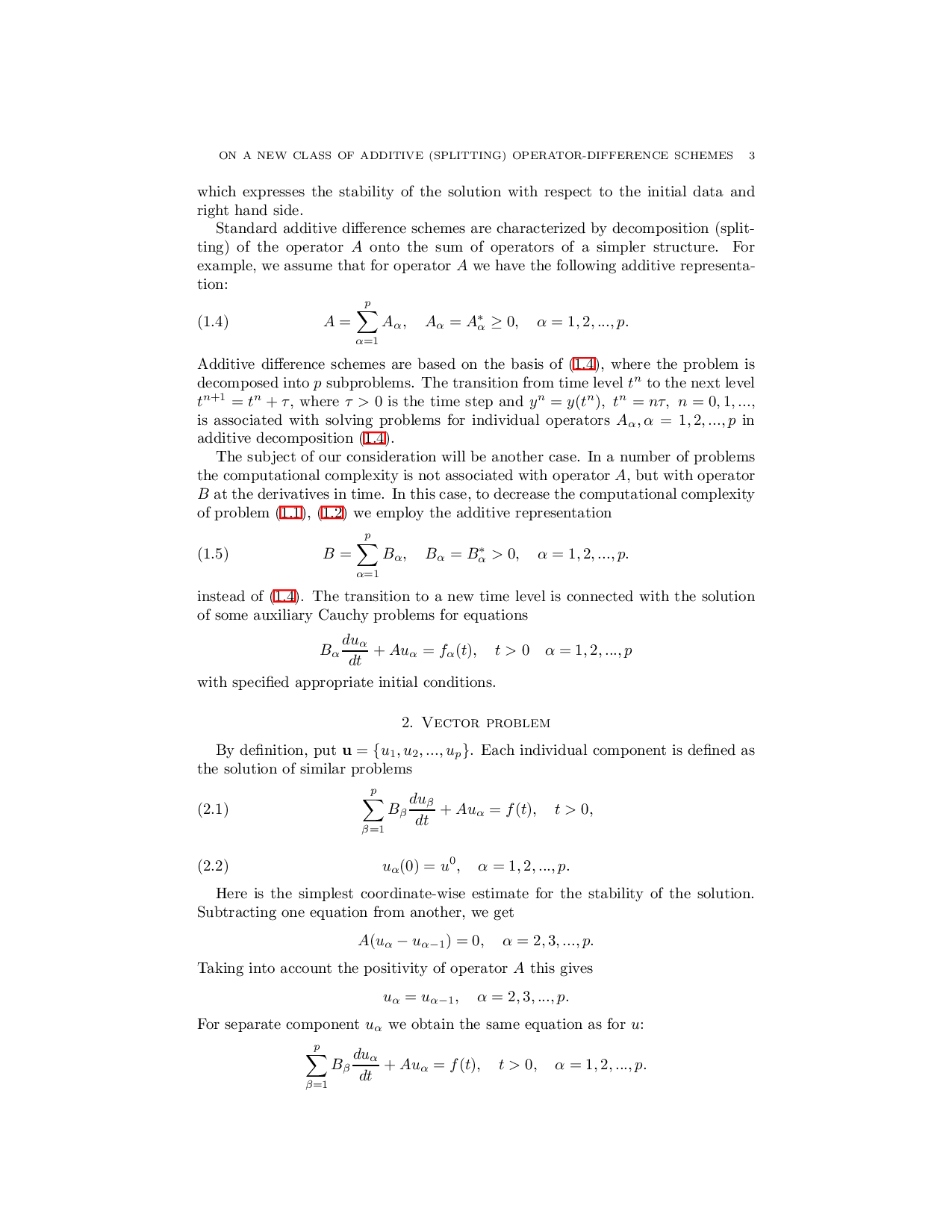
Additive difference schemes are based on the basis of (1.4), where the problem is decomposed into p subproblems. The transition from time level t n to the next level t n+1 = t n + τ , where τ > 0 is the time step and y n = y(t n ), t n = nτ, n = 0, 1, …, is associated with solving problems for individual operators A α , α = 1, 2, …, p in additive decomposition (1.4). The subject of our consideration will be another case. In a number of problems the computational complexity is not associated with operat
…(Full text truncated)…
This content is AI-processed based on ArXiv data.