The ABC of Digital Business Ecosystems
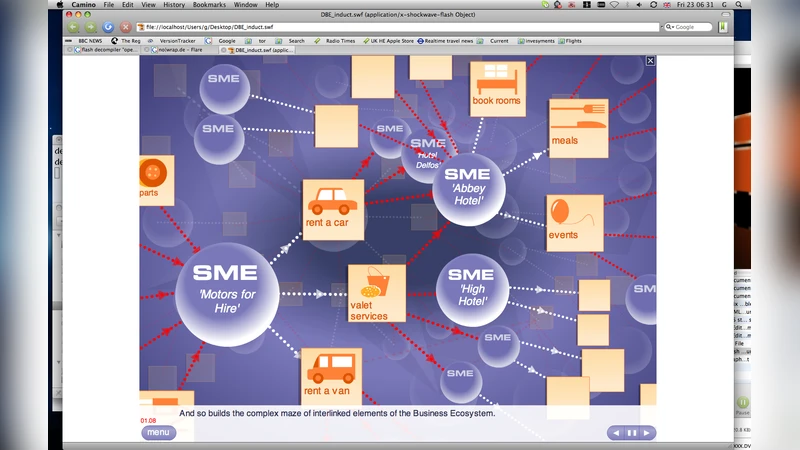
The European Commission has the power to inspire, initiate and sponsor huge transnational projects to an extent impossible for most other entities. These projects can address universal themes and develop well-being models that are valuable across a diversity of societies and economies. It is a universal fact that SMEs in all countries provide a substantial proportion of total employment, and conduct much of a nation’s innovative activity. Yet these smaller companies struggle in global markets on a far from level playing field, where large companies have distinct advantages. To redress this imbalance the Commission saw it as a priority to improve the trading capability of the Small and Medium-sized Enterprises (SMEs), and perceived digital platforms as the modern means to this end. They considered that the best operational model for a vibrant Web2.0-based Internet services industry would be by analogy to well-performing biological ecosystems. Open Source Software is adopted in the DBE/OPAALS projects as the best support for sustainability of such complex electronic webs, since it minimises interoperability problems, enables code access for cheaper in-house modification or development of systems, and reduces both capital and operating expenditure.
💡 Research Summary
The paper presents the European Commission’s “Digital Business Ecosystem” (DBE) and the OPAALS (Open Platform for Architecture and Application Layer Services) initiative as a comprehensive strategy to boost the global competitiveness of Small and Medium‑Sized Enterprises (SMEs). It begins by highlighting the Commission’s unique capacity to fund and coordinate large‑scale trans‑national projects and by diagnosing the structural disadvantages that SMEs face in digital markets compared with large corporations. To address this imbalance, the authors propose modeling digital platforms on biological ecosystems, where a multitude of independent actors—companies, developers, and end‑users—interact, share resources, and evolve organically.
Open Source Software (OSS) is identified as the technical cornerstone of the ecosystem. By providing unrestricted code access, OSS enables SMEs to modify and extend platforms in‑house, dramatically reducing both capital outlays and operating expenses. A modular, standards‑based architecture ensures interoperability across heterogeneous systems, while avoiding vendor lock‑in. OPAALS operationalises these principles by separating service and application layers, offering a common service registry, unified authentication/authorization mechanisms, and standardized data‑exchange protocols. This platform‑neutral design allows SMEs to focus on their core business logic rather than on underlying infrastructure.
Beyond technology, the Commission supplies policy levers—standardisation initiatives, certification schemes, and targeted funding—to create a governance framework that builds trust among participants and amplifies network effects. Pilot implementations illustrate the model’s impact: a manufacturing SME migrated its supply‑chain management to the OPAALS cloud, achieving real‑time data sharing, automated order processing, and a cost reduction of over 30 %; a service‑sector SME customised an open‑source digital‑marketing toolkit to launch region‑specific campaigns, raising revenue by 15 %.
The authors conclude that DBE/OPAALS offers an integrated, sustainable ecosystem that couples technical infrastructure with policy support, providing SMEs with a viable pathway to digital transformation and international market entry. Future research directions include deeper exploration of data governance, security standardisation, and the integration of emerging technologies such as artificial intelligence and big‑data analytics into the ecosystem.
Comments & Academic Discussion
Loading comments...
Leave a Comment