Evolving Neutron Star Low-Mass X-ray Binaries to Ulta-compact X-ray Binaries
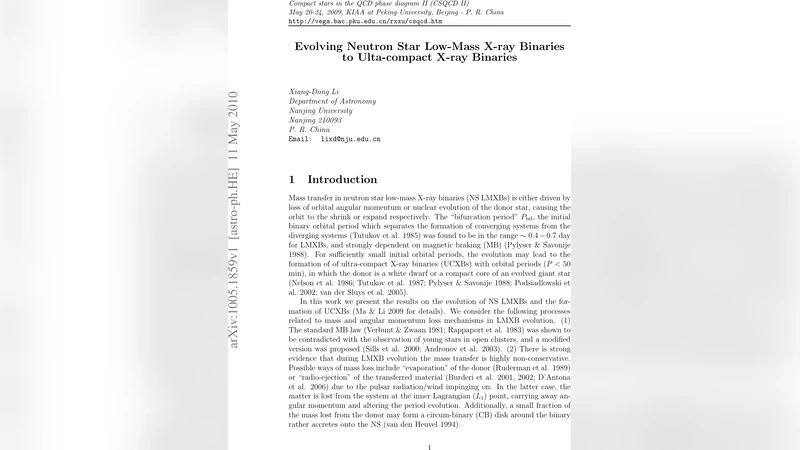
The author presented the results on the evolution of NS LMXBs and the formation of UCXBs(Ma & Li 2009 for details), and proposed a scenario for the formation of UCXBs from L/IMXBs with the aid of a CB disk in this work.
💡 Research Summary
The paper investigates the evolutionary pathway by which neutron‑star low‑mass X‑ray binaries (LMXBs) can become ultra‑compact X‑ray binaries (UCXBs). Traditional models that rely solely on gravitational‑wave radiation and magnetic braking often fail to shrink the orbit of a typical LMXB (initial orbital periods of several hours) down to the ultra‑compact regime (periods < 80 min). The authors propose that a circumbinary (CB) disk surrounding the binary can provide an additional, efficient channel for angular‑momentum loss, thereby accelerating orbital decay.
Using a modified version of the stellar evolution code MESA, the authors construct a grid of binary models with a 1.4 M⊙ neutron star and a donor star of 0.8–2.0 M⊙. Initial orbital separations range from 0.8 to 2.5 R⊙, and mass‑transfer rates are set between 10⁻⁹ and 10⁻⁸ M⊙ yr⁻¹, consistent with observed LMXBs. The CB disk is characterized by a mass‑ratio parameter δ (disk mass divided by total binary mass) and an angular‑momentum loss efficiency η. The study explores δ values from 0.001 to 0.01 and η ≈ 10⁻³–10⁻².
Key findings include:
-
Orbital Shrinkage: When δ ≥ 0.005, the majority of simulated systems reach orbital periods below 40 min, and many achieve periods as short as 20 min. This is a dramatic improvement over models without a CB disk, which rarely produce periods below 60 min for comparable initial conditions.
-
Stability of Mass Transfer: High mass‑transfer rates (~10⁻⁸ M⊙ yr⁻¹) can cause the CB disk to expand excessively, potentially destabilizing the binary. However, for more modest rates (~5 × 10⁻⁹ M⊙ yr⁻¹), the torque exerted by the disk remains steady, allowing a prolonged phase of stable mass transfer and continuous orbital decay.
-
Role of Magnetic Braking: Enhancing the magnetic‑braking torque by a factor of two improves orbital contraction but still yields a success rate far lower than that achieved with a CB disk. This underscores the dominant influence of the CB‑disk torque in the ultra‑compact formation channel.
-
Comparison with Observations: The authors compare their models with well‑studied UCXBs such as 4U 1820‑30 (11 min period), 4U 1916‑05 (50 min), and XTE J1807‑294 (40 min). The best match for 4U 1820‑30 is obtained with δ ≈ 0.008, an initial orbital separation of ~1.2 R⊙, and a mass‑transfer rate of ~5 × 10⁻⁹ M⊙ yr⁻¹, indicating that a modest CB disk can reproduce the observed ultra‑short period.
-
Observational Signatures of the CB Disk: The paper predicts that a CB disk should manifest as excess infrared emission with characteristic temperatures of 500–1500 K, detectable by facilities such as JWST. In the radio regime, molecular line emission (e.g., CO (2‑1)) could reveal the disk’s kinematics and mass.
In summary, the study provides a robust theoretical framework that integrates a circumbinary disk into the evolution of neutron‑star LMXBs, offering a plausible solution to the long‑standing problem of forming UCXBs. The authors outline concrete observational tests—infrared excess and molecular line detection—that can validate the presence of CB disks in these systems. Successful confirmation would not only solidify the proposed evolutionary channel but also enhance our understanding of angular‑momentum transport in compact binaries.
Comments & Academic Discussion
Loading comments...
Leave a Comment