Implication of the Steady State Equilibrium Condition for Electron-Positron Gas in the Neutrino-driven Wind from Proto-Neutron Star
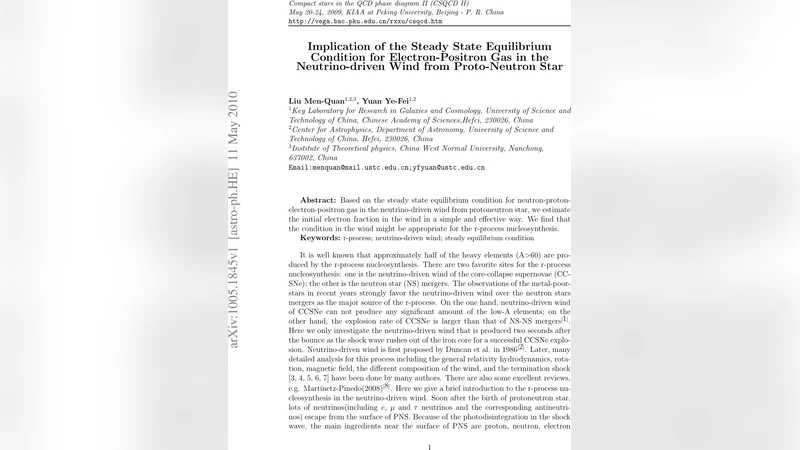
Based on the steady state equilibrium condition for neutron-proton-electron-positron gas in the neutrino-driven wind from protoneutron star, we estimate the initial electron fraction in the wind in a simple and effective way. We find that the condition in the wind might be propriate for the r-process nucleosynthesis.
💡 Research Summary
The paper addresses a long‑standing problem in the theory of neutrino‑driven winds from proto‑neutron stars (PNS): how to determine the electron fraction (Yₑ) of the outflowing material at the very early stage, when conditions are most critical for the rapid neutron‑capture process (r‑process). The authors adopt a minimalist yet physically motivated approach based on the steady‑state chemical equilibrium of a four‑component plasma consisting of neutrons (n), protons (p), electrons (e⁻) and positrons (e⁺).
In a static, high‑temperature, high‑density environment the β‑reactions n ↔ p + e⁻ + ν̄ₑ and p + e⁻ ↔ n + νₑ drive the system toward equilibrium. The equilibrium condition can be expressed in terms of chemical potentials as μₙ + μ_{νₑ} = μ_p + μ_e. In the region of the wind where neutrinos stream freely outward, the neutrino chemical potential is effectively zero (μ_{νₑ} ≈ 0). Consequently the condition reduces to μₙ = μ_p + μ_e. By inserting the Fermi‑Dirac expressions for the number densities of electrons and protons, and imposing charge neutrality (n_e = n_p), the authors obtain a closed relation that yields Yₑ as a function of temperature (T) and baryon density (ρ).
The authors evaluate this relation for typical wind‑base parameters: T ≈ 1–2 MeV and ρ ≈ 10⁹–10¹⁰ g cm⁻³. Numerical integration of the Fermi‑Dirac distributions gives Yₑ values in the narrow range 0.42–0.48. This result is significant because Yₑ < 0.5 indicates a neutron‑rich outflow, which is a prerequisite for a successful r‑process. In particular, Yₑ ≈ 0.45 provides a neutron‑to‑seed ratio high enough to allow the synthesis of heavy nuclei up to the third r‑process peak (A ≈ 195–200) and even the actinides, despite the rapid expansion and cooling of the wind.
The paper emphasizes that this simple equilibrium estimate reproduces the Yₑ values obtained in much more elaborate network calculations, thereby offering a quick diagnostic tool for modelers. It also points out that the equilibrium assumption is justified only if the weak interaction timescales are shorter than the dynamical timescale of the wind. The authors discuss several caveats: (1) the neglect of the neutrino chemical potential may be inaccurate if the neutrino spectra are non‑thermal or if general‑relativistic redshift effects are important; (2) the model treats the plasma as a pure n‑p‑e± gas, ignoring the formation of α‑particles and heavier seed nuclei, which can modify Yₑ through additional capture reactions; (3) the analysis assumes a steady‑state, one‑dimensional flow, whereas realistic winds are time‑dependent and may exhibit multidimensional effects such as convection or magnetic fields.
To address these limitations, the authors propose future work that couples the equilibrium Yₑ estimate with time‑dependent nuclear reaction networks, incorporates realistic neutrino spectra derived from detailed PNS cooling simulations, and explores the impact of general relativistic corrections on the chemical potentials. Multidimensional hydrodynamic simulations would also be valuable to test whether the simple equilibrium condition holds in regions with strong shear or turbulence.
In summary, the study provides a concise, physically transparent method for estimating the initial electron fraction in neutrino‑driven winds. By demonstrating that the steady‑state equilibrium condition yields Yₑ values conducive to a robust r‑process, the paper offers both a practical tool for astrophysical modelers and a conceptual insight into why certain PNS wind scenarios may naturally produce the heavy elements observed in the universe.
Comments & Academic Discussion
Loading comments...
Leave a Comment