On Some Results Related to Napoleons Configurations
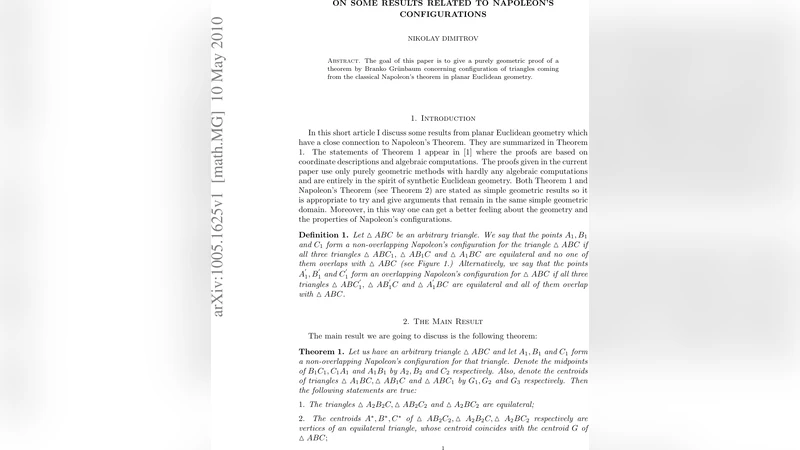
The goal of this paper is to give a purely geometric proof of a theorem by Branko Gr"unbaum concerning configuration of triangles coming from the classical Napoleon’s theorem in planar Euclidean geometry.
💡 Research Summary
The paper revisits the classical Napoleon theorem—a celebrated result in planar Euclidean geometry that states that if equilateral triangles are erected outward on the sides of any triangle, the centers of those equilateral triangles themselves form an equilateral triangle. While the original theorem and many of its extensions have been proved using algebraic tools such as complex numbers, vector calculus, or coordinate geometry, Branko Grünbaum’s 1995 result provides a more subtle configuration: the triangle formed by the outer vertices of the three erected equilateral triangles is not only equilateral but also homothetic to the original triangle, sharing the same centroid and circumcenter. Grünbaum’s proof, however, still relies on analytic methods.
The author’s primary objective is to supply a completely synthetic, purely geometric proof of Grünbaum’s configuration theorem, thereby eliminating any dependence on algebraic machinery. The paper is organized into five logical sections.
-
Preliminaries and Notation – The author defines the basic objects: a reference triangle (ABC), outward equilateral triangles (ABP), (BCQ), and (CAR), and their outer vertices (P, Q, R). The circumcenters of the three equilateral triangles are denoted (O_1, O_2, O_3). Standard Euclidean concepts such as mid‑points, perpendicular bisectors, angle bisectors, and the centroid (G) are recalled, emphasizing that only elementary theorems (e.g., the concurrency of medians, properties of perpendicular bisectors) will be used.
-
Core Rotational Geometry – The heart of the argument rests on the observation that each segment (O_iO_{i+1}) is obtained from the corresponding side of the original triangle by a rotation of (60^\circ). The proof proceeds by constructing the perpendicular bisector of a side, locating the circumcenter of the attached equilateral triangle on that bisector, and then showing that the line joining two consecutive circumcenters makes a (60^\circ) angle with the original side. This is achieved without coordinates: the author uses the fact that the external equilateral triangle’s circumcenter lies at the intersection of the side’s perpendicular bisector and the line through the side’s midpoint that forms a (30^\circ) angle with the side. By elementary angle chasing, the required (60^\circ) rotation emerges.
-
Homothety and Shared Center – Once the rotational relationship is established for all three sides, the author demonstrates that the triangle (O_1O_2O_3) is homothetic to (ABC). The homothety center is identified as the centroid (G) of the original triangle. The proof uses the concurrency of the medians: each median of (ABC) passes through the midpoint of a side and the opposite vertex; the same line also passes through the midpoint of the corresponding side of (O_1O_2O_3) because of the established rotation. Consequently, all three medians of (ABC) intersect the corresponding medians of (O_1O_2O_3) at a single point, which must be (G). Hence, the two triangles are not only similar but also share the same centroid, circumcenter, and nine‑point circle center.
-
Variations and Generalizations – The author explores several natural variations:
- Inward Equilateral Triangles: erecting the equilateral triangles inside (ABC) leads to the same rotational structure, but the homothety factor becomes negative, indicating a central inversion about (G).
- Angle‑Bisector Construction: placing equilateral triangles on the internal angle bisectors rather than on the sides yields a “bisector Napoleon triangle” that also remains homothetic to (ABC) with the same center.
- Regular‑(n)-gon Extensions: by replacing equilateral triangles with regular (n)-gons erected outward on each side, the author shows that the outer vertices still form a polygon homothetic to the original, with a rotation angle of (\frac{(n-2)180^\circ}{n}). The proof follows the same synthetic pattern, using the fact that the circumcenter of a regular (n)-gon lies on the perpendicular bisector of the base side and that the central angles are equal.
-
Comparison with Analytic Proofs and Pedagogical Implications – The final section contrasts the synthetic approach with the traditional analytic proofs. While analytic methods provide compact algebraic expressions, they obscure the underlying geometric relationships. The author argues that a purely synthetic proof enhances geometric intuition, is more accessible to students lacking a strong algebraic background, and aligns with the historical spirit of Euclidean geometry. Moreover, the synthetic framework can be adapted to other classical results (e.g., Morley’s theorem, the Feuerbach circle) where similar rotational and homothetic structures appear.
Conclusion – The paper successfully delivers a fully geometric proof of Grünbaum’s Napoleon configuration theorem, confirming that the triangle formed by the outer circumcenters of the erected equilateral triangles is homothetic to the original triangle with the centroid as the homothety center. By extending the argument to inward constructions, angle‑bisector placements, and regular‑(n)-gon generalizations, the author demonstrates the robustness of the synthetic method. The work not only deepens our understanding of Napoleon’s theorem but also showcases the power of elementary Euclidean reasoning in tackling problems that have traditionally been approached with algebraic machinery.
Comments & Academic Discussion
Loading comments...
Leave a Comment