Google matrix and Ulam networks of intermittency maps
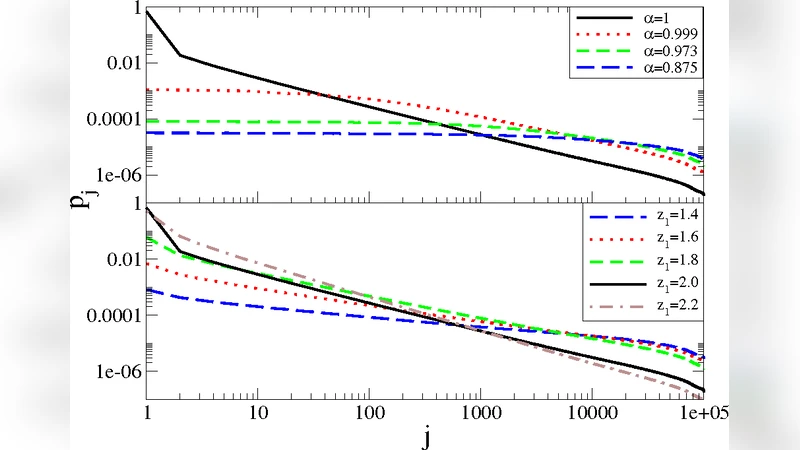
We study the properties of the Google matrix of an Ulam network generated by intermittency maps. This network is created by the Ulam method which gives a matrix approximant for the Perron-Frobenius operator of dynamical map. The spectral properties of eigenvalues and eigenvectors of this matrix are analyzed. We show that the PageRank of the system is characterized by a power law decay with the exponent $\beta$ dependent on map parameters and the Google damping factor $\alpha$. Under certain conditions the PageRank is completely delocalized so that the Google search in such a situation becomes inefficient.
💡 Research Summary
The paper investigates how the Google matrix, the core of the PageRank algorithm, behaves when it is built from an Ulam network derived from intermittency maps. An intermittency map is a low‑dimensional dynamical system whose trajectories spend long periods in a “laminar” region before making rapid excursions; this mixture of slow and fast dynamics creates a non‑uniform invariant measure. The authors first discretize the unit interval into N cells and apply the Ulam method: a large number of trajectories are launched from each cell, and the fraction that lands in another cell after one iteration defines the transition matrix U. This matrix approximates the Perron‑Frobenius operator of the map and inherits its non‑reversible, non‑normal character.
To obtain a Google matrix suitable for PageRank, the authors normalize the columns of U to form a stochastic matrix S and then introduce the usual damping factor α (0 < α < 1) via G = αS + (1 − α)E/N, where E is the all‑ones matrix. Two families of intermittency maps are studied: (i) the Pomeau‑Manneville type f(x)=x + a x^z (mod 1) and (ii) a sinusoidal map f(x)=x + b sin(πx) (mod 1). By varying the control parameters a (or b) and the number of cells N (from 2^10 up to 2^20), the authors generate a series of large, sparse Google matrices and compute their spectra and eigenvectors using Arnoldi iteration.
Spectral analysis reveals a universal structure: the leading eigenvalue λ₁ = 1 is always present, corresponding to the PageRank vector P. All other eigenvalues lie inside the unit circle, with moduli roughly proportional to α. As α approaches 1, a clear spectral gap separates λ₁ from the bulk, guaranteeing fast convergence of the power‑iteration method. When α is reduced, the gap shrinks, many eigenvalues crowd near the unit circle, and the convergence becomes slow. The non‑leading eigenvectors display fractal‑like localization, especially those associated with eigenvalues close to zero, reflecting the intermittent dynamics’ tendency to trap probability in the laminar region.
The central focus of the paper is the statistical distribution of PageRank components. Ordering nodes by decreasing P_i, the authors find a power‑law decay P(k) ∝ k^{−β}. The exponent β is not a universal constant; it varies systematically with both the map parameter (a or b) and the damping factor α. Larger a (or b) intensifies intermittency, producing a heavier tail (smaller β) because the laminar region contributes many low‑rank nodes that nevertheless receive a non‑negligible share of probability. Conversely, decreasing α increases the random‑jump term (1 − α)E/N, which tends to flatten the distribution and drive β toward zero. In the extreme case α ≲ 0.5, the PageRank becomes almost uniform (β ≈ 0), indicating a complete delocalization of probability across the network. The authors quantify the β(α, a) relationship by fitting log‑log plots and propose an approximate scaling law β ≈ (1 − α)·f(a), where f(a) captures the map‑specific intermittency strength.
This delocalization has practical implications. In typical web graphs, a concentrated PageRank (β ≈ 1) highlights a few authoritative pages, making search efficient. In the intermittency‑Ulam networks studied here, however, parameter regimes exist where the PageRank is spread almost evenly; a random surfer would not preferentially visit any subset of nodes, rendering the Google search ineffective. The authors argue that this phenomenon is linked to the vanishing spectral gap and the presence of many near‑unit eigenvalues, which together prevent the power‑iteration from quickly isolating the dominant eigenvector.
The paper concludes by contrasting these findings with those for scale‑free web networks, where β is relatively stable (≈0.9–1.1) and largely insensitive to α. The intermittency‑driven Ulam networks exhibit a far richer dependence on dynamical parameters, offering a novel testbed for studying how underlying dynamics influence ranking algorithms. Future work suggested includes extending the analysis to higher‑dimensional intermittent maps, exploring the role of non‑uniform cell partitions, and applying the framework to real‑world systems where transport or information flow is governed by intermittent dynamics (e.g., neuronal firing patterns, climate models, or traffic flows).
Comments & Academic Discussion
Loading comments...
Leave a Comment