On The Maximum Mass of Stellar Black Holes
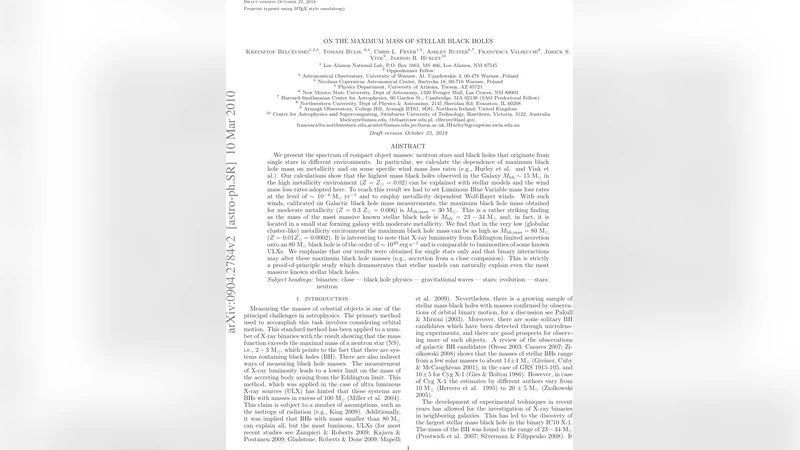
We present the spectrum of compact object masses: neutron stars and black holes that originate from single stars in different environments. In particular, we calculate the dependence of maximum black hole mass on metallicity and on some specific wind mass loss rates (e.g., Hurley et al. and Vink et al.). Our calculations show that the highest mass black holes observed in the Galaxy M_bh = 15 Msun in the high metallicity environment (Z=Zsun=0.02) can be explained with stellar models and the wind mass loss rates adopted here. To reach this result we had to set Luminous Blue Variable mass loss rates at the level of about 0.0001 Msun/yr and to employ metallicity dependent Wolf-Rayet winds. With such winds, calibrated on Galactic black hole mass measurements, the maximum black hole mass obtained for moderate metallicity (Z=0.3 Zsun=0.006) is M_bh,max = 30 Msun. This is a rather striking finding as the mass of the most massive known stellar black hole is M_bh = 23-34 Msun and, in fact, it is located in a small star forming galaxy with moderate metallicity. We find that in the very low (globular cluster-like) metallicity environment the maximum black hole mass can be as high as M_bh,max = 80 Msun (Z=0.01 Zsun=0.0002). It is interesting to note that X-ray luminosity from Eddington limited accretion onto an 80 Msun black hole is of the order of about 10^40 erg/s and is comparable to luminosities of some known ULXs. We emphasize that our results were obtained for single stars only and that binary interactions may alter these maximum black hole masses (e.g., accretion from a close companion). This is strictly a proof-of-principle study which demonstrates that stellar models can naturally explain even the most massive known stellar black holes.
💡 Research Summary
The paper investigates how the maximum mass of stellar‑origin black holes depends on the metallicity of their progenitor stars and on the adopted stellar wind mass‑loss prescriptions. Using single‑star evolutionary calculations, the authors explore two widely used wind models—those of Hurley et al. (2000) and Vink et al. (2001)—and adjust the mass‑loss rates in the Luminous Blue Variable (LBV) and Wolf‑Rayet (WR) phases to reproduce the observed 15 M⊙ black hole in the Milky Way, which resides in a high‑metallicity environment (Z≈Z⊙=0.02). The LBV mass‑loss rate is fixed at ≈10⁻⁴ M⊙ yr⁻¹, while the WR wind is scaled with metallicity as Ṁ∝Z^0.86, a relation calibrated against Galactic black‑hole mass measurements.
The authors compute the final core masses for a grid of initial stellar masses (1–150 M⊙) at three representative metallicities: solar (Z=Z⊙), moderate (Z=0.3 Z⊙≈0.006), and very low (Z=0.01 Z⊙≈0.0002). The results show a clear trend: higher metallicity leads to stronger winds, larger mass loss, and consequently lower final black‑hole masses. In the solar‑metallicity case the most massive black hole that can be produced from a single star is about 15 M⊙, matching the most massive Galactic black holes known. At moderate metallicity the maximum black‑hole mass rises to ≈30 M⊙, which is consistent with the most massive stellar black holes observed in nearby star‑forming galaxies (e.g., M33 X‑7, with a mass estimate of 23–34 M⊙). In the extremely low‑metallicity regime the calculations predict black holes as massive as 80 M⊙. An 80 M⊙ black hole accreting at the Eddington limit would emit X‑rays at ~10⁴⁰ erg s⁻¹, comparable to the luminosities of several known ultra‑luminous X‑ray sources (ULXs).
The study emphasizes that these findings are derived for isolated, single stars; binary interactions—mass transfer, common‑envelope evolution, tidal spin‑up, or accretion from a close companion—could significantly modify the final black‑hole mass distribution. The authors discuss the uncertainties inherent in the wind prescriptions, particularly the LBV mass‑loss mechanism and the exact metallicity exponent for WR winds, and note that modest changes in these parameters could shift the predicted maximum masses. They also point out that stellar rotation, which is not included in the present models, may further affect core growth and mass loss.
In the discussion, the authors argue that the ability of low‑metallicity single stars to produce black holes up to ~80 M⊙ provides a natural explanation for the most luminous ULXs without invoking exotic scenarios such as intermediate‑mass black holes or super‑Eddington accretion. Moreover, the results have implications for the formation channels of gravitational‑wave sources detected by LIGO/Virgo, many of which involve black holes in the 30–50 M⊙ range; such masses are readily achievable in moderate‑metallicity environments according to the presented models.
The paper concludes that metallicity‑dependent stellar winds are a key factor governing the upper mass limit of stellar black holes. While the current work serves as a proof‑of‑principle demonstration that single‑star evolution can account for the observed massive black holes and ULXs, the authors stress the need for future studies that incorporate binary evolution, rotation, and more sophisticated wind physics, as well as observational campaigns to refine black‑hole mass measurements across a range of galactic environments.
Comments & Academic Discussion
Loading comments...
Leave a Comment