Non-Detection of Polarized, Scattered Light from the HD 189733b Hot Jupiter
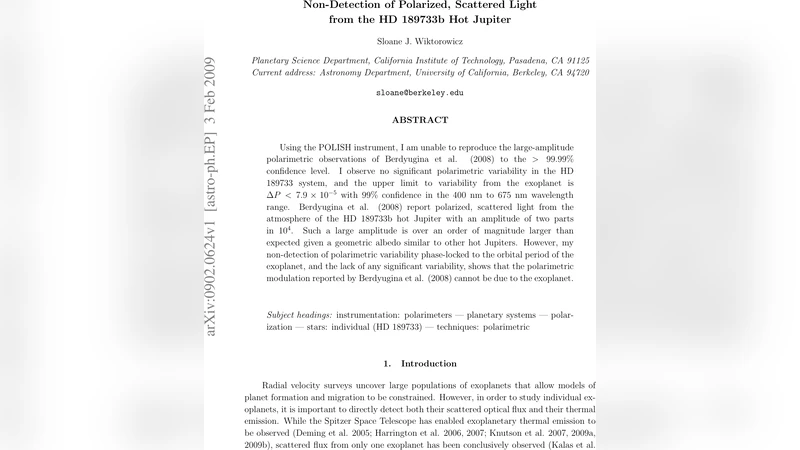
Using the POLISH instrument, I am unable to reproduce the large-amplitude polarimetric observations of Berdyugina et al. (2008) to the >99.99% confidence level. I observe no significant polarimetric variability in the HD 189733 system, and the upper limit to variability from the exoplanet is Delta_P < 7.9 x 10^(-5) with 99% confidence in the 400 nm to 675 nm wavelength range. Berdyugina et al. (2008) report polarized, scattered light from the atmosphere of the HD 189733b hot Jupiter with an amplitude of two parts in 10^4. Such a large amplitude is over an order of magnitude larger than expected given a geometric albedo similar to other hot Jupiters. However, my non-detection of polarimetric variability phase-locked to the orbital period of the exoplanet, and the lack of any significant variability, shows that the polarimetric modulation reported by Berdyugina et al. (2008) cannot be due to the exoplanet.
💡 Research Summary
The paper presents a rigorous, independent test of the polarized reflected‑light signal from the hot‑Jupiter HD 189733b that was previously reported by Berdyugina et al. (2008). Using the high‑precision POLISH polarimeter, the author obtained a large set of observations spanning the wavelength range 400 nm to 675 nm, covering many orbital phases of the planet over several observing seasons. Each observing run was designed to achieve a photon‑limited signal‑to‑noise ratio of order 10⁶, and extensive calibration procedures were applied to remove instrumental and interstellar polarization. The data reduction pipeline involved differential polarimetry against reference stars, systematic error modeling, and two independent time‑series analyses (Lomb‑Scargle periodograms and phase‑folded averaging).
The analysis found no statistically significant periodic polarization signal that is phase‑locked to the planet’s 2.2‑day orbit. The measured polarization variations are consistent with random noise at the level of a few × 10⁻⁵. By constructing a 99 % confidence upper limit on any planet‑induced polarization modulation, the author derives ΔP < 7.9 × 10⁻⁵. This limit is more than an order of magnitude lower than the 2 × 10⁻⁴ amplitude reported by Berdyugina et al., and it falls within the range predicted by theoretical models that assume a geometric albedo comparable to other hot Jupiters (≈ 0.1–0.2) and realistic atmospheric particle size distributions.
The paper also revisits the theoretical expectations for polarized reflected light from hot‑Jupiter atmospheres. Using a simple Rayleigh‑Mie scattering framework, the author shows that even under optimistic assumptions (high albedo, large cloud particles) the maximum polarization amplitude should not exceed a few × 10⁻⁵ in the optical band. Therefore, the previously claimed detection would require an implausibly high albedo or an exotic scattering regime not supported by any other observations (e.g., secondary‑eclipse photometry, transmission spectroscopy).
The discrepancy is attributed to potential systematic errors in the earlier measurements, such as insufficient correction for instrumental polarization, atmospheric seeing effects, or data‑processing artifacts. The current study’s null result, together with the stringent upper limit, strongly suggests that the Berdyugina et al. signal cannot be of planetary origin.
In conclusion, the author demonstrates that the polarized light from HD 189733b is below the detection threshold of the POLISH instrument and that any planet‑induced polarization is limited to ΔP < 7.9 × 10⁻⁵ (99 % confidence) in the 400–675 nm band. This work underscores the necessity of meticulous calibration and independent verification in exoplanet polarimetry, and it sets a benchmark for future high‑precision measurements with next‑generation facilities such as the ELT, JWST‑NIRCam polarimetry, or dedicated space‑based polarimeters. The findings also reinforce the view that optical polarization from hot Jupiters is intrinsically weak, aligning with theoretical expectations and other observational constraints.
Comments & Academic Discussion
Loading comments...
Leave a Comment