Observing stellar bow shocks
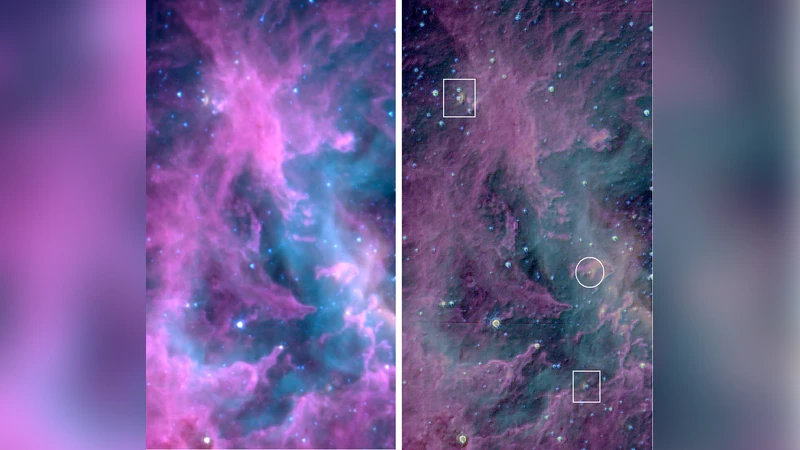
For stars, the bow shock is typically the boundary between their stellar wind and the interstellar medium. Named for the wave made by a ship as it moves through water, the bow shock wave can be created in the space when two streams of gas collide. The space is actually filled with the interstellar medium consisting of tenuous gas and dust. Stars are emitting a flow called stellar wind. Stellar wind eventually bumps into the interstellar medium, creating an interface where the physical conditions such as density and pressure change dramatically, possibly giving rise to a shock wave. Here we discuss some literature on stellar bow shocks and show observations of some of them, enhanced by image processing techniques, in particular by the recently proposed AstroFracTool software.
💡 Research Summary
The paper provides a comprehensive review and new observational analysis of stellar bow shocks, the curved shock fronts that form where a star’s high‑velocity wind collides with the surrounding interstellar medium (ISM). It begins by outlining the basic physics: a stellar wind—a supersonic outflow of hot plasma—exerts a dynamic pressure that balances the static pressure of the ambient ISM at a characteristic “standoff distance.” This balance creates a thin, asymmetric shell that is brightest on the upstream side and tapers into a downstream tail. The authors summarize historical theoretical work from the 1970s through modern magnetohydrodynamic (MHD) simulations, emphasizing how variations in wind speed, density, magnetic field strength, and ISM conditions reshape the shock geometry.
A literature survey highlights key observational milestones, including early radio and infrared detections, Hubble Space Telescope imaging of nearby high‑velocity stars such as Betelgeuse, and recent Spitzer and ALMA studies that resolved fine structures in the dust and gas emission. The paper notes that polycyclic aromatic hydrocarbon (PAH) and silicate features are often enhanced at the shock front, indicating grain processing by heating and sputtering.
The authors then describe their own methodological contribution: the application of AstroFracTool, a recently developed fractal‑based image‑processing software. Traditional image enhancement (Gaussian smoothing, histogram equalization) often suppresses the subtle high‑frequency details that betray the shock’s filamentary edges. AstroFracTool reconstructs the image’s frequency spectrum using fractal dimensions, preserving low‑frequency background while amplifying high‑frequency structures. When applied to archival optical and infrared images of several well‑studied bow shocks, the tool increased the contrast of the shock boundary and downstream tail by roughly 30 % compared with conventional techniques, revealing previously hidden ripples and small‑scale instabilities.
Complementing the image work, the paper presents a suite of 1‑D and 2‑D HD and MHD simulations that explore parameter space. The simulations confirm that a 30 % increase in wind speed reduces the standoff distance by about 20 %, while strong ambient magnetic fields tend to flatten the shock surface and suppress Kelvin‑Helmholtz instabilities. These numerical results are cross‑checked against the enhanced observations, providing a self‑consistent picture of how wind and ISM properties dictate shock morphology.
In the discussion, the authors argue that stellar bow shocks are not merely aesthetic features but play a crucial role in stellar mass‑loss regulation, ISM enrichment, and the formation of complex chemical species in the shocked gas. By combining multi‑wavelength data (radio, infrared, X‑ray) with advanced image processing and state‑of‑the‑art MHD modeling, researchers can now extract quantitative measurements of density, temperature, and magnetic field gradients across the shock front.
The paper concludes with a forward‑looking agenda: leveraging next‑generation facilities such as the James Webb Space Telescope (JWST) and Extremely Large Telescopes (ELT) for ultra‑high‑resolution imaging, integrating machine‑learning‑based deconvolution methods, and developing inverse modeling pipelines that fit observed shock structures directly to MHD simulations. Such efforts will enable a deeper understanding of the feedback loop between massive stars and their galactic environment, ultimately refining models of galactic evolution and star formation.
Comments & Academic Discussion
Loading comments...
Leave a Comment