Fast Digital Convolutions using Bit-Shifts
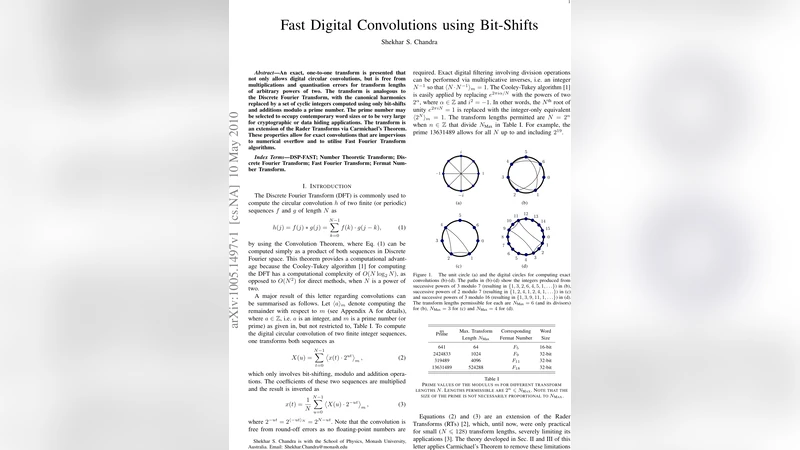
An exact, one-to-one transform is presented that not only allows digital circular convolutions, but is free from multiplications and quantisation errors for transform lengths of arbitrary powers of two. The transform is analogous to the Discrete Fourier Transform, with the canonical harmonics replaced by a set of cyclic integers computed using only bit-shifts and additions modulo a prime number. The prime number may be selected to occupy contemporary word sizes or to be very large for cryptographic or data hiding applications. The transform is an extension of the Rader Transforms via Carmichael’s Theorem. These properties allow for exact convolutions that are impervious to numerical overflow and to utilise Fast Fourier Transform algorithms.
💡 Research Summary
The paper introduces a novel integer‑based transform that enables exact circular convolution without any multiplication operations, thereby eliminating quantisation errors and overflow concerns that plague conventional Fast Fourier Transform (FFT) based methods. The transform is constructed for sequence lengths that are arbitrary powers of two (N = 2^k) and is mathematically analogous to the Discrete Fourier Transform (DFT). Instead of complex exponentials, the basis functions are a set of cyclic integers generated solely by bit‑shifts and modular additions modulo a carefully chosen prime p.
The theoretical foundation rests on an extension of Rader’s algorithm, which originally reduces a prime‑length DFT to a convolution, combined with Carmichael’s theorem that guarantees the existence of a primitive root g whose order divides p − 1. By selecting p such that p − 1 is an exact multiple of N, the set {g^0, g^1, …, g^{N‑1}} modulo p forms a complete, orthogonal basis for the transform space. Crucially, each power g^i can be expressed as a power of two, i.e., g^i ≡ 2^{e_i} (mod p), allowing the evaluation of g^i·x
Comments & Academic Discussion
Loading comments...
Leave a Comment