Overlap properties of geometric expanders
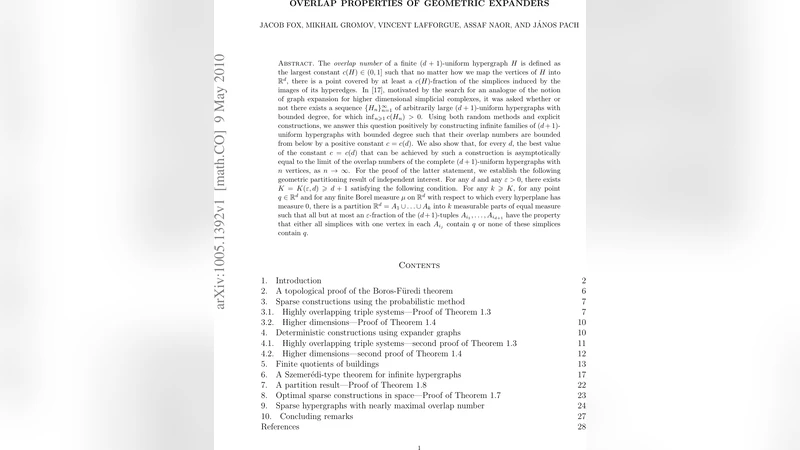
The {\em overlap number} of a finite $(d+1)$-uniform hypergraph $H$ is defined as the largest constant $c(H)\in (0,1]$ such that no matter how we map the vertices of $H$ into $\R^d$, there is a point covered by at least a $c(H)$-fraction of the simplices induced by the images of its hyperedges. In~\cite{Gro2}, motivated by the search for an analogue of the notion of graph expansion for higher dimensional simplicial complexes, it was asked whether or not there exists a sequence ${H_n}{n=1}^\infty$ of arbitrarily large $(d+1)$-uniform hypergraphs with bounded degree, for which $\inf{n\ge 1} c(H_n)>0$. Using both random methods and explicit constructions, we answer this question positively by constructing infinite families of $(d+1)$-uniform hypergraphs with bounded degree such that their overlap numbers are bounded from below by a positive constant $c=c(d)$. We also show that, for every $d$, the best value of the constant $c=c(d)$ that can be achieved by such a construction is asymptotically equal to the limit of the overlap numbers of the complete $(d+1)$-uniform hypergraphs with $n$ vertices, as $n\rightarrow\infty$. For the proof of the latter statement, we establish the following geometric partitioning result of independent interest. For any $d$ and any $\epsilon>0$, there exists $K=K(\epsilon,d)\ge d+1$ satisfying the following condition. For any $k\ge K$, for any point $q \in \mathbb{R}^d$ and for any finite Borel measure $\mu$ on $\mathbb{R}^d$ with respect to which every hyperplane has measure $0$, there is a partition $\mathbb{R}^d=A_1 \cup \ldots \cup A_{k}$ into $k$ measurable parts of equal measure such that all but at most an $\epsilon$-fraction of the $(d+1)$-tuples $A_{i_1},\ldots,A_{i_{d+1}}$ have the property that either all simplices with one vertex in each $A_{i_j}$ contain $q$ or none of these simplices contain $q$.
💡 Research Summary
The paper introduces and studies the “overlap number” of a finite ((d+1))-uniform hypergraph (H). For a given embedding of the vertex set into (\mathbb{R}^d), each hyperedge determines a (d)-dimensional simplex. The overlap number (c(H)\in(0,1]) is defined as the largest constant such that, regardless of how the vertices are mapped, there always exists a point that belongs to at least a (c(H))-fraction of those simplices. This notion was motivated by Gromov’s work on topological overlap for complete hypergraphs, where it was shown that the overlap numbers of the complete ((d+1))-uniform hypergraphs (K_n^{(d+1)}) converge to a positive constant (c_d) as (n\to\infty). However, it remained open whether a sequence of bounded‑degree hypergraphs could achieve a uniformly positive overlap constant.
The authors answer this question affirmatively by constructing infinite families of bounded‑degree ((d+1))-uniform hypergraphs whose overlap numbers are bounded below by a positive constant (c(d)) that depends only on the dimension (d). Two complementary construction methods are presented:
-
Probabilistic construction.
Starting from a fixed average degree (r), the authors consider a random (r)-regular ((d+1))-uniform hypergraph obtained by independently selecting hyperedges. Using concentration inequalities and mixing properties of the associated Markov chain, they show that with high probability every embedding of the vertex set yields a point covered by at least a ((c_d - o(1)))-fraction of the simplices. The argument hinges on a careful counting of “bad” embeddings and a union bound over all possible point configurations. -
Explicit construction.
The paper leverages high‑dimensional Ramanujan complexes, coset complexes, and other families of high‑dimensional expanders that possess strong cohomological connectivity and uniform face distribution. By applying Gromov’s topological overlap theorem to these complexes, the authors obtain deterministic hypergraphs with bounded degree and overlap number at least (c(d)). The explicit constructions also allow the authors to control the exact degree and to verify the required regularity properties.
A central technical contribution is a new geometric partition theorem of independent interest. For any point (q\in\mathbb{R}^d) and any finite Borel measure (\mu) that assigns zero measure to every hyperplane, the theorem guarantees the existence of a partition of (\mathbb{R}^d) into (k) measurable parts of equal (\mu)-measure (for sufficiently large (k) depending only on (d) and a tolerance (\epsilon)) such that all but an (\epsilon)-fraction of the ((d+1))-tuples of parts are “monochromatic” with respect to (q): either every simplex formed by picking one vertex from each part contains (q), or none of them does. This result can be viewed as a hybrid of the ham‑sandwich theorem and Tverberg’s theorem, and it is the key tool for converting the combinatorial regularity of the hypergraphs into a geometric guarantee on the overlap number.
The authors then prove an optimality statement: for each dimension (d), the best possible constant achievable by any bounded‑degree ((d+1))-uniform hypergraph family equals the limit of the overlap numbers of the complete hypergraphs, i.e. (\sup_{\text{bounded degree }H} c(H)=\lim_{n\to\infty}c(K_n^{(d+1)})=c(d)). Consequently, the random and explicit constructions presented are essentially optimal.
The paper’s contributions have several implications. First, they establish the existence of high‑dimensional “geometric expanders”—objects that simultaneously enjoy bounded degree, strong combinatorial expansion, and robust geometric overlap properties. Second, the geometric partition theorem provides a versatile tool that may find applications in measure partition problems, discrepancy theory, and algorithmic load balancing. Third, the connection between overlap numbers and cohomological connectivity suggests new quantitative invariants for topological data analysis and for the design of error‑correcting codes based on high‑dimensional complexes.
In summary, the work resolves a fundamental open problem about the existence of bounded‑degree hypergraphs with uniformly positive overlap numbers, supplies both probabilistic and deterministic constructions that achieve the optimal constant, and introduces a novel partition theorem that bridges measure theory, convex geometry, and high‑dimensional combinatorics.
Comments & Academic Discussion
Loading comments...
Leave a Comment