Polymorphic Dynamics of Microtubules
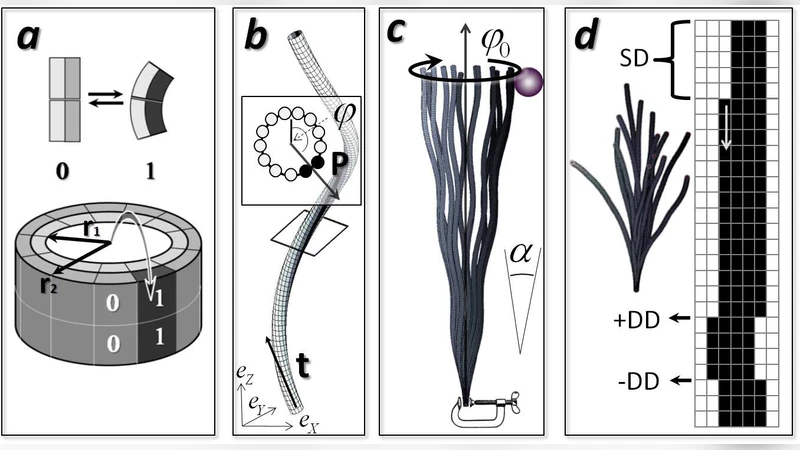
Starting from the hypothesis that the tubulin dimer is a conformationally bistable molecule - fluctuating between a curved and a straight configuration at room temperature - we develop a model for polymorphic dynamics of the microtubule lattice. We show that tubulin bistability consistently explains unusual dynamic fluctuations, the apparent length-stiffness relation of grafted microtubules and the curved-helical appearance of microtubules in general. Analyzing experimental data we conclude that taxol stabilized microtubules exist in highly cooperative yet strongly fluctuating helical states. When clamped by the end the microtubule undergoes an unusual zero energy motion - in its effect reminiscent of a limited rotational hinge.
💡 Research Summary
The paper proposes a radical reinterpretation of microtubule (MT) mechanics by postulating that the fundamental building block, the tubulin dimer, is a bistable molecule capable of existing in either a straight or a curved conformation at physiological temperature. This bistability is not an isolated property of a single dimer; rather, the authors argue that it propagates cooperatively through the MT lattice, giving rise to a “polymorphic” state in which large segments of the filament can collectively adopt a curved geometry while still being linked to neighboring straight segments.
To formalize this idea, the authors map each dimer onto a two‑state spin variable σ_i (σ_i = +1 for straight, σ_i = −1 for curved) and introduce a nearest‑neighbour coupling term –Jσ_iσ_{i+1}. The coupling constant J quantifies the energetic preference for like‑state neighbours, i.e., the degree of cooperativity. In the statistical‑mechanical framework, the MT becomes a one‑dimensional Ising‑like chain with an external field that represents the intrinsic bias between the two conformations. When J is large compared to thermal energy k_BT, the chain orders into macroscopic domains of uniform curvature, producing a helical or gently curved filament. When J is small, the filament breaks into short polymorphic domains, leading to a mixture of straight and curved sections.
The authors then incorporate the effect of the anti‑cancer drug taxol, which is known experimentally to stabilize MTs. In the model taxol lowers the energy barrier between the two dimer states and simultaneously increases J, thereby enhancing cooperativity while also allowing rapid stochastic switching. This dual action predicts that taxol‑stabilized MTs reside in a highly cooperative yet strongly fluctuating helical state—a prediction that matches a range of experimental observations, including increased persistence length variability and the appearance of long‑wavelength bending modes.
A particularly striking prediction concerns the dynamics of a MT that is clamped at one end (a common experimental configuration). In the polymorphic framework the curved domain can slide along the filament without changing the total bending energy, effectively acting as a “zero‑energy” mode. The filament therefore behaves like a limited rotational hinge: the free end can rotate around the clamp with negligible energetic cost, a behavior that cannot be explained by classical Euler‑Bernoulli beam theory. The authors support this claim with both analytical calculations of the mode spectrum and direct comparison to high‑resolution video microscopy data, showing a pronounced low‑frequency peak that corresponds to the predicted hinge‑like motion.
Beyond the hinge phenomenon, the model naturally accounts for the puzzling length‑stiffness relationship observed in grafted MTs. Classical beam theory predicts a length‑independent flexural rigidity, yet experiments show that longer MTs appear softer. In the polymorphic picture, longer filaments accommodate more curved domains, which effectively reduce the filament’s macroscopic bending modulus. This explains the observed softening with length without invoking ad‑hoc changes in material properties.
In summary, the paper builds a coherent theoretical framework that links tubulin conformational bistability, cooperative lattice interactions, drug‑induced modulation, and emergent filament‑scale mechanics. By doing so, it resolves several longstanding anomalies in MT biophysics—namely, the unexpected bending fluctuations, the helical appearance of taxol‑stabilized MTs, the zero‑energy hinge motion under clamped conditions, and the non‑linear length‑stiffness relation. The work opens new avenues for designing MT‑based nanodevices, interpreting cellular force generation, and understanding how chemotherapeutic agents alter cytoskeletal dynamics at a molecular level.
Comments & Academic Discussion
Loading comments...
Leave a Comment