Performance tuning of Database Management Systems(DBMS) is both complex and challenging as it involves identifying and altering several key performance tuning parameters. The quality of tuning and the extent of performance enhancement achieved greatly depends on the skill and experience of the Database Administrator (DBA). As neural networks have the ability to adapt to dynamically changing inputs and also their ability to learn makes them ideal candidates for employing them for tuning purpose. In this paper, a novel tuning algorithm based on neural network estimated tuning parameters is presented. The key performance indicators are proactively monitored and fed as input to the Neural Network and the trained network estimates the suitable size of the buffer cache, shared pool and redo log buffer size. The tuner alters these tuning parameters using the estimated values using a rate change computing algorithm. The preliminary results show that the proposed method is effective in improving the query response time for a variety of workload types. .
Deep Dive into Adaptive Tuning Algorithm for Performance tuning of Database Management System.
Performance tuning of Database Management Systems(DBMS) is both complex and challenging as it involves identifying and altering several key performance tuning parameters. The quality of tuning and the extent of performance enhancement achieved greatly depends on the skill and experience of the Database Administrator (DBA). As neural networks have the ability to adapt to dynamically changing inputs and also their ability to learn makes them ideal candidates for employing them for tuning purpose. In this paper, a novel tuning algorithm based on neural network estimated tuning parameters is presented. The key performance indicators are proactively monitored and fed as input to the Neural Network and the trained network estimates the suitable size of the buffer cache, shared pool and redo log buffer size. The tuner alters these tuning parameters using the estimated values using a rate change computing algorithm. The preliminary results show that the proposed method is effective in improvin
Database Management Systems are an integral part of any corporate house, the online systems, and e-commerce applications. For these systems, to provide reliable services with quick query response times to their customers, the Database Management Systems(DBMS) must be functioning efficiently and should have built-in support for quick system recovery time in case of partial failure or system resource bottlenecks. The performance of these systems is affected by several factors. The important among them include database size which grows with its usage over a period of time, increased user base, sudden increase in the user processes, improperly or un-tuned DBMS. All of these tend to degrade the system response time and hence call for a system that anticipates performance degradation by carefully monitoring the system performance indicators and auto tune the system.
Maintaining a database of an enterprise involves considerable effort on part of a Database Administrator (DBA) as, it is a continuous process and requires in-depth knowledge, experience and expertise. The DBA has to monitor several system parameters and fine tune them to keep the system functioning smoothly in the event of reduced performance or partial failure. It is therefore desirable to build a system that can tune itself and relieve the DBA of the tedious and error prone task of tuning. Oracle 9i and 10g have built in support for tuning in the form of tuning advisor. The tuning advisor estimates the optimal values of the tuning parameters and recommends them to the DBA. A similar advisor is also available in SQL Server 2005 which is based on what-if analysis. In this approach, the DBA provides a physical design as input and the Tuning Advisor performs the analysis without actually materializing the physical design. However, the advisor available in 2005 recommends the changes needed at the physical level such as creation of index on tables or views, restructuring of tables, creation of clustered index etc. which are considered to be very expensive in terms of Database Server down time and the effort on part of the DBA.
Several methods have been proposed that proactively monitor the system performance indicators analyze the symptoms and auto tune the DBMS to deliver enhanced performance. Use of Materialized views and Indexes, Pruning table and column sets [1][2], Use of self healing techniques [3][4], use of physical design tuning are among the proposed solutions. The classical control is modified and a three stage control involving Monitor, Analyze and Tune [6] is employed to ensure system stability. The architecture presented in [5] for self healing database forms the basis for the new architecture presented here in this paper. This paper presents a new DBMS architecture based on modular approach, where in each functional module can be monitored by set of monitoring hooks. These monitoring hooks are responsible for saving the current status information or a snapshot of the server to the log. This architecture has high monitoring overhead, due to the fact that when large number of parameters to be monitored, almost every module’s status information has to be stored on to the log and if done frequently may eat up a lot of CPU time. Moreover, this architecture focuses more on healing the system and does not consider tuning the DBMS for performance improvement.
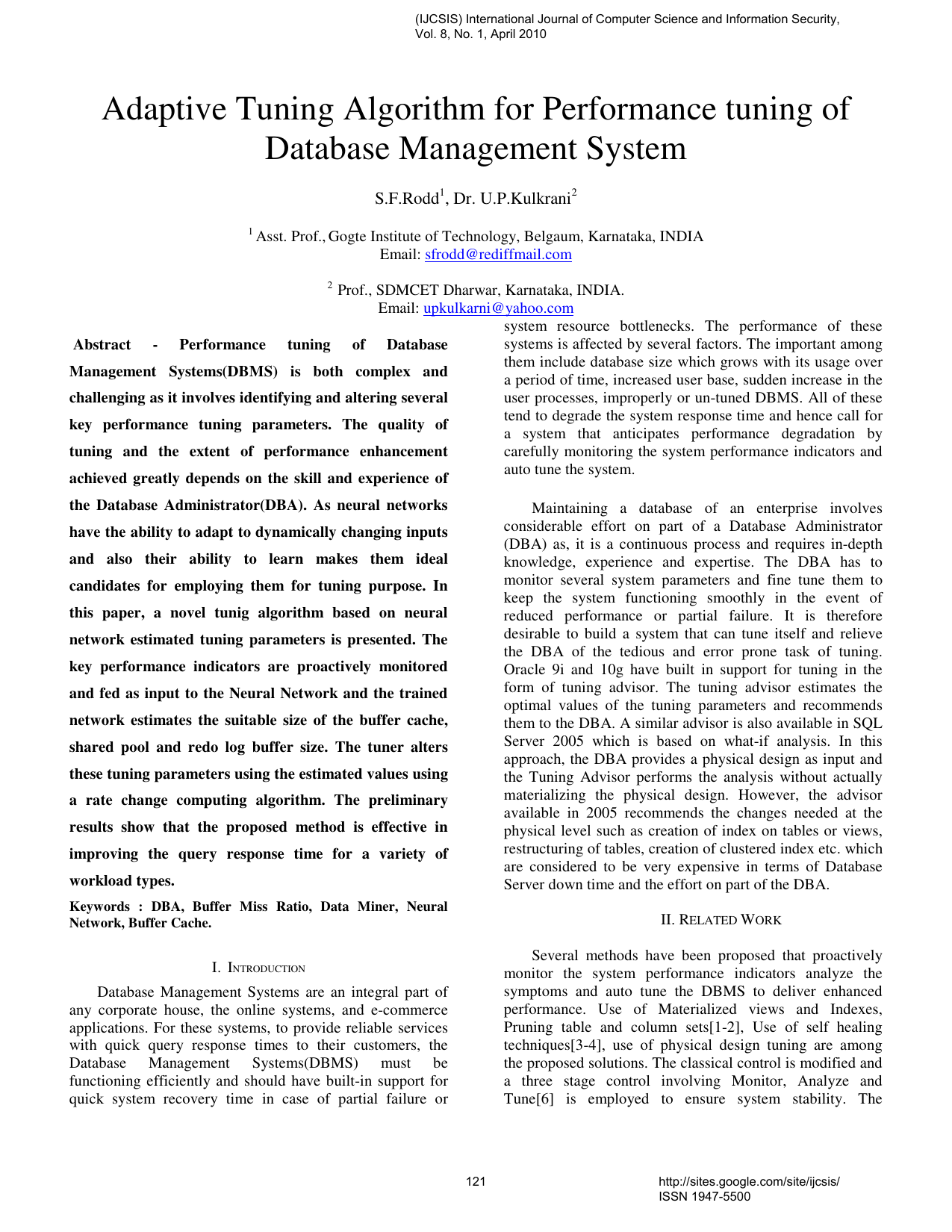
Ranking of various tuning parameters based on statistical analysis is presented in [6]. The ranking of parameters is based on the amount of impact they produce on system performance for a given workload. A formal knowledge framework for self tuning database system is presented in [7] that defines several knowledge components. The knowledge components include Policy knowledge, Workload knowledge, Problem diagnosis knowledge, Problem Resolution Knowledge, Effector knowledge, and Dependency knowledge. The architecture presented in this paper involves extracting useful information from the system log and also from the DBMS using system related queries. This information gathered over a period of time is then used to train a Neural Network for a desired output response time. The neural network would then estimate the extent of correction to be applied to the key system parameters that help scale up the system performance.
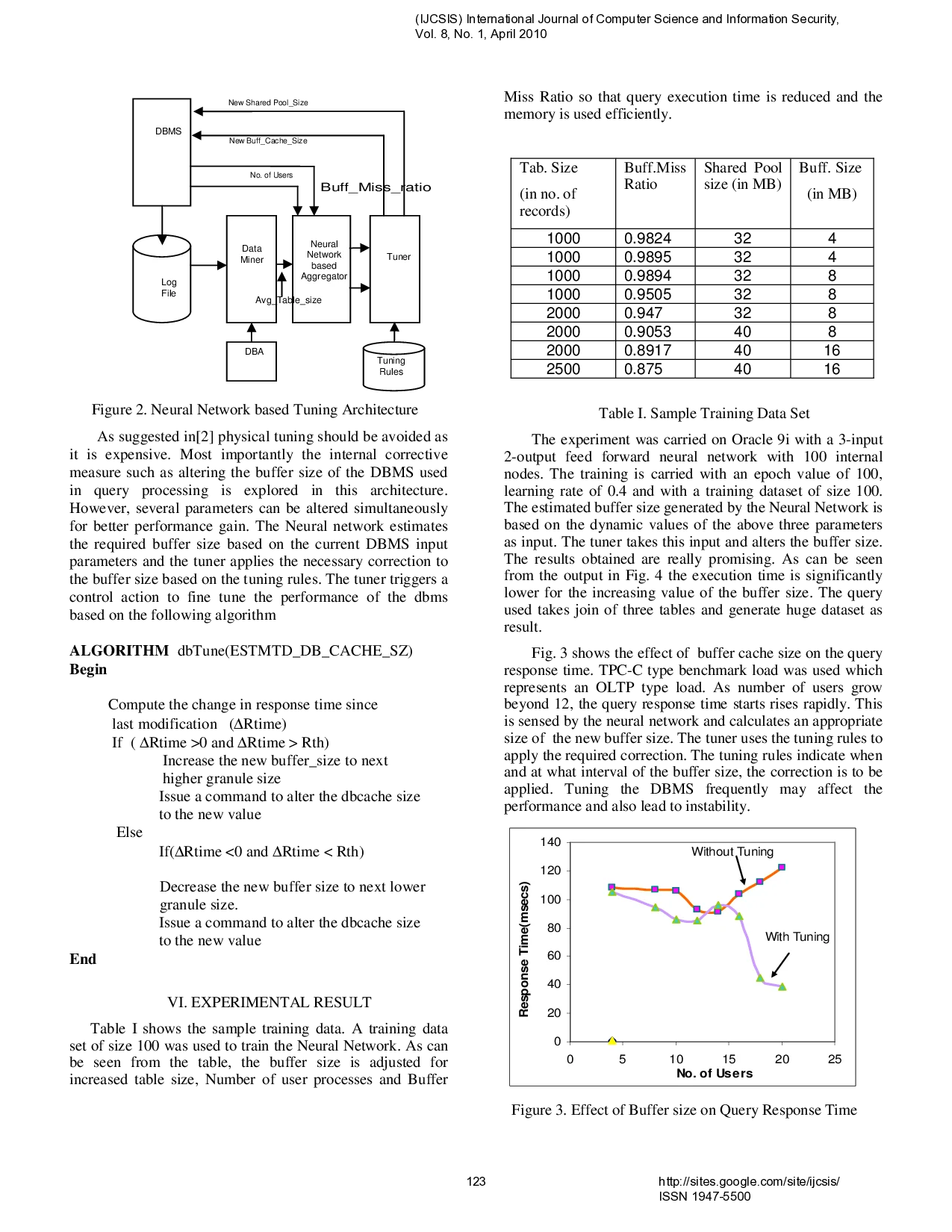
Calibrating the system for desired response time is called performance tuning. The objective of this system is to analyze the DBMS system log file and apply information extraction techniques and also gather key system parameters like buffer miss ratio, number of active processes and the tables that are showing signs of rapid growth. The control architecture presented in this paper, only one parameter namely, the buffer cache is tuned. Using the statistical information of these three parameters to train the Neural Network and generate an output that gives an estimate of the optimal system buffer size. Since, the DBMS are dynamic and continuously running around the clock, the ab
…(Full text truncated)…
This content is AI-processed based on ArXiv data.