Programming Discrete Physical Systems
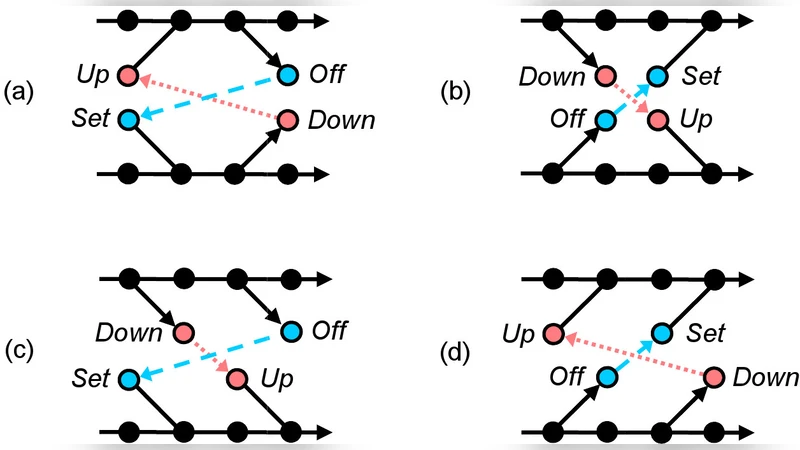
Every algorithm which can be executed on a computer can at least in principle be realized in hardware, i.e. by a discrete physical system. The problem is that up to now there is no programming language by which physical systems can constructively be described. Such tool, however, is essential for the compact description and automatic production of complex systems. This paper introduces a programming language, called Akton-Algebra, which provides the foundation for the complete description of discrete physical systems. The approach originates from the finding that every discrete physical system reduces to a spatiotemporal topological network of nodes, if the functional and metric properties are deleted. A next finding is that there exists a homeomorphism between the topological network and a sequence of symbols representing a program by which the original nodal network can be reconstructed. Providing Akton-Algebra with functionality turns it into a flow-controlled general data processing language, which by introducing clock control and addressing can be further transformed into a classical programming language. Providing Akton-Algebra with metrics, i.e. the shape and size of the components, turns it into a novel hardware system construction language.
💡 Research Summary
The paper tackles a fundamental gap in computer engineering: while every computable algorithm can in principle be realized as a discrete physical system, there is no dedicated programming language that can directly describe such systems for constructive synthesis. The authors introduce Akton‑Algebra, a formal language that serves as a universal description medium for discrete physical structures, bridging the divide between high‑level algorithmic specifications and low‑level hardware realizations.
Core Concept – Topological Reduction
The authors begin by observing that any discrete physical system—whether an electronic circuit, a mechanical linkage, a cellular automaton, or a modular robot—can be stripped of its functional (electrical, mechanical, optical) and metric (size, angle, distance) attributes, leaving behind a pure spatiotemporal topological network of nodes and edges. This network captures only the connectivity pattern, which is invariant under continuous deformation. By treating the network as a 1‑dimensional simplicial complex, the authors show that it can be abstracted away from any specific physical domain.
Homeomorphism to Symbolic Programs
The next breakthrough is the proof that such a topological network is homeomorphic to a linear sequence of symbols generated by a deterministic traversal (e.g., preorder depth‑first) combined with a set of syntactic rules. The symbols belong to a minimal operator set called Aktons. An Akton represents a primitive node together with its input‑output ports; the operators (· for sequential connection, ⊕ for parallel merge, ↔ for bidirectional coupling, etc.) encode how ports are wired. Parentheses and precedence rules allow the expression of arbitrarily nested branching and merging structures. Consequently, any discrete physical system can be uniquely encoded as a finite string in Akton‑Algebra.
From Pure Topology to Functional Language
To turn the purely topological description into a flow‑controlled data‑processing language, the authors assign semantics to each Akton. For example, an “AND” Akton implements logical conjunction on its two inputs, a “MUX” Akton selects one of several inputs based on a control signal, and a “REG” Akton stores a value across clock cycles. By introducing a global clock and addressing mechanism, sequential state, memory access, and conditional branching become expressible. The resulting language is shown to be Turing‑complete, meaning any algorithm describable in conventional programming languages can be written in Akton‑Algebra.
Metric Extension – From Code to Hardware
A crucial extension is the reintegration of metric information (size, shape, spatial orientation) into the Akton model. Each Akton can be annotated with geometric parameters, turning the abstract string into a hardware construction language. The authors outline a compilation pipeline: a high‑level Akton program → topological net → metric‑augmented net → CAD layout. This pipeline enables automatic generation of physical layouts, routing, and placement, effectively merging the roles of hardware description languages (HDL) and mechanical design tools.
Key Contributions
- Unified Formalism – Demonstrates that any discrete physical system reduces to a topological graph and that this graph is homeomorphic to a linear Akton string.
- General‑Purpose Language – Provides a minimal yet expressive set of operators that support sequential, parallel, conditional, and iterative constructs, achieving Turing completeness.
- Clock‑ and Address‑Aware Semantics – Extends the language to model time‑dependent behavior and memory, bridging the gap between software‑style programming and hardware description.
- Metric‑Aware Synthesis – Shows how to embed geometric data, enabling automatic translation from algorithmic description to manufacturable hardware layouts.
Implications and Future Work
Akton‑Algebra promises to streamline the design of cyber‑physical systems, neuromorphic chips, and reconfigurable robotics, where the boundary between algorithm and embodiment is blurred. By allowing designers to write a single high‑level specification that can be automatically compiled into both executable code and physical hardware, development cycles could be dramatically shortened and error rates reduced. The paper suggests several avenues for further research: formal verification of Akton programs, optimization techniques for minimizing hardware resources, integration with existing CAD/EDA ecosystems, and experimental prototypes that validate the end‑to‑end synthesis flow.
In summary, the work presents a novel, mathematically grounded programming paradigm that unifies algorithmic description, flow control, and physical construction, potentially reshaping how engineers conceive, program, and fabricate discrete physical systems.
Comments & Academic Discussion
Loading comments...
Leave a Comment