On $K$-theory automorphisms related to bundles of finite order
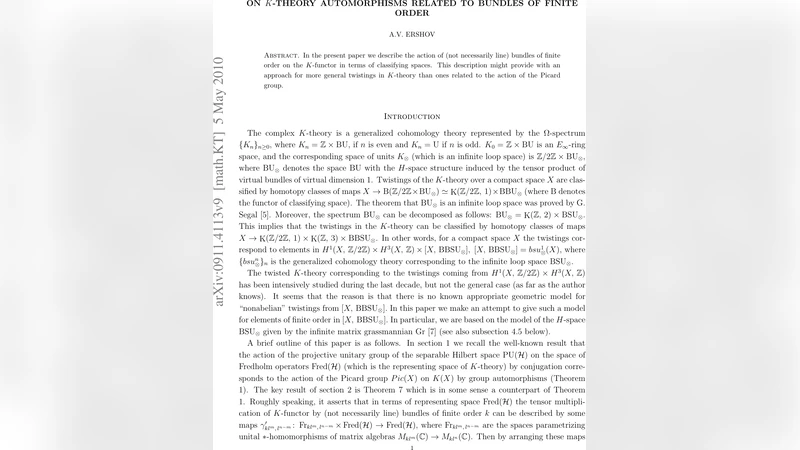
In the present paper we describe the action of (not necessarily line) bundles of finite order on the $K$-functor in terms of classifying spaces. This description might provide with an approach for more general twistings in $K$-theory than ones related to the action of the Picard group.
💡 Research Summary
The paper investigates how complex vector bundles of finite order act on complex topological K‑theory, extending the well‑known action of line bundles (elements of the Picard group) to higher‑rank bundles whose tensor powers become trivial after a finite number of repetitions. The authors begin by recalling that the Picard group of a space X, identified with the classifying space BGL₁(ℂ) or equivalently BGL₁(KU), gives rise to the familiar “twistings” of K‑theory classified by H³(X;ℤ). A line bundle L defines an automorphism of K⁰(X) by tensoring with L, and this automorphism corresponds to the map BGL₁(KU) → BGL₁(KU) induced by the classifying map of L.
To treat bundles of higher rank, the authors introduce, for each integer n ≥ 1 and each finite order k, the subgroup Gₙ,k ⊂ GLₙ(ℂ) consisting of matrices g satisfying gᵏ = Iₙ. The classifying space BGₙ,k parametrises isomorphism classes of rank‑n complex bundles whose k‑fold tensor power is trivial. By passing to the K‑theory spectrum KU, they define the analogous subgroup GLₙ(KU)^{(k)} of the unitary group of the KU‑module of rank n, and its classifying space BGLₙ(KU)^{(k)}. The central construction is a natural map
i_k : BGL₁(KU) → BGLₙ(KU)^{(k)}
which encodes the operation “tensor with a rank‑n bundle of order k”. The main theorem proves that i_k is homotopic to the k‑fold multiplication map on BGL₁(KU); in other words, the automorphism of K⁰(X) induced by tensoring with a finite‑order bundle of order k coincides, up to homotopy, with the ordinary k‑fold “addition” (or “multiplication”) on K‑theory. Consequently, the space of such automorphisms is completely described by the familiar Picard‑group classifying space together with the integer k.
The authors illustrate the theory with concrete examples. For a sphere S^{2m}, a complex line bundle L of order two (equivalently a real line bundle) satisfies L⊗L ≅ 1, so tensoring with L yields the 2‑fold map on K⁰(S^{2m}). In this case BG₁,2 ≃ Bℤ₂, confirming the homotopy equivalence with the 2‑multiplication on BGL₁(KU). More generally, any rank‑n bundle of order k gives rise to a map BGL₁(KU) → BGₙ,k that factors through the k‑fold map on BGL₁(KU).
Beyond the purely topological description, the paper points toward applications in twisted K‑theory. Traditional twists are classified by H³ and arise from line bundles (or gerbes). The present framework suggests that finite‑order higher‑rank bundles could generate twists associated with higher cohomology groups, such as H^{2k+1}, thereby providing a systematic way to define “higher‑order” twisted K‑theories. This perspective may be relevant for physical models involving higher‑dimensional charges, for instance D‑branes with non‑trivial world‑volume gauge bundles, where the twist is not captured by a mere H³ class.
In summary, the authors give a precise homotopy‑theoretic description of the action of finite‑order complex bundles on K‑theory, showing that these actions are homotopically equivalent to the k‑fold multiplication on the Picard‑group classifying space. This result extends the classical picture of Picard‑group twistings, opens the door to new types of twisted K‑theory, and provides a clear geometric and homotopical framework for future investigations into higher‑order bundle twistings and their applications in topology and mathematical physics.
Comments & Academic Discussion
Loading comments...
Leave a Comment