A New Benchmark For Evaluation Of Graph-Theoretic Algorithms
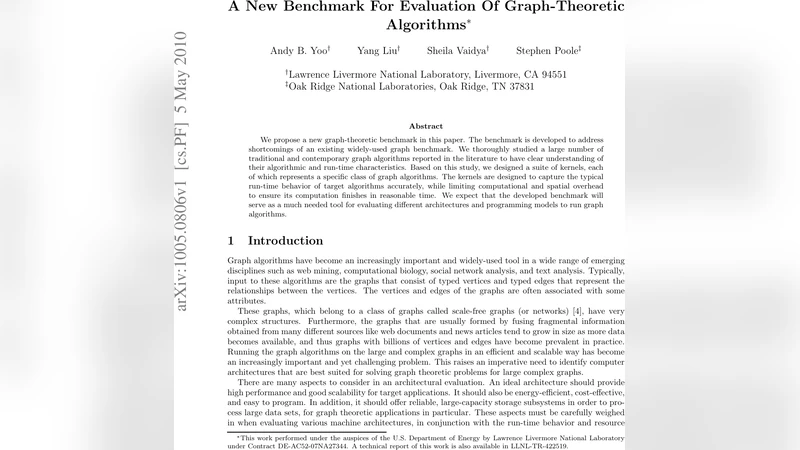
We propose a new graph-theoretic benchmark in this paper. The benchmark is developed to address shortcomings of an existing widely-used graph benchmark. We thoroughly studied a large number of traditional and contemporary graph algorithms reported in the literature to have clear understanding of their algorithmic and run-time characteristics. Based on this study, we designed a suite of kernels, each of which represents a specific class of graph algorithms. The kernels are designed to capture the typical run-time behavior of target algorithms accurately, while limiting computational and spatial overhead to ensure its computation finishes in reasonable time. We expect that the developed benchmark will serve as a much needed tool for evaluating different architectures and programming models to run graph algorithms.
💡 Research Summary
The paper introduces a novel benchmark suite specifically designed to evaluate graph‑theoretic algorithms across a wide range of hardware architectures and programming models. In the introduction, the authors point out that existing benchmarks such as Graph500 and GAP, while popular, suffer from two major drawbacks: they do not faithfully represent the diversity of real‑world graph workloads, and they tend to be biased toward a narrow set of algorithmic patterns. To address these issues, the authors first conduct an exhaustive literature survey covering traditional algorithms (depth‑first search, breadth‑first search, Dijkstra’s shortest path, connected components, PageRank) and contemporary techniques (graph neural networks, streaming edge updates, sparse matrix multiplications). Their analysis reveals that each algorithm class exhibits distinct memory‑access patterns, computational intensity, and synchronization requirements. For example, traversal‑based algorithms generate highly irregular memory accesses and suffer from cache misses, whereas matrix‑based kernels are compute‑bound and benefit from vectorization.
Based on this taxonomy, the authors propose a set of eight “kernels,” each of which abstracts the core computational behavior of a particular algorithm class while keeping the overall work proportional to O(V + E). The kernels are:
- BFS – level‑synchronous traversal emphasizing irregular memory accesses.
- DFS – recursive‑stack traversal highlighting depth‑first behavior.
- Dijkstra – priority‑queue driven shortest‑path computation.
- PageRank – iterative sparse matrix‑vector multiplication.
- Connected Components – label‑propagation with frequent synchronization.
- Graph Convolution – a representative GNN layer combining aggregation and transformation.
- Streaming Edge Update – dynamic insertion/deletion to model real‑time graph changes.
- Sparse Matrix Multiply – CSR‑based multiplication to test vectorization efficiency.
Each kernel is parameterized by graph size, density, degree distribution, and clustering coefficient, allowing the benchmark to generate a spectrum of synthetic graphs that mimic real datasets. Moreover, the authors provide both memory‑friendly and compute‑friendly variants of each kernel, enabling a clear separation of bandwidth‑limited versus compute‑limited performance regimes. The design deliberately limits memory overhead to at most twice the size of the input graph, ensuring that the benchmark itself does not dominate system resources.
The experimental methodology spans three hardware categories: multi‑core CPUs (Intel Xeon), GPUs (NVIDIA RTX series), and FPGAs (Altera Stratix). For each platform, the authors implement the kernels using multiple programming models—OpenMP, CUDA, OpenCL, and SYCL—so that the impact of software abstraction layers can be observed. Results show that the new benchmark captures performance nuances that existing suites miss. For instance, the BFS kernel reveals a pronounced bandwidth bottleneck on CPUs compared to GPUs, while the Graph Convolution kernel highlights the superior arithmetic intensity of modern GPUs. The Streaming Edge Update kernel quantifies the cost of dynamic memory management, offering valuable guidance for real‑time analytics systems. Across all tests, the proposed kernels demonstrate higher correlation with the performance of full‑scale algorithms than the legacy benchmarks.
The paper concludes with a candid discussion of limitations. Current experiments are limited to graphs with up to a few hundred million edges; scaling to billion‑node graphs remains an open challenge. Additionally, the parameter space for kernel configuration is extensive, which may pose a steep learning curve for non‑experts. The authors suggest future work on automated parameter tuning, integration with distributed execution frameworks, and the inclusion of real‑world graph datasets to further validate the benchmark’s relevance.
In summary, this work delivers a comprehensive, algorithm‑aware benchmark suite that balances realism with practicality. By faithfully reproducing the diverse runtime characteristics of modern graph workloads while keeping execution costs manageable, the benchmark provides a robust tool for architects, compiler developers, and performance engineers to assess and compare the suitability of emerging hardware and software solutions for graph‑centric computing.
Comments & Academic Discussion
Loading comments...
Leave a Comment