Hardness results on generalized connectivity
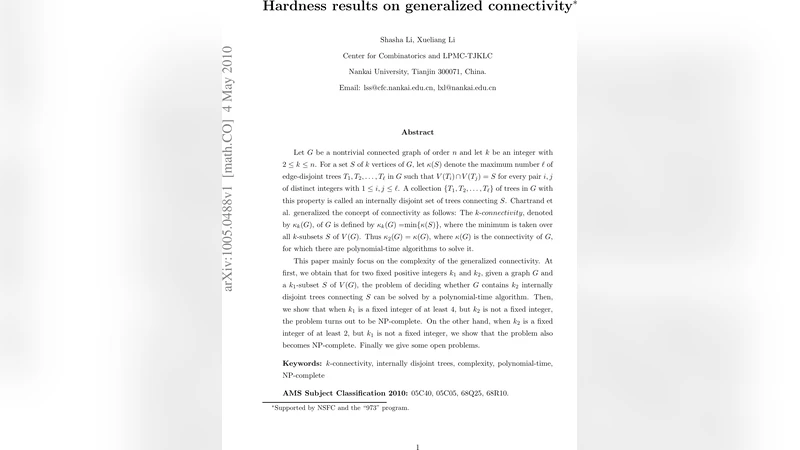
Let $G$ be a nontrivial connected graph of order $n$ and let $k$ be an integer with $2\leq k\leq n$. For a set $S$ of $k$ vertices of $G$, let $\kappa (S)$ denote the maximum number $\ell$ of edge-disjoint trees $T_1,T_2,…,T_\ell$ in $G$ such that $V(T_i)\cap V(T_j)=S$ for every pair $i,j$ of distinct integers with $1\leq i,j\leq \ell$. A collection ${T_1,T_2,…,T_\ell}$ of trees in $G$ with this property is called an internally disjoint set of trees connecting $S$. Chartrand et al. generalized the concept of connectivity as follows: The $k$-$connectivity$, denoted by $\kappa_k(G)$, of $G$ is defined by $\kappa_k(G)=$min${\kappa(S)}$, where the minimum is taken over all $k$-subsets $S$ of $V(G)$. Thus $\kappa_2(G)=\kappa(G)$, where $\kappa(G)$ is the connectivity of $G$, for which there are polynomial-time algorithms to solve it. This paper mainly focus on the complexity of the generalized connectivity. At first, we obtain that for two fixed positive integers $k_1$ and $k_2$, given a graph $G$ and a $k_1$-subset $S$ of $V(G)$, the problem of deciding whether $G$ contains $k_2$ internally disjoint trees connecting $S$ can be solved by a polynomial-time algorithm. Then, we show that when $k_1$ is a fixed integer of at least 4, but $k_2$ is not a fixed integer, the problem turns out to be NP-complete. On the other hand, when $k_2$ is a fixed integer of at least 2, but $k_1$ is not a fixed integer, we show that the problem also becomes NP-complete. Finally we give some open problems.
💡 Research Summary
The paper investigates the computational complexity of the generalized connectivity of a graph, denoted κₖ(G). For a set S of k vertices, κ(S) is defined as the maximum number ℓ of edge‑disjoint trees T₁,…,T_ℓ such that the only common vertices of any two trees are exactly the vertices of S. The k‑connectivity κₖ(G) is the minimum of κ(S) over all k‑subsets S⊆V(G). When k=2 this coincides with the ordinary vertex‑connectivity, which can be computed in polynomial time. The authors ask how the complexity changes when both k and the required number of internally disjoint trees ℓ are part of the input.
The first result shows that if both parameters k₁ (the size of the prescribed vertex set S) and k₂ (the required number of internally disjoint S‑connecting trees) are fixed constants, then the decision problem “does G contain at least k₂ internally disjoint trees connecting a given k₁‑subset S?” can be solved in polynomial time. The algorithm enumerates all possible connection patterns of the trees on the fixed set S, transforms each pattern into a flow network, and checks whether a flow of value k₂ exists. Because the number of patterns depends only on k₁ and k₂, the overall running time is polynomial in |V(G)|.
The paper then turns to the case where one of the parameters is fixed while the other is part of the input. Two complementary NP‑completeness proofs are given:
-
Fixed k₁ ≥ 4, variable k₂. The authors reduce from classic NP‑complete problems such as Set Cover or 3‑SAT. They construct a graph that contains a distinguished set S of size k₁ and gadgets that force any collection of internally disjoint S‑connecting trees to correspond to a selection of sets (or truth assignments) in the original instance. The existence of at least k₂ such trees is shown to be equivalent to a solution of the underlying NP‑complete problem, establishing NP‑hardness. Membership in NP follows from the fact that a family of trees can be verified in polynomial time, so the problem is NP‑complete.
-
Fixed k₂ ≥ 2, variable k₁. Here the reduction is from the Disjoint Paths or Disjoint Spanning Trees problem. By allowing the size of S to vary, the authors embed a requirement that two (or more) internally disjoint trees must together cover a large portion of the graph, which is known to be NP‑hard. Even the case k₂ = 2 already captures the difficulty of finding two edge‑disjoint S‑spanning trees, a problem that is NP‑complete in general graphs. Hence the decision problem is NP‑complete when k₁ is not bounded.
These two results together demonstrate a sharp dichotomy: the generalized connectivity decision problem is polynomial‑time solvable only when both the size of the terminal set and the number of required trees are constants. If either parameter is allowed to grow with the input, the problem becomes NP‑complete.
The authors conclude by outlining several open directions. The complexity of computing κₖ(G) when both k and ℓ are part of the input (i.e., the global minimum over all S) remains unresolved. They suggest investigating approximation algorithms that guarantee a factor‑c approximation of κₖ(G), exploring fixed‑parameter tractability with respect to parameters such as treewidth, and studying special graph classes (planar graphs, bounded‑degree graphs, etc.) where the problem might be easier. Moreover, connections between κₖ(G) and other robustness measures (e.g., edge‑connectivity, survivable network design) are highlighted as promising avenues for future research.
In summary, the paper provides a comprehensive complexity landscape for generalized connectivity: a polynomial‑time algorithm for the fully fixed‑parameter case, and NP‑completeness when either the terminal set size or the number of required trees is unbounded. This contributes both theoretical insight and practical guidance for algorithm designers working on network reliability and multi‑path routing problems.
Comments & Academic Discussion
Loading comments...
Leave a Comment