Invariance properties of the multidimensional matching distance in Persistent Topology and Homology
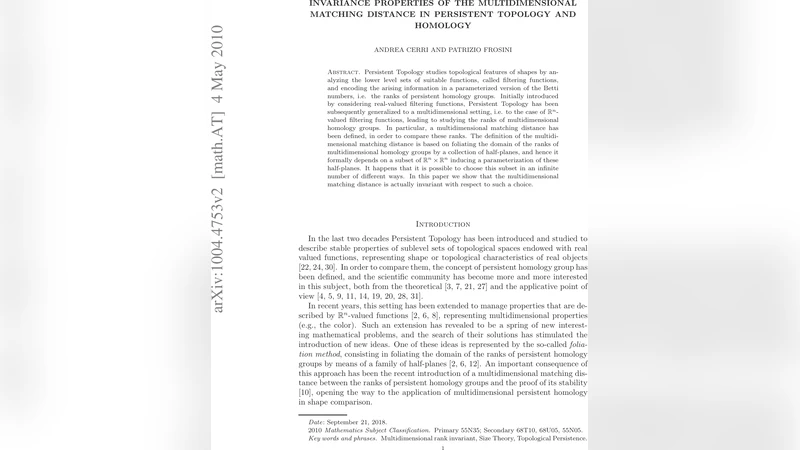
Persistent Topology studies topological features of shapes by analyzing the lower level sets of suitable functions, called filtering functions, and encoding the arising information in a parameterized version of the Betti numbers, i.e. the ranks of persistent homology groups. Initially introduced by considering real-valued filtering functions, Persistent Topology has been subsequently generalized to a multidimensional setting, i.e. to the case of $\R^n$-valued filtering functions, leading to studying the ranks of multidimensional homology groups. In particular, a multidimensional matching distance has been defined, in order to compare these ranks. The definition of the multidimensional matching distance is based on foliating the domain of the ranks of multidimensional homology groups by a collection of half-planes, and hence it formally depends on a subset of $\R^n\times\R^n$ inducing a parameterization of these half-planes. It happens that it is possible to choose this subset in an infinite number of different ways. In this paper we show that the multidimensional matching distance is actually invariant with respect to such a choice.
💡 Research Summary
The paper addresses a fundamental question in multidimensional persistent homology: whether the multidimensional matching distance, a metric designed to compare rank invariants of homology groups derived from vector‑valued filtering functions, depends on the particular choice of the parameter set that defines the foliation of the parameter space into half‑planes. In the classical one‑dimensional setting, persistent diagrams are compared via the bottleneck (or Wasserstein) distance, and the construction is canonical. When the filtering function takes values in $\mathbb{R}^n$, the rank invariant $\beta_k(\mathbf{a})$ becomes a function on an $n$‑dimensional domain, and a direct comparison is not straightforward. The standard approach, introduced in earlier works, is to foliate the domain by a family of half‑planes $\pi_{(\mathbf{u},\mathbf{v})}$ parameterized by pairs $(\mathbf{u},\mathbf{v})\in\mathbb{R}^n\times\mathbb{R}^n$ satisfying certain positivity and normalization conditions. Each half‑plane induces a linear functional that collapses the multidimensional filtration to a one‑dimensional filtration; the resulting one‑dimensional persistence diagrams are then compared using the bottleneck distance. The multidimensional matching distance $D_{\text{match}}$ is defined as the supremum of these bottleneck distances over all chosen half‑planes.
The core issue is that the set $S\subset\mathbb{R}^n\times\mathbb{R}^n$ used to generate the foliation is not unique; infinitely many such sets satisfy the required covering and non‑overlap properties. If $D_{\text{match}}$ were to vary with $S$, the metric would be ill‑posed for applications, because the analyst would have to commit to an arbitrary parametrization that could affect the outcome. The authors prove that, under mild and natural assumptions on $S$ (full coverage of the parameter space, pairwise disjoint half‑planes, and unit‑norm positivity of $\mathbf{u}$ and $\mathbf{v}$), the matching distance is invariant under any admissible choice of $S$.
The proof proceeds in two main steps. First, the authors construct an explicit linear transformation $T:\mathbb{R}^n\to\mathbb{R}^n$ that maps the foliation defined by one parameter set $S_1$ onto that defined by another $S_2$. This transformation is a composition of a positive scalar dilation and an orthogonal rotation; consequently it preserves the Euclidean structure of the space. They then show that $T$ carries lower‑level sets to lower‑level sets: for any $\mathbf{a}\in\mathbb{R}^n$, the sublevel set $X_{\mathbf{a}}={x\mid f(x)\le\mathbf{a}}$ is homeomorphic to $X_{T(\mathbf{a})}$, implying an isomorphism $H_k(X_{\mathbf{a}})\cong H_k(X_{T(\mathbf{a})})$. Hence the rank invariant $\beta_k$ is unchanged under $T$.
Second, the authors exploit the well‑known invariance of the bottleneck distance under isometries. Since $T$ is distance‑preserving (up to a uniform scaling factor), the bottleneck distance between any two one‑dimensional persistence diagrams is identical before and after applying $T$: $d_{\text{bottleneck}}(D_1,D_2)=d_{\text{bottleneck}}(T(D_1),T(D_2))$. Combining this with the first step yields that for every half‑plane in $S_1$ there exists a corresponding half‑plane in $S_2$ producing exactly the same bottleneck distance. Taking the supremum over all half‑planes therefore gives the same value for both parameterizations, establishing the invariance of $D_{\text{match}}$.
The significance of this result is threefold. Practically, it frees algorithm designers from having to select a “canonical” foliation; any convenient choice—perhaps one that minimizes computational cost or aligns with domain‑specific geometry—can be used without affecting the final distance. Theoretically, the invariance strengthens the stability properties of multidimensional persistence: the matching distance remains robust not only to perturbations of the filtering function but also to the choice of foliation. Finally, the theorem resolves a lingering criticism that multidimensional persistent homology lacked a well‑defined metric comparable to the one‑dimensional bottleneck distance, thereby placing the multidimensional framework on a firmer mathematical foundation.
The paper concludes by suggesting future directions, such as developing algorithms that automatically select an optimal foliation for a given dataset, extending the invariance proof to more general (non‑linear) reparameterizations, and investigating analogous invariance phenomena for higher‑order homology groups or for other metrics (e.g., Wasserstein distances). Overall, the work solidifies the multidimensional matching distance as a reliable and mathematically sound tool for topological data analysis in high‑dimensional settings.
Comments & Academic Discussion
Loading comments...
Leave a Comment