We study cascading failures in networks using a dynamical flow model based on simple conservation and distribution laws to investigate the impact of transient dynamics caused by the rebalancing of loads after an initial network failure (triggering event). It is found that considering the flow dynamics may imply reduced network robustness compared to previous static overload failure models. This is due to the transient oscillations or overshooting in the loads, when the flow dynamics adjusts to the new (remaining) network structure. We obtain {\em upper} and {\em lower} limits to network robustness, and it is shown that {\it two} time scales $\tau$ and $\tau_0$, defined by the network dynamics, are important to consider prior to accurately addressing network robustness or vulnerability. The robustness of networks showing cascading failures is generally determined by a complex interplay between the network topology and flow dynamics, where the ratio $\chi=\tau/\tau_0$ determines the relative role of the two of them.
Deep Dive into Dynamic Effects Increasing Network Vulnerability to Cascading Failures.
We study cascading failures in networks using a dynamical flow model based on simple conservation and distribution laws to investigate the impact of transient dynamics caused by the rebalancing of loads after an initial network failure (triggering event). It is found that considering the flow dynamics may imply reduced network robustness compared to previous static overload failure models. This is due to the transient oscillations or overshooting in the loads, when the flow dynamics adjusts to the new (remaining) network structure. We obtain {\em upper} and {\em lower} limits to network robustness, and it is shown that {\it two} time scales $\tau$ and $\tau_0$, defined by the network dynamics, are important to consider prior to accurately addressing network robustness or vulnerability. The robustness of networks showing cascading failures is generally determined by a complex interplay between the network topology and flow dynamics, where the ratio $\chi=\tau/\tau_0$ determines the rela
Societies rely on the stable operation and high performance of complex infrastructure networks, which are critical for their optimal functioning. Examples are electrical power grids, telecommunication networks, water, gas and oil distribution pipelines, or road, railway and airline transportation networks. Their failure can have serious economic and social consequences, as various large-scale blackouts and other incidents all over the world have recently shown. It is therefore a key question how to better protect such critical systems against failures and random or deliberate attacks [1,2,3]. Issues of network robustness and vulnerability have not only been addressed by engineers [4,5], but also by the physics community [2,3,6,7,8,9,10,11,12,13,14,15,16,17]. In the initial studies of this kind [2,6,7,8,11], the primary concern was dedicated to what can be termed structural robustness; the study of different classes of network topologies and how they were affected by the removal of a finite number of links and/or nodes (e.g. how the average network diameter changed). It was concluded that the more heterogeneous a network is in terms of, e.g., degree distribution, the more robust it is to random failures, while, at the same time, it appears more vulnerable to deliberate attacks on highly connected nodes [7,11].
Later on, the concepts of network loads, capacities, and overload failures were introduced [9,10,12,14,15,16]. For networks supporting the flow of a physical quantity, the removal of a node/link will cause the flow to redistribute with the risk that some other nodes/links may be overloaded and failure prone. Hence a triggering event can cause a whole sequence of failures due to overload, and may even threaten the global stability of the network. Such behavior has been termed cascading failures. A seminal work in this respect is the paper by Motter and Lai [9]. These authors defined the load of a node by its betweenness centrality [3,9]. Subsequent studies introduced alternative measures for the network loads [12] as well as more realistic redistribution mechanisms [12,14,15,16].
In all studies cited above, the redistribution of loads is treated time-independent or static. We will refer to them collectively as static overload failure models. The load redistributions in such models are instantaneously and discontinuously switched to the stationary loads of the new (perturbed) network, i.e. the transient dynamical adjustment towards the new stationary loads of the perturbed network is neglected.
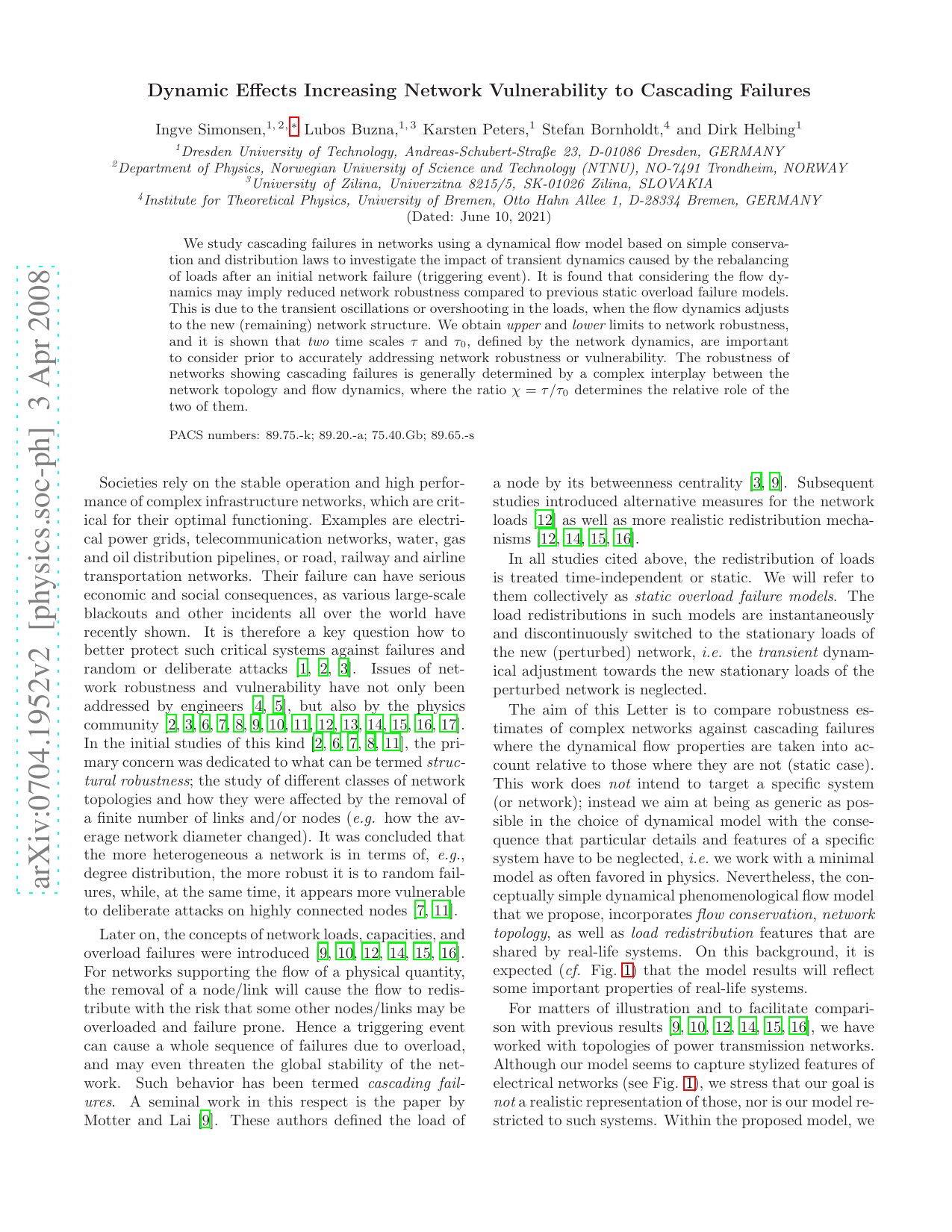
The aim of this Letter is to compare robustness estimates of complex networks against cascading failures where the dynamical flow properties are taken into account relative to those where they are not (static case). This work does not intend to target a specific system (or network); instead we aim at being as generic as possible in the choice of dynamical model with the consequence that particular details and features of a specific system have to be neglected, i.e. we work with a minimal model as often favored in physics. Nevertheless, the conceptually simple dynamical phenomenological flow model that we propose, incorporates flow conservation, network topology, as well as load redistribution features that are shared by real-life systems. On this background, it is expected (cf. Fig. 1) that the model results will reflect some important properties of real-life systems.
For matters of illustration and to facilitate comparison with previous results [9,10,12,14,15,16], we have worked with topologies of power transmission networks. Although our model seems to capture stylized features of electrical networks (see Fig. 1), we stress that our goal is not a realistic representation of those, nor is our model restricted to such systems. Within the proposed model, we want to demonstrate that time-dependent adjustments can play a crucial role. In particularly, we will show that static overload failure models give the lower limit of the vulnerability of flow networks to failures and attacks, and hence of the probability of cascading failures.
In order to study this, in the very tradition of physics, we use a simple flow model with few parameters, which however considers the network topology, flow conservation, and the distribution of loads over the neighboring links of a node [20,22]. We assume a network consisting of N nodes and represent it by a matrix W , whose entries W ij ≥ 0 (with i, j = 1, 2, . . . , N ) shall reflect the weight of the (directed) link from node j to i (with W ij = 0 indicating no link present). The relative weights T ij = W ij /w i shall define the elements of the transfer matrix T , where w j = N i=1 W ij is the total outgoing weight of node j [22]. These elements describe the distribution of the overall flow (per unit weight) c j (t) reaching node j at time t over the neighboring links i. When the flow is assumed to reach the neighboring nodes i at time step t+1, we obtain 20,22,23], where we hav
…(Full text truncated)…
This content is AI-processed based on ArXiv data.