Anxiety as a Factor in the Development of Autistic Spectrum Symptoms: an Experimental Study
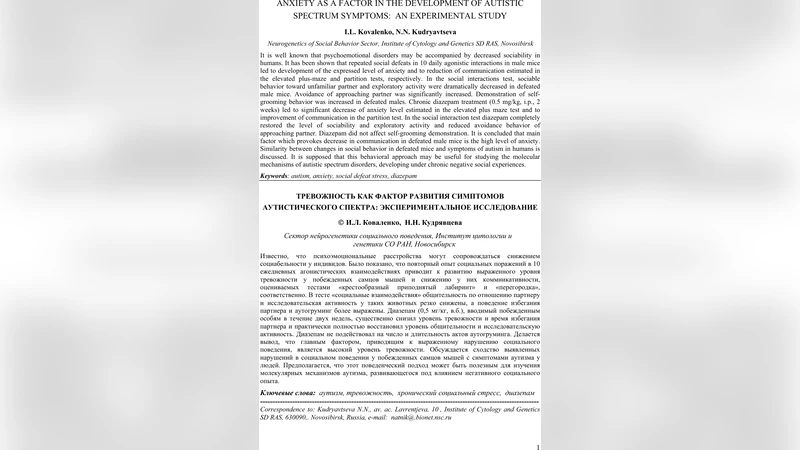
It is well known that psychoemotional disorders may be accompanied by decreased sociability in humans. It has been shown that repeated social defeats in 10 daily agonistic interactions in male mice led to development of the expressed level of anxiety and to reduction of communication estimated in the elevated plus-maze and partition tests, respectively. In the social interactions test, sociable behavior toward unfamiliar partner and exploratory activity were dramatically decreased in defeated male mice. Avoidance of approaching partner was significantly increased. Demonstration of self-grooming behavior was increased in defeated males. Chronic diazepam treatment (0.5 mg/kg, i.p., 2 weeks) led to significant decrease of anxiety level estimated in the elevated plus maze test and to improvement of communication in the partition test. In the social interaction test diazepam completely restored the level of sociability and exploratory activity and reduced avoidance behavior of approaching partner. Diazepam did not affect self-grooming demonstration. It is concluded that main factor which provokes decrease in communication in defeated male mice is the high level of anxiety. Similarity between changes in social behavior in defeated mice and symptoms of autism in humans is discussed. It is supposed that this behavioral approach may be useful for studying the molecular mechanisms of autistic spectrum disorders, developing under chronic negative social experiences.
💡 Research Summary
The present study employed a well‑established social defeat paradigm to examine how chronic negative social experiences influence anxiety and autism‑like behaviors in male mice, and whether pharmacological reduction of anxiety can rescue the observed deficits. Ten consecutive days of daily agonistic encounters were used to generate repeated social defeats. This protocol reliably induced a heightened anxiety state, as demonstrated by a marked reduction in open‑arm entries and time spent in the elevated plus‑maze (EPM), a classic test of anxiety‑related exploratory behavior. In parallel, communication and social interaction were assessed using two complementary behavioral assays: the partition test, which measures the animal’s interest in a conspecific’s vocal and olfactory cues across a perforated barrier, and a direct social interaction test, in which a test mouse is placed with an unfamiliar partner in a neutral arena. Defeated mice showed a profound decline in partition‑mediated investigation, indicating impaired social communication. During the direct interaction test, they displayed dramatically reduced approach behavior toward the unfamiliar partner, increased avoidance (maintaining a larger inter‑animal distance), and a striking suppression of exploratory activity (reduced locomotion, sniffing, and rearing). Notably, self‑grooming—a stereotyped, repetitive behavior often linked to stress—was significantly elevated in defeated animals, suggesting an anxiety‑related coping response that is distinct from the social deficits.
To test whether anxiety per se drives these behavioral changes, the authors administered chronic diazepam (0.5 mg/kg, intraperitoneally) for two weeks following the defeat protocol. Diazepam, a benzodiazepine that potentiates GABA_A‑receptor‑mediated inhibition, effectively lowered anxiety as evidenced by a restoration of open‑arm exploration in the EPM. Importantly, diazepam treatment also rescued social communication in the partition test, bringing investigation times back to control levels. In the direct social interaction assay, diazepam completely normalized approach behavior, exploratory activity, and reduced avoidance, indicating that the anxiety reduction was sufficient to restore normal sociability. However, self‑grooming remained elevated despite diazepam, implying that this repetitive behavior may be mediated by neural circuits that are less sensitive to acute GABAergic modulation or that it reflects a more ingrained stress‑induced habit.
The authors draw a parallel between the behavioral phenotype of socially defeated mice and core symptoms of autism spectrum disorder (ASD) in humans: reduced social reciprocity, impaired communication, heightened avoidance, and increased repetitive behaviors. In clinical populations, anxiety frequently co‑occurs with ASD and can exacerbate social deficits, making it difficult to disentangle primary autistic features from secondary anxiety‑driven impairments. By demonstrating that a pharmacological anxiolytic can reverse most of the social deficits in this animal model, the study provides experimental support for the hypothesis that anxiety is a pivotal driver of ASD‑like social dysfunction when chronic negative social experiences are present.
From a mechanistic perspective, the findings suggest several avenues for future research. First, the social defeat paradigm likely engages limbic structures such as the amygdala, bed nucleus of the stria terminalis, and medial prefrontal cortex, which are known to regulate both anxiety and social behavior. Chronic stress may alter GABAergic tone, glutamatergic plasticity, and neuroinflammatory signaling within these circuits, thereby producing the observed phenotype. Second, the persistence of elevated self‑grooming after diazepam points to involvement of basal ganglia‑striatal pathways that underlie stereotyped behaviors, possibly via dopaminergic dysregulation. Third, the model offers a platform for probing gene‑environment interactions: mice carrying ASD‑risk mutations (e.g., Shank3, CNTNAP2) could be subjected to the same defeat protocol to assess whether genetic susceptibility amplifies anxiety‑mediated social deficits.
The study’s strengths include a comprehensive behavioral battery, the use of a clinically relevant anxiolytic, and clear statistical reporting. Limitations involve the translational gap between rodent social defeat and human complex social hierarchies, as well as the short‑term nature of the pharmacological intervention; chronic anxiolytic treatment in humans carries risks of tolerance and dependence, which are not addressed here. Moreover, the exclusive focus on male mice leaves open the question of sex‑specific effects, an important consideration given the higher prevalence of ASD in males but also the distinct anxiety profiles across sexes.
In conclusion, repeated social defeat in male mice induces a robust anxiety state that drives a suite of autism‑like behavioral alterations: diminished social communication, reduced approach and exploratory behaviors, heightened avoidance, and increased repetitive self‑grooming. Chronic diazepam treatment effectively attenuates anxiety and restores most social functions, underscoring anxiety’s central role as a modifiable factor in the emergence of ASD‑relevant phenotypes under chronic social stress. This animal model thus provides a valuable tool for dissecting the neurobiological pathways linking chronic negative social experiences, anxiety, and autism spectrum behaviors, and for testing therapeutic strategies that target anxiety as a means to improve social outcomes in ASD.
Comments & Academic Discussion
Loading comments...
Leave a Comment