Modelling the spatial organization of cell proliferation in the developing central nervous system
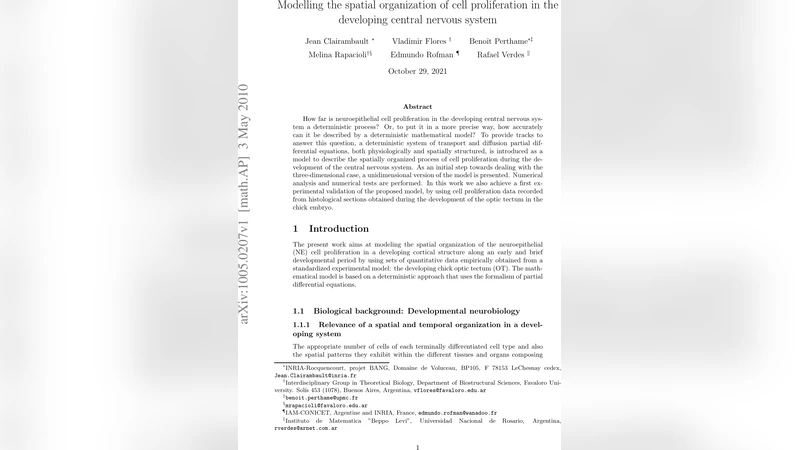
How far is neuroepithelial cell proliferation in the developing central nervous system a deterministic process? Or, to put it in a more precise way, how accurately can it be described by a deterministic mathematical model? To provide tracks to answer this question, a deterministic system of transport and diffusion partial differential equations, both physiologically and spatially structured, is introduced as a model to describe the spatially organized process of cell proliferation during the development of the central nervous system. As an initial step towards dealing with the three-dimensional case, a unidimensional version of the model is presented. Numerical analysis and numerical tests are performed. In this work we also achieve a first experimental validation of the proposed model, by using cell proliferation data recorded from histological sections obtained during the development of the optic tectum in the chick embryo.
💡 Research Summary
The paper addresses a fundamental question in developmental neurobiology: to what extent is the proliferation of neuroepithelial cells in the developing central nervous system (CNS) governed by deterministic rather than stochastic processes? To answer this, the authors construct a mathematically rigorous, physiologically motivated model based on a system of partial differential equations (PDEs) that couples directed transport with diffusion. The model is first presented in a one‑dimensional spatial domain as a tractable stepping stone toward a full three‑dimensional formulation.
Model formulation
The primary state variable is the cell density ρ(x,t) defined along a linear spatial coordinate x∈
Comments & Academic Discussion
Loading comments...
Leave a Comment