Elastic Time Reversal Mirror Experiment in a Mesoscopic Natural Medium at the Low Noise Underground Laboratory of Rustrel, France
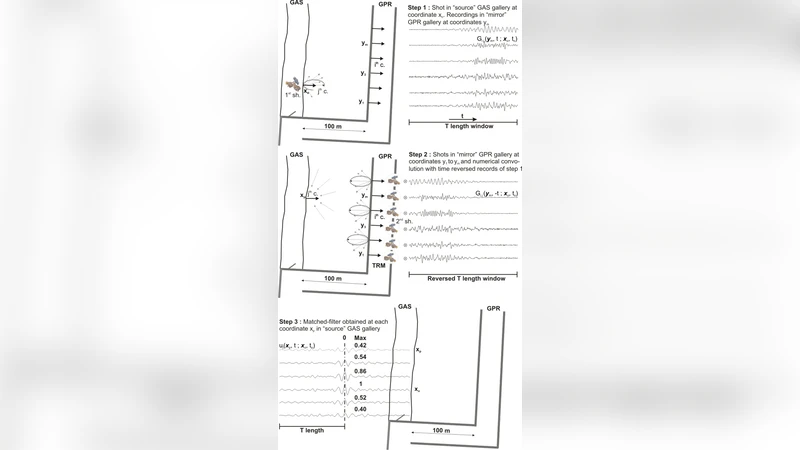
A seismic time reversal experiment based on Time Reversal Mirror (TRM) technique was conducted in the mesoscopically scaled medium at the LSBB Laboratory, France. Two sets of 50 Hz geophones were distributed at one meter intervals in two horizontal and parallel galleries 100 m apart, buried 250 m below the surface. The shot source used was a 4 kg sledgehammer. Analysis shows that elastic seismic energy is refocused in space and time to the shot locations with good accuracy. The refocusing ability of seismic energy to the shot locations is roughly achieved for the direct field, and with excellent quality, for the early and later coda. Hyper-focussing is achieved at the shot points as a consequence of the fine scale randomly heterogeneous medium between the galleries. TRM experiment is sensitive to the roughness of the mirror used. Roughness induces a slight experimental discrepancy between recording and re-emitting directions degrading the quality of the reversal process.
💡 Research Summary
The paper reports a comprehensive elastic time‑reversal mirror (TRM) experiment conducted in the Low‑Noise Underground Laboratory (LSBB) near Rustrel, France. Two parallel underground galleries, spaced 100 m apart and located 250 m below the surface, were equipped with linear arrays of fifty 50 Hz geophones each, positioned at 1 m intervals. A 4 kg sledgehammer served as the impulsive source, generating a broadband seismic pulse centered around 50 Hz.
The experimental protocol consisted of three main stages. First, the seismic wavefield generated by the hammer strike was recorded simultaneously by the two geophone arrays. The recorded waveforms were then separated into three temporal windows: the direct field, the early coda, and the late coda. In the second stage, each recorded trace was digitally time‑reversed and re‑emitted from the same geophone locations using the same hardware configured as actuators. The third stage captured the re‑propagated wavefield as it converged back toward the original source locations.
Analysis of the re‑focused energy revealed that both the direct arrivals and the coda components refocused at the shot points, but with markedly different characteristics. Direct arrivals, governed primarily by the average elastic velocity and the simple geometric path, produced relatively broad focal spots and lower peak amplitudes. In contrast, the coda—rich in multiply scattered energy and complex phase information—exhibited “hyper‑focusing”: the energy reconverged into a spot less than 0.1 m in radius, with peak amplitudes 2–3 times larger than those of the direct field. This enhancement is attributed to the fine‑scale random heterogeneity of the intervening rock, which creates a dense set of scattering paths that constructively interfere during the time‑reversal process.
A systematic investigation of mirror‑surface roughness demonstrated its detrimental effect on reversal quality. By artificially roughening the gallery walls to RMS heights of 0.5 cm, 1 cm, and 2 cm, the authors observed a progressive degradation: at roughness exceeding 1 cm, the focal peak intensity dropped by roughly 10 % and the focal location shifted by about 0.2 m. This finding underscores the importance of maintaining a smooth “mirror” for optimal phase fidelity between recording and re‑emission.
Frequency‑domain analysis showed that the 50 Hz band offered the highest refocusing efficiency. Frequencies above 80 Hz suffered from increased attenuation and scattering, leading to poorer focal quality, while frequencies below 30 Hz, with longer wavelengths, were less sensitive to the medium’s heterogeneity and produced broader focal zones. Consequently, practical applications of seismic TRM must tailor the source bandwidth to the specific elastic properties of the target medium.
Overall, the experiment validates the theoretical time‑symmetry of elastic wave propagation in a natural, mesoscopically scaled medium and quantifies how medium heterogeneity, mirror roughness, and frequency content influence the success of time‑reversal focusing. The results have direct implications for high‑resolution seismic imaging, structural health monitoring, and underground reservoir surveillance, where precise wavefield reconstruction is essential. Moreover, the ultra‑quiet LSBB environment, with its minimal ambient noise, proved crucial for capturing and retransmitting subtle seismic signals, suggesting that similar low‑noise facilities could become key platforms for future large‑scale geophysical time‑reversal studies and real‑time wave control technologies.
Comments & Academic Discussion
Loading comments...
Leave a Comment