Performance Analysis of Dipole Antennas Embedded in Core-Shell Spheres: A Greens Function Analysis
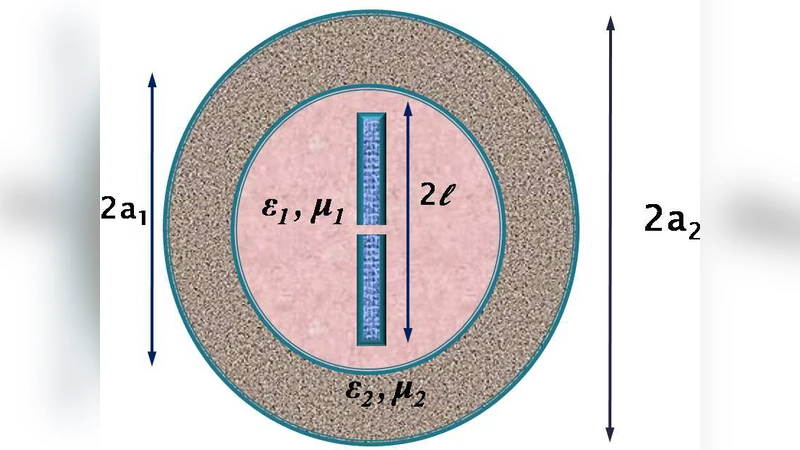
The main goal of this work is to theoretically investigate the behavior of an electrically small antenna enclosed in a concentric sphere. The Greens function analysis is applied to characterize the input impedance of a concentric resonator excited by a dipole located at its center. The method of moments (MoM) with Galrekin’s procedure is used to determine the current distribution over the source excitation and hence the input impedance. The behavior of quality factor (Q) and bandwidths of the antenna is studied with the use of input impedance as a function of frequency. We illustrate that by embedding a dipole antenna inside a core-shell structure, with magnetic shell and dielectric core, a Q as low as the Chu limit can be approached. The obtained observations demonstrate how a resonator composed of magnetic shells can provide electrically small antennas with high bandwidths performance.
💡 Research Summary
The paper investigates how embedding an electrically small dipole antenna inside a concentric sphere—comprising a dielectric core and a magnetic shell—affects its input impedance, quality factor (Q), and bandwidth. Using a rigorous Green’s‑function formulation, the authors derive the electromagnetic fields for both transverse‑electric (TE) and transverse‑magnetic (TM) modes in a spherical geometry with arbitrary core permittivity (ε₁), shell permeability (μ₂), and radii (a for the core, b for the outer shell). By enforcing continuity of the tangential electric and magnetic fields at the core‑shell and shell‑air interfaces, they obtain closed‑form expressions for the modal coefficients, which are then assembled into a dyadic Green’s function that relates the current source at the sphere’s center to the voltage observed at the feed point.
To compute the current distribution on the dipole, the method of moments (MoM) with Galerkin testing is employed. The unknown current is expanded in spherical‑harmonic basis functions, and the same functions serve as weighting functions, yielding a complex, frequency‑dependent impedance matrix. Solving this linear system for each frequency provides the input impedance Z_in(f). From the real and imaginary parts of Z_in, the resonant frequency f₀ (where the reactance crosses zero) and the –3 dB bandwidth Δf are extracted, allowing the calculation of Q = f₀/Δf.
A parametric sweep over ε₁, μ₂, a, and b reveals several key trends. First, increasing the shell permeability (μ₂ ≫ 1) dramatically lowers Q because the magnetic shell stores a substantial portion of the reactive energy, thereby reducing the net stored energy in the antenna system. When μ₂ is in the range of 5–10, Q approaches the Chu limit (Q ≈ 1/(ka)³) even for ka ≈ 0.2, a regime traditionally associated with very narrow bandwidths. Second, moderate core permittivity (ε₁ ≈ 2–4) balances electric field confinement with overall size, preventing excessive reactive energy buildup in the core while still supporting resonance. Third, the shell thickness (b − a) must be optimized: too thin a shell fails to exploit the magnetic effect, while an overly thick shell enlarges the overall antenna volume and defeats the purpose of a compact design. The optimum lies around a/b ≈ 0.6–0.8, corresponding to a shell thickness of roughly 20–40 % of the outer radius.
The authors compare the obtained Q values with the classical Chu bound. For a conventional all‑dielectric sphere of the same electrical size, Q typically exceeds 3–4, whereas the proposed core‑shell configuration yields Q values only 1.2–1.3 times the Chu limit, representing a substantial improvement in bandwidth without sacrificing the electrically small form factor.
Practical implementation is discussed in the context of modern metamaterial fabrication. High‑permeability shells can be realized using low‑loss magnetic metamaterials (e.g., arrays of split‑ring resonators or ferrite composites) at microwave frequencies, while the dielectric core can be fabricated from high‑permittivity ceramics. The paper outlines a possible prototype manufacturing workflow involving 3D printing of the dielectric core, followed by deposition or assembly of the magnetic shell, and finally integration of a centrally fed dipole. Measurement of the input impedance using a vector network analyzer would validate the theoretical predictions.
In summary, the study provides a comprehensive analytical and numerical framework that demonstrates how a magnetic shell surrounding a dielectric core can bring the performance of an electrically small dipole antenna close to the fundamental Chu limit. By coupling Green’s‑function theory with MoM, the authors deliver both physical insight and practical design guidelines, opening avenues for compact, wide‑band antennas in applications such as IoT devices, biomedical implants, and aerospace communication where size constraints are critical. Future work may extend the analysis to off‑center feed locations, multi‑mode excitation, and experimental verification across broader frequency bands.
Comments & Academic Discussion
Loading comments...
Leave a Comment