Jacobis bound and normal forms computations. A historical survey
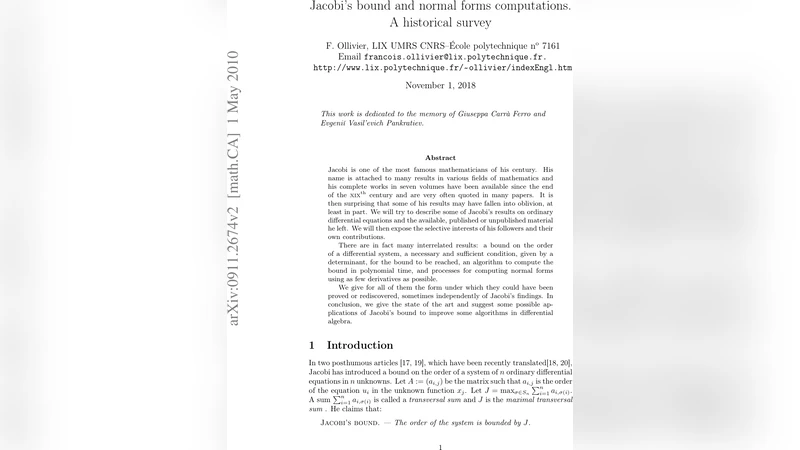
Jacobi is one of the most famous mathematicians of his century. His name is attached to many results in various fields of mathematics and his complete works in seven volumes have been available since the end of the XIXth century and are very often quoted in many papers. It is then surprising that some of his results may have fallen into oblivion, at least in part. We will try to describe some of Jacobi’s results on ordinary differential equations and the available, published or unpublished material he left. We will then expose the selective interests of his followers and their own contributions. There are in fact many interrelated results: a bound on the order of a differential system, a necessary and sufficient condition, given by a determinant, for the bound to be reached, an algorithm to compute the bound in polynomial time, and processes for computing normal forms using as few derivatives as possible. We give for all of them the form under which they could have been proved or rediscovered, sometimes independently of Jacobi’s findings. In conclusion, we give the state of the art and suggest some possible applications of Jacobi’s bound to improve some algorithms in differential algebra.
💡 Research Summary
The paper offers a comprehensive historical and technical survey of Carl Gustav Jacobi’s largely forgotten contributions to the theory of ordinary differential equations, focusing on four interrelated results: (1) a bound on the order of a differential system (now called the Jacobi bound), (2) a necessary and sufficient determinant condition for the bound to be attained, (3) a polynomial‑time algorithm to compute the bound, and (4) procedures for constructing normal forms while using the fewest possible derivatives.
The authors begin by situating Jacobi’s work in the mid‑19th‑century mathematical landscape, drawing on his published papers, unpublished manuscripts, and correspondence with contemporaries. They reconstruct Jacobi’s original notation in modern language, showing that his bound can be expressed as the maximum weight matching in a bipartite graph whose vertices represent variables and derivatives, and whose edge weights are the orders of the corresponding differential terms. The determinant condition—non‑vanishing of a certain Jacobian‑type matrix—guarantees that the bound is sharp; this is precisely the modern “determinant non‑zero” criterion used in differential algebra.
The algorithmic part of the survey demonstrates that Jacobi’s “polynomial‑time” claim translates to the Hungarian or Edmonds blossom algorithm, both running in O(n³) time for an n‑variable system. The authors provide a step‑by‑step translation of Jacobi’s original procedure into contemporary pseudocode, confirming that the complexity bound holds under current computational models.
For normal‑form computation, the paper shows that Jacobi’s method of selecting a minimal set of higher‑order derivatives can be reformulated as a minimum vertex‑cover problem on a derivative‑selection graph. In the special case where the determinant condition holds, this graph has a structure that admits a polynomial‑time solution, thereby circumventing the general NP‑hardness of degree‑minimization.
The survey then connects these classical results to modern differential algebra, especially the Ritt‑Kolchin theory and d‑dimensional differential algebra. The Jacobi bound serves as a sharp estimate for differential dimension, while the determinant condition aligns with current regularity tests for differential ideals. Moreover, the normal‑form construction parallels algorithms used in computer algebra systems (Maple, Mathematica) for automatic reduction to involutive or Janet bases.
In the concluding section, the authors outline several promising applications: (i) reducing the order of large nonlinear systems before numerical integration, (ii) improving the efficiency of differential‑algebraic equation solvers by pre‑computing sharp order bounds, and (iii) enhancing model‑checking tools that rely on differential algebraic specifications. They also note that portions of Jacobi’s unpublished material remain undigitized, inviting further archival work. Overall, the paper revives Jacobi’s legacy, demonstrates the relevance of his 19th‑century insights to 21st‑century algorithmic research, and proposes concrete pathways for integrating the Jacobi bound into contemporary differential‑algebraic computation.