Mechanizing the Metatheory of LF
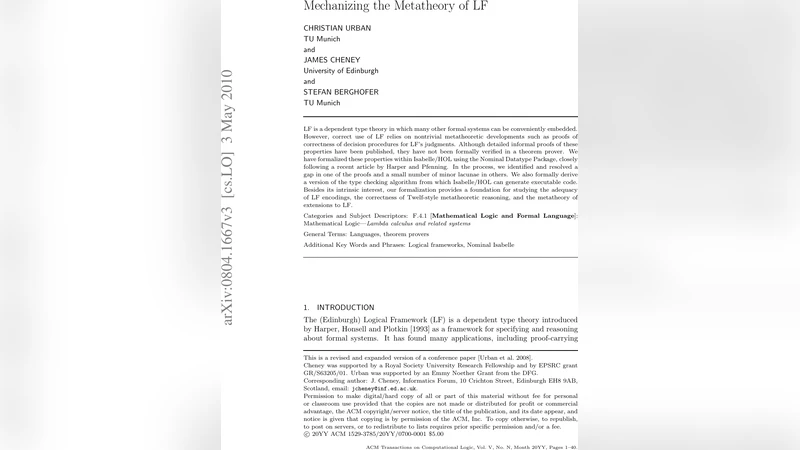
LF is a dependent type theory in which many other formal systems can be conveniently embedded. However, correct use of LF relies on nontrivial metatheoretic developments such as proofs of correctness of decision procedures for LF’s judgments. Although detailed informal proofs of these properties have been published, they have not been formally verified in a theorem prover. We have formalized these properties within Isabelle/HOL using the Nominal Datatype Package, closely following a recent article by Harper and Pfenning. In the process, we identified and resolved a gap in one of the proofs and a small number of minor lacunae in others. We also formally derive a version of the type checking algorithm from which Isabelle/HOL can generate executable code. Besides its intrinsic interest, our formalization provides a foundation for studying the adequacy of LF encodings, the correctness of Twelf-style metatheoretic reasoning, and the metatheory of extensions to LF.
💡 Research Summary
The paper “Mechanizing the Metatheory of LF” presents a comprehensive formalization of the core metatheoretic results for the Edinburgh Logical Framework (LF) within the Isabelle/HOL proof assistant, using the Nominal Datatype Package to handle binding and α‑equivalence. LF is a dependent type theory that serves as a logical framework for encoding a wide variety of formal systems; its practical use depends on the correctness of decision procedures for its judgments, especially type checking and definitional equality. While Harper and Pfenning’s 2005 journal article gave detailed informal proofs of soundness and completeness for a type‑driven algorithm, those proofs had never been mechanically verified.
The authors first encode the syntax of LF (kinds, type families, objects) as nominal datatypes. Constructors λ and Π bind variables, and the Nominal package automatically supplies freshness conditions and α‑equivalence classes, simplifying the definition of capture‑avoiding substitution. Signatures and contexts are represented as lists of (identifier, type) pairs, with explicit freshness constraints (e.g., x # Γ) that are automatically discharged by the package’s induction principles.
Next, they formalize the validity judgments for signatures, contexts, objects, type families, and kinds, as well as the definitional equivalence judgment (≡) and the algorithmic equivalence judgment (≈) introduced by Harper and Pfenning. The algorithmic equivalence is syntax‑directed and uses a simplified notion of simple types τ and simple kinds κ, which is sufficient for a sound and complete decision procedure. The Isabelle development reproduces the entire set of inference rules, adds a few redundant freshness premises to enable strong induction, and makes explicit several hypotheses that were implicit in the original paper.
During this effort the authors discovered a genuine gap in the original soundness proof: a case involving the exchange of bound variables omitted an essential freshness condition, making the argument incomplete. By leveraging the Nominal infrastructure they added the missing premise, proved auxiliary lemmas about preservation of free variables under swapping, and repaired the proof without altering the overall result. They also identified several minor lacunae in other lemmas (e.g., strengthening, strong extensionality) and supplied formal proofs or sketches for them.
Because Isabelle/HOL’s code generation does not directly support nominal datatypes, the authors also provide a second, executable version of the type‑checking algorithm based on a locally‑nameless representation (de Bruijn‑style indices). They prove that this representation is equivalent to the nominal one, thereby justifying the extraction of verified ML code that implements LF’s type checker and equality decision procedure. This constitutes a verified implementation of the LF type checker, something previously available only as an unverified prototype in Twelf.
The paper further discusses additional metatheoretic results that were only sketched in Harper and Pfenning: admissibility of strengthening, strong extensionality, existence and uniqueness of quasi‑canonical forms, and a partial adequacy proof for a sample LF encoding. While the full decidability proof for algorithmic type checking is not completed—owing to the need for a classical treatment of complement relations in Isabelle—the authors outline how such a proof could be pursued by developing a substantial amount of computability theory within Isabelle/HOL.
In the concluding sections the authors reflect on the experience of mechanizing a large, mature metatheory. They argue that the effort validates the expressive power of the Nominal Datatype Package for handling complex binding structures, increases confidence in widely‑used LF algorithms, and yields a reusable library of formally verified LF results. This library can serve as a foundation for future work on Twelf‑style meta‑reasoning, extensions of LF (e.g., modules, richer type constructors), and the mechanization of other logical frameworks.
Overall, the contribution is threefold: (1) a complete Isabelle/HOL formalization of LF’s core metatheory, exposing and fixing subtle gaps in the original literature; (2) a verified, executable type‑checking algorithm derived from the formalization; and (3) a demonstration that nominal techniques can scale to the mechanization of sophisticated type‑theoretic meta‑reasoning, opening the door to further verified developments in logical frameworks.
Comments & Academic Discussion
Loading comments...
Leave a Comment