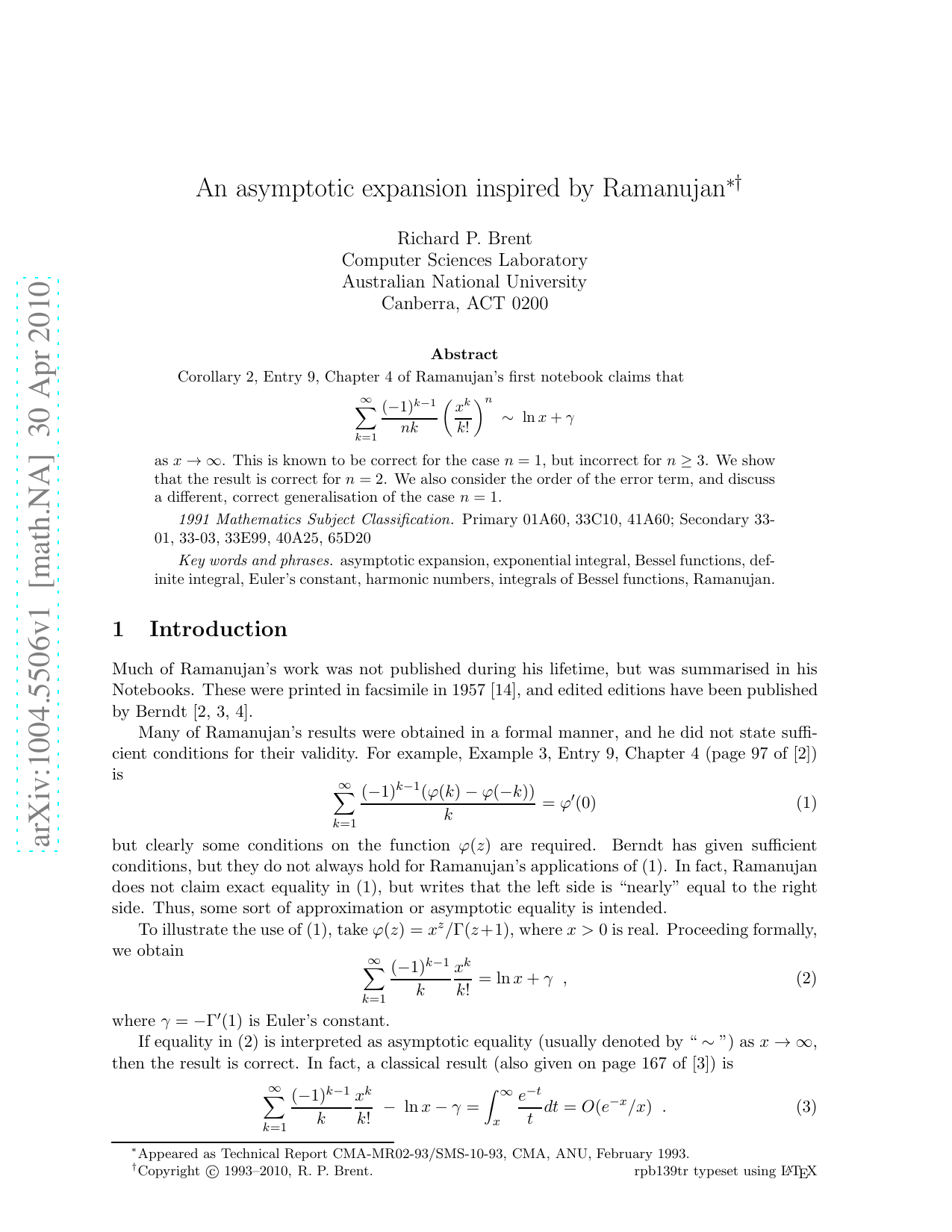
Corollary 2, Entry 9, Chapter 4 of Ramanujan's first notebook claims that a certain sum is asymptotic to ln(x) + gamma, where x is a real variable in the sum and gamma is Euler's constant. Ramanujan's claim is known to be correct for the case n = 1, but incorrect for n > 2 (here n is an integer parameter in the sum). We show that the result is correct for n = 2. We also consider the order of the error term, and discuss a different, correct generalisation of the case n = 1.
Deep Dive into An asymptotic expansion inspired by Ramanujan.
Corollary 2, Entry 9, Chapter 4 of Ramanujan’s first notebook claims that a certain sum is asymptotic to ln(x) + gamma, where x is a real variable in the sum and gamma is Euler’s constant. Ramanujan’s claim is known to be correct for the case n = 1, but incorrect for n > 2 (here n is an integer parameter in the sum). We show that the result is correct for n = 2. We also consider the order of the error term, and discuss a different, correct generalisation of the case n = 1.
Much of Ramanujan's work was not published during his lifetime, but was summarised in his Notebooks. These were printed in facsimile in 1957 [14], and edited editions have been published by Berndt [2,3,4].
Many of Ramanujan’s results were obtained in a formal manner, and he did not state sufficient conditions for their validity. For example, Example 3, Entry 9, Chapter 4 (page 97 of [2]) is
but clearly some conditions on the function ϕ(z) are required. Berndt has given sufficient conditions, but they do not always hold for Ramanujan’s applications of (1). In fact, Ramanujan does not claim exact equality in (1), but writes that the left side is “nearly” equal to the right side. Thus, some sort of approximation or asymptotic equality is intended.
To illustrate the use of (1), take ϕ(z) = x z /Γ(z +1), where x > 0 is real. Proceeding formally, we obtain
where γ = -Γ ′ (1) is Euler’s constant. If equality in ( 2) is interpreted as asymptotic equality (usually denoted by " ∼ “) as x → ∞, then the result is correct. In fact, a classical result (also given on page 167 of [3]) is
In view of (3), this is equivalent to
It is plausible that Ramanujan derived this result from (1) in the same formal manner that we derived (2) above, but taking ϕ(z) = (x z /Γ(z + 1)) n .
Berndt [2] shows that (4) is false for n ≥ 3; in fact, the function defined by the left side of (4) changes sign infinitely often, and grows exponentially large as x → ∞. However, Berndt leaves the case n = 2 open.
The aim of this paper is to show that ( 4) is true in the case n = 2. Theorem 1 in Section 3 gives an exact expression for the error in (4) as an integral involving the Bessel function J 0 (x), and Corollary 1 deduces an asymptotic expansion. The most significant term is
Theorem 1 is a special case1 of a formula given on page 48 of Luke [9]. However, the connection with Ramanujan does not seem to have been noticed before.
In Corollary 2, Entry 2, Chapter 3 of his first Notebook, Ramanujan shows that the function on the left side of (2) can be written as
where
In Section 4 we indicate how Ramanujan might have generalised (5) in much the same way that he attempted to generalise (2).
In this section we give some preliminary results on integrals involving J 0 . These results may be found in the literature, but for completeness we sketch their proofs.
Recall that
J 0 (z) is an entire function, but we are only concerned with its behaviour on the positive real axis. For small positive x, J 0 (x) = 1 + O(x 2 ). For large positive x, Hankel’s asymptotic expansion [11,15] gives J 0 (x) = O(x -1/2 ). These observations are sufficient to show that the integral occurring in Lemma 2 below is absolutely convergent.
In the proof of the following Lemma, (a) k = a(a + 1)
is a hypergeometric function.
Our main result is the following Theorem, which proves that ( 4) is valid for n = 2.
Then, for real positive x,
Proof. Proceeding as on page 99 of [2], using the fact5 that
we have
Now, from Lemma 2 with a change of variable,
and Theorem 1 follows by a change of variable. ✷ Corollary 1 Let e(x) be as in Theorem 1. Then, for large positive x, e(x) has an asymptotic expansion whose leading terms are given by
Proof. Using integration by parts and the fact that xJ ′′ 0 (x) + J ′ 0 (x) + xJ 0 (x) = 0 (a special case of Bessel’s differential equation), it is easy to deduce from Theorem 1 that
Continuing in the same way, we obtain an asymptotic expansion
The Corollary follows from Hankel’s asymptotic expansions for J 0 (z) and J ′ 0 (z) = -J 1 (z). ✷
An obvious generalisation of ( 5) is
It is easy to show that ( 10) is valid for all positive integer n. An essential difference between ( 4) and (10) is that there is a large amount of cancellation between terms on the left side of ( 4), but there is no cancellation in the numerator and denominator on the left side of (10). The function (x k /k!) n acts as a smoothing kernel with a peak at k ≃ x -1/2. Since
the result (10) is not surprising. What may be surprising is the speed of convergence. Brent and McMillan [5] show that6
as x → ∞, where
In the case n = 2, (11) has error O(e -4x ). Brent and McMillan used this case with x ≃ 17, 400 to compute γ to more than 30,000 decimal places. From Corollary 1, the same value of x in (4) would give less than 8-decimal place accuracy 7 .
The case n = 3 of ( 11) is interesting because max c n = c 3 = 4.5. However, no one seems to have used n > 2 in a serious computation of γ.
Although Ramanujan [3,13] gave many rapidly-convergent series and other good approximations for π, he does not seem to have given series which are particularly useful for approximating γ, except for (3) and ( 5) above. In his paper [12] on series for γ, he gives several interesting series, of which the simplest8 is
, but these series all involve the Riemann zeta function or related functions, so they are not very convenient for computational purposes. Our analysis has assumed that n
…(Full text truncated)…
This content is AI-processed based on ArXiv data.