Accurate calculations of the WIMP halo around the Sun and prospects for its gamma-ray detection
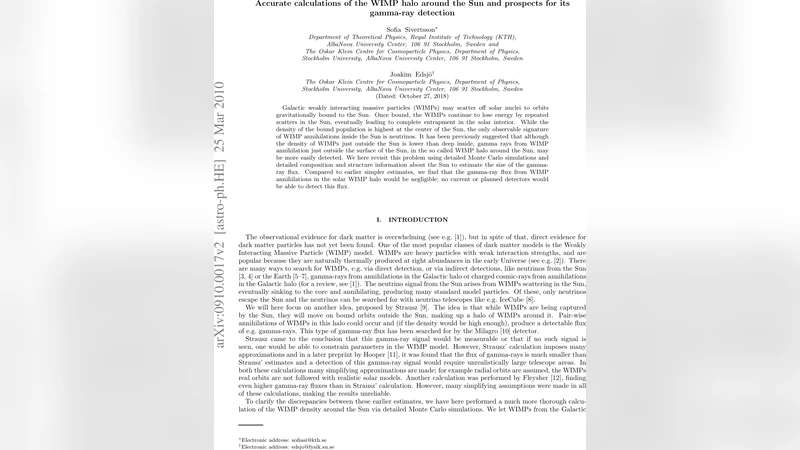
Galactic weakly interacting massive particles (WIMPs) may scatter off solar nuclei to orbits gravitationally bound to the Sun. Once bound, the WIMPs continue to lose energy by repeated scatters in the Sun, eventually leading to complete entrapment in the solar interior. While the density of the bound population is highest at the center of the Sun, the only observable signature of WIMP annihilations inside the Sun is neutrinos. It has been previously suggested that although the density of WIMPs just outside the Sun is lower than deep inside, gamma rays from WIMP annihilation just outside the surface of the Sun, in the so called WIMP halo around the Sun, may be more easily detected. We here revisit this problem using detailed Monte Carlo simulations and detailed composition and structure information about the Sun to estimate the size of the gamma-ray flux. Compared to earlier simpler estimates, we find that the gamma-ray flux from WIMP annihilations in the solar WIMP halo would be negligible; no current or planned detectors would be able to detect this flux.
💡 Research Summary
The paper revisits the hypothesis that weakly interacting massive particles (WIMPs) captured by the Sun could form a tenuous halo just outside the solar surface, and that annihilations within this halo might produce a detectable gamma‑ray signal. The authors combine a state‑of‑the‑art Standard Solar Model (including detailed radial profiles of temperature, density, and elemental composition) with a comprehensive Monte‑Carlo simulation of individual WIMP trajectories. They consider a broad range of WIMP masses (10 GeV–10 TeV) and both spin‑dependent and spin‑independent scattering cross sections on solar nuclei.
In the simulation, each WIMP initially traverses the Sun on a hyperbolic orbit, suffers its first elastic scatter with a solar nucleus, loses a fraction of its kinetic energy, and becomes bound on an eccentric orbit. Subsequent passages through the solar interior lead to additional scatters, gradually reducing the orbital energy until the particle is fully thermalised and sinks to the solar core. By recording the orbital parameters after each scatter, the authors compute the spatial density distribution of bound WIMPs, paying special attention to the population that spends any time outside the photosphere. They find that the residence time of a typical WIMP in the region just above the solar surface is of order seconds, and the corresponding number density is roughly 10⁻⁶ of the central density.
Using this density profile, the annihilation rate per unit volume is calculated as ( \Gamma_{\rm ann}(r) = \frac{1}{2}\langle\sigma v\rangle n_{\chi}^2(r) ). Because the annihilation rate scales with the square of the density, the extremely low halo density translates into an annihilation rate many orders of magnitude below that in the solar core. The authors then adopt standard annihilation channels (e.g., (b\bar b), (W^+W^-), (\tau^+\tau^-)) to generate the gamma‑ray spectra from each annihilation, and integrate over the halo volume to obtain the total gamma‑ray flux at Earth.
The resulting fluxes are compared with the sensitivities of current and planned gamma‑ray observatories, including Fermi‑LAT, HAWC, and the upcoming Cherenkov Telescope Array (CTA). In every case, the predicted flux lies 5–6 orders of magnitude below the detection thresholds, even under optimistic assumptions about the scattering cross section and WIMP mass. The authors also explore variations in solar composition, scattering kinematics, and WIMP model parameters, but none of these changes bring the flux into a realistic observable range.
Consequently, the paper concludes that the “solar WIMP halo” does not provide a viable indirect detection channel. The dominant observable signature of solar‑captured WIMPs remains the high‑energy neutrinos produced by annihilations deep inside the Sun, which are already the target of neutrino telescopes such as IceCube and Super‑Kamiokande. The study therefore redirects future indirect‑detection efforts away from gamma‑ray searches around the Sun and toward more promising avenues, such as neutrino detection, direct detection experiments, or astrophysical observations of regions with intrinsically higher dark‑matter densities. This work also sets a benchmark for the level of precision required when modeling dark‑matter capture and annihilation in stellar environments.
Comments & Academic Discussion
Loading comments...
Leave a Comment