A Novel Approach to Model Hybrid Stars
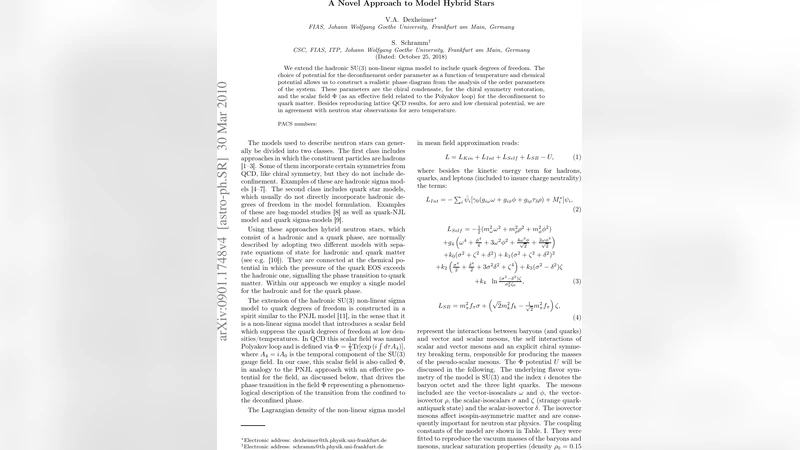
We extend the hadronic SU(3) non-linear sigma model to include quark degrees of freedom. The choice of potential for the Polyakov loop as a function of temperature and chemical potential allows us to construct a realistic phase diagram from the analysis of the order parameters of the system. These parameters are the chiral condensate, for the chiral symmetry restoration and the Polyakov loop, for the deconfinement to quark matter. Besides reproducing lattice QCD results, for zero and low chemical potential, we are in agreement with neutron star observations for zero temperature.
💡 Research Summary
The paper presents a unified theoretical framework that extends the well‑established SU(3) non‑linear sigma model of hadronic matter to explicitly include quark degrees of freedom, thereby enabling a consistent description of hybrid stars—compact objects whose interiors contain both nucleonic (hadronic) and deconfined quark phases. The authors achieve this by introducing the Polyakov loop variable Φ as an order parameter for color confinement and by constructing a temperature (T) and baryon chemical potential (μ) dependent Polyakov‑loop potential U(Φ,T,μ). This potential is calibrated against lattice QCD thermodynamics at low μ, ensuring that the model reproduces the correct equation of state (EOS) in the regime where first‑principles calculations are reliable.
In the mean‑field approximation, the Lagrangian contains the usual scalar (σ, ζ) and vector (ω, ρ, φ) mesons that mediate interactions among the baryon octet, while quarks (up, down, strange) couple to the same mesons via Yukawa terms. The effective thermodynamic potential Ω(T,μ;σ,ζ,Φ) is then minimized with respect to the three mean fields, yielding coupled gap equations that determine the chiral condensate σ (the order parameter for chiral symmetry restoration) and the Polyakov loop Φ (the order parameter for deconfinement). By solving these equations across a wide range of T and μ, the authors map out the phase diagram in the temperature–chemical‑potential plane. The resulting diagram displays a first‑order chiral/deconfinement transition line at low temperature and high density, terminating at a critical end point (CEP) that aligns with lattice QCD predictions for μ≈0.
From the same thermodynamic potential the pressure‑energy density relation (the EOS) is extracted for zero temperature, which is the relevant regime for mature neutron stars. The EOS exhibits a smooth crossover from pure hadronic matter at low densities to a mixed phase and finally to a pure quark phase at densities of roughly 5–8 times nuclear saturation density. This behavior is fed into the Tolman‑Oppenheimer‑Volkoff (TOV) equations to compute stellar structure. The resulting mass–radius (M–R) curves show a maximum mass of about 2.1 M⊙ and radii in the 12–13 km range, comfortably satisfying the constraints from recent high‑precision pulsar mass measurements (e.g., PSR J0740+6620) and from the NICER X‑ray observations. Moreover, the central densities of the most massive configurations are high enough that Φ≈1, indicating that a deconfined quark core is present, thus confirming the hybrid‑star nature of the solutions.
Key contributions of the work include:
-
Unified Treatment of Chiral and Deconfinement Dynamics – By coupling the chiral condensate and the Polyakov loop within a single thermodynamic potential, the model captures both symmetry restorations simultaneously, a feature often missing in separate hadronic or quark‑only models.
-
μ‑Dependent Polyakov‑Loop Potential – The authors go beyond the usual μ‑independent parametrizations, introducing a functional form that remains consistent with lattice data at μ≈0 while providing a plausible extrapolation to the high‑density regime relevant for neutron stars.
-
Consistency with Astrophysical Observations – The EOS derived from the model yields M–R relations that respect the 2 M⊙ pulsar mass bound, the tidal‑deformability limits from the GW170817 binary neutron‑star merger, and the radius constraints from NICER, thereby demonstrating that the inclusion of quark degrees of freedom does not conflict with current observational data.
-
Predictive Phase Diagram – The calculated phase diagram predicts a first‑order transition line and a critical end point that could be probed by future heavy‑ion experiments (e.g., FAIR, NICA) and by multimessenger observations of neutron‑star mergers, offering a bridge between terrestrial QCD studies and astrophysical phenomena.
In summary, the paper delivers a robust, phenomenologically grounded model that successfully merges hadronic and quark physics, reproduces lattice QCD thermodynamics at low chemical potential, and yields an equation of state compatible with the most stringent neutron‑star observations. This work therefore represents a significant step toward a comprehensive understanding of the dense matter equation of state and the possible existence of quark cores inside massive neutron stars.
Comments & Academic Discussion
Loading comments...
Leave a Comment