Soft gamma repeaters (SGRs) have unique properties that make them intriguing targets for gravitational wave (GW) searches. They are nearby, their burst emission mechanism may involve neutron star crust fractures and excitation of quasi-normal modes, and they burst repeatedly and sometimes spectacularly. A recent LIGO search for transient GW from these sources placed upper limits on a set of almost 200 individual SGR bursts. These limits were within the theoretically predicted range of some models. We present a new search strategy which builds upon the method used there by "stacking" potential GW signals from multiple SGR bursts. We assume that variation in the time difference between burst electromagnetic emission and burst GW emission is small relative to the GW signal duration, and we time-align GW excess power time-frequency tilings containing individual burst triggers to their corresponding electromagnetic emissions. Using Monte Carlo simulations, we confirm that gains in GW energy sensitivity of N^{1/2} are possible, where N is the number of stacked SGR bursts. Estimated sensitivities for a mock search for gravitational waves from the 2006 March 29 storm from SGR 1900+14 are also presented, for two GW emission models, "fluence-weighted" and "flat" (unweighted).
Deep Dive into Stacking Gravitational Wave Signals from Soft Gamma Repeater Bursts.
Soft gamma repeaters (SGRs) have unique properties that make them intriguing targets for gravitational wave (GW) searches. They are nearby, their burst emission mechanism may involve neutron star crust fractures and excitation of quasi-normal modes, and they burst repeatedly and sometimes spectacularly. A recent LIGO search for transient GW from these sources placed upper limits on a set of almost 200 individual SGR bursts. These limits were within the theoretically predicted range of some models. We present a new search strategy which builds upon the method used there by “stacking” potential GW signals from multiple SGR bursts. We assume that variation in the time difference between burst electromagnetic emission and burst GW emission is small relative to the GW signal duration, and we time-align GW excess power time-frequency tilings containing individual burst triggers to their corresponding electromagnetic emissions. Using Monte Carlo simulations, we confirm that gains in GW energy
Soft gamma repeaters (SGRs) are promising potential sources of gravitational waves (GWs). They sporadically emit brief (≈ 0.1 s) intense bursts of soft gammarays with peak luminosities commonly up to 10 42 erg/s. Three of the five known galactic SGRs have produced rare "giant flare" events with initial bright, short (≈ 0.2 s) pulses followed by tails lasting minutes, with peak luminosities between 10 44 and 10 47 erg/s. According to the "magnetar" model SGRs are neutron stars with extreme magnetic fields ∼ 10 15 G [1]. Bursts may result from the interaction of the star's magnetic field with its solid crust, leading to crustal deformations and occasional catastrophic cracking [2][3][4] with subsequent excitation of nonradial star modes [5][6][7] and the emission of GWs [6][7][8][9]. For reviews, see [10,11].
The LIGO Scientific Collaboration recently completed a search for transient gravitational waves associated with almost 200 individual electromagnetic SGR triggers [12]. That search did not detect GW, but it explicitly targeted neutron star f -modes, placed the most stringent upper limits on transient gravitational wave amplitudes at the time it was published, and set isotropic emission energy upper limits that fell within the theoretically predicted range of some SGR models [7].
In this paper we extend that work and describe a new electromagnetically triggered search method for gravitational waves from multiple SGR bursts. Triggered grav- * peter.kalmus@ligo.org itational wave searches assume that gravitational waves associated with an electromagnetic astrophysical event would reach earth at approximately the same time as light from the event. In addition, source sky location is also known. Knowledge of time and sky position can be a great advantage to gravitational wave searches [13]. It allows us to calculate the detector response functions, allowing us to estimate more relevant upper limits on GW emission using simulated signals from the source. Also, upper limits are typically lower than for untriggered all-sky searches, largely because they are more robust to loud glitches. Finally, searches can target known astrophysical events. If the distance to the source is known, results can be given in terms of isotropic gravitational wave energy emitted from the source instead of strain amplitude at the detector. This ties the search to the astrophysical source instead of the detector on Earth. All of these advantages apply to searches for gravitational waves from SGR bursts.
The new analysis method described here, “Stack-aflare,” builds upon the analysis pipeline (“Flare pipeline”) used in [12] and described in [14,15] by attempting to “stack” potential gravitational wave signals from multiple SGR bursts. To stack N bursts, we first generate N excess power time-frequency tilings. These are 2dimensional matrices in time and frequency generated from the two detectors’ data streams. Each tiling element gives an excess power estimate in the GW detector data stream in a small period of time δt and a small range of frequency δf . The time range of each tiling is chosen to be centered on the time of one of the target EM bursts in the storm. We then align these N tilings along the time dimension so that times of the target EM bursts coincide, and perform a weighted addition according to a particular GW emission model.
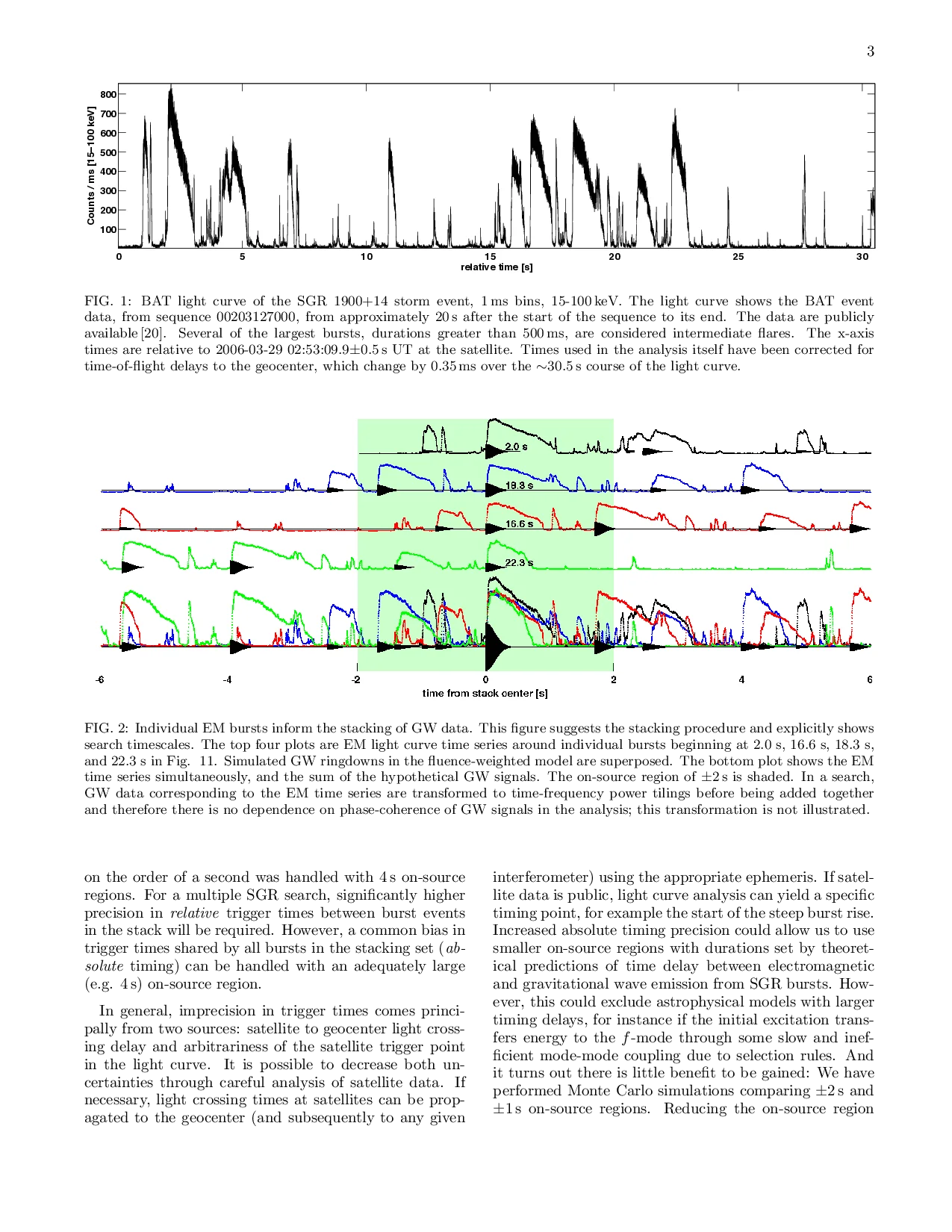
We hope to improve the search sensitivity by combining potential gravitational wave signals from separate bursts in an attempt to increase the signal-to-noise ratio, increasing the probability of detection and placing more stringent constraints on theoretical models via upper limits. We expect that this method would be suitable for performing searches using data from interferometric detectors such as LIGO’s, for gravitational waves associated with SGR storm events such as the 2006 March 29 SGR 1900+14 storm. Figure 1 shows the storm light curve obtained by the BAT detector aboard the Swift satellite [16], and Figure 2 illustrates the stacking procedure with the four most energetic bursts from the storm, showing the main search timescales.
This paper is organized as follows. In Section II we discuss the general strategy of multiple SGR burst searches. In Section III we describe two versions of the analysis method (“Stack-a-flare”), both of which are built upon the Flare pipeline. One version coherently stacks GW time series associated with electromagnetic bursts in the storm, while the other stacks incoherently. We characterize the two versions using simulations in gaussian noise, demonstrating the strengths and weaknesses of each and showing that relatively weak signals which could not be detected in the individual burst search can easily be detected with the new method. Gains in GW energy sensitivity of N 1/2 are feasible with the incoherent version even in the presence of realistic relative timing uncertainties between SGR bursts, where N is the number of stacked SGR bursts. Finally, in Section
…(Full text truncated)…
This content is AI-processed based on ArXiv data.