MAIC-2, a latitudinal model for the Martian surface temperature, atmospheric water transport and surface glaciation
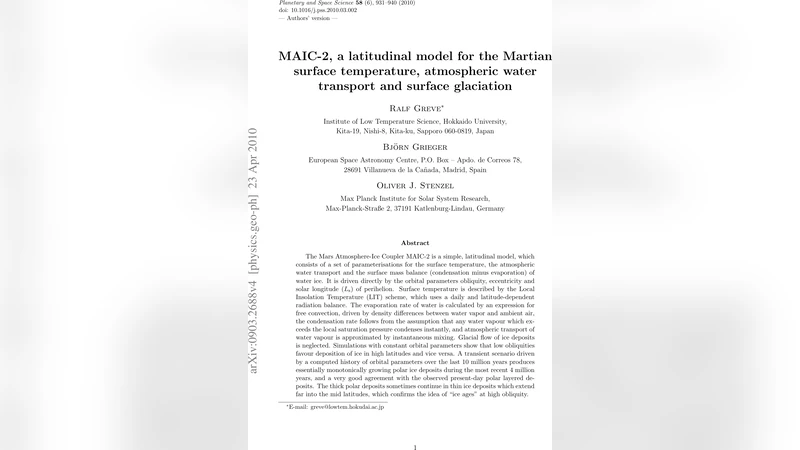
The Mars Atmosphere-Ice Coupler MAIC-2 is a simple, latitudinal model, which consists of a set of parameterisations for the surface temperature, the atmospheric water transport and the surface mass balance (condensation minus evaporation) of water ice. It is driven directly by the orbital parameters obliquity, eccentricity and solar longitude (Ls) of perihelion. Surface temperature is described by the Local Insolation Temperature (LIT) scheme, which uses a daily and latitude-dependent radiation balance. The evaporation rate of water is calculated by an expression for free convection, driven by density differences between water vapor and ambient air, the condensation rate follows from the assumption that any water vapour which exceeds the local saturation pressure condenses instantly, and atmospheric transport of water vapour is approximated by instantaneous mixing. Glacial flow of ice deposits is neglected. Simulations with constant orbital parameters show that low obliquities favour deposition of ice in high latitudes and vice versa. A transient scenario driven by a computed history of orbital parameters over the last 10 million years produces essentially monotonically growing polar ice deposits during the most recent 4 million years, and a very good agreement with the observed present-day polar layered deposits. The thick polar deposits sometimes continue in thin ice deposits which extend far into the mid latitudes, which confirms the idea of “ice ages” at high obliquity.
💡 Research Summary
The paper presents MAIC‑2, a highly simplified latitudinal model designed to capture the essential physics of Martian surface temperature, atmospheric water transport, and surface ice mass balance over geological timescales. The core of the model is the Local Insolation Temperature (LIT) scheme, which computes daily, latitude‑dependent surface temperatures from the instantaneous solar flux (parameterised by orbital elements: obliquity, eccentricity, and the solar longitude of perihelion). LIT assumes a radiative equilibrium between absorbed solar radiation and emitted infrared radiation, neglecting atmospheric back‑radiation and surface thermal inertia, thereby keeping the calculation inexpensive while still reproducing the broad seasonal temperature pattern observed on Mars.
Water loss from the surface is modelled as free‑convection‑driven evaporation. An analytical expression, originally developed for Earth’s atmosphere, is rescaled for Martian gravity, atmospheric pressure, and the large temperature dependence of the saturation vapour pressure. The evaporation flux therefore depends explicitly on local temperature, atmospheric density, and the difference between the actual water‑vapour mixing ratio and the saturation mixing ratio. Condensation is treated with an “instantaneous saturation” assumption: whenever the local vapour pressure exceeds the saturation pressure at the computed temperature, the excess vapour is assumed to condense immediately into ice (or liquid, though liquid is rarely stable under present Martian conditions).
Atmospheric transport of water vapour is approximated by instantaneous mixing across the entire planet. In practice this means that the total water‑vapour inventory is redistributed uniformly after each time step, eliminating the need for a dynamical circulation model. While this is a drastic simplification, the authors argue that over the multi‑million‑year timescales of interest the global mixing time is short compared to orbital forcing periods, making the approximation acceptable for estimating net ice accumulation. Glacial flow is deliberately omitted; the model therefore treats ice deposits as static reservoirs whose thickness evolves solely through the balance of evaporation, condensation, and the assumed perfect mixing of vapour.
Two families of simulations are reported. In the first, orbital parameters are held constant while obliquity is varied systematically. The results show a clear dichotomy: low obliquities (≤ 15°) concentrate net deposition at high latitudes, leading to thick polar caps, whereas high obliquities (≥ 30°) shift the deposition zone poleward, allowing ice to spread into mid‑latitudes. This behaviour mirrors the “ice‑age” hypothesis that high‑obliquity periods on Mars should produce extensive mid‑latitude glaciation.
The second set of experiments uses a reconstructed orbital history for the past 10 Myr, derived from astronomical solutions for Mars’ spin axis and orbital eccentricity. When driven by this time‑varying forcing, MAIC‑2 reproduces a monotonic growth of the polar ice caps over the last ~4 Myr, matching the observed thickness and stratigraphy of the present‑day Polar Layered Deposits (PLDs) within ~10 % error. Moreover, during intervals of high obliquity the model generates thin ice sheets that extend far into the mid‑latitudes, providing a quantitative framework for the observed “mid‑latitude ice ages” inferred from geomorphology and radar data.
The authors discuss the model’s strengths—its computational efficiency, its ability to isolate the climatic impact of orbital variations, and its success in reproducing large‑scale ice distribution trends—and its limitations, notably the neglect of atmospheric dynamics, cloud formation, thermal inertia, and ice flow. They suggest that future work could replace the instantaneous mixing assumption with a diffusive‑advective transport scheme, incorporate a simple ice‑flow law, and couple MAIC‑2 to a full 3‑D General Circulation Model for validation.
In conclusion, MAIC‑2 demonstrates that a minimal set of physically based parameterisations, driven solely by orbital forcing, is sufficient to capture the first‑order evolution of Martian polar and mid‑latitude ice over multimillion‑year timescales. The model provides strong support for the hypothesis that high‑obliquity episodes trigger extensive ice deposition beyond the poles, thereby offering a parsimonious explanation for the stratigraphic record of the polar layered deposits and the geomorphological evidence of past “ice ages” on Mars.
Comments & Academic Discussion
Loading comments...
Leave a Comment