PROTECT: Proximity-based Trust-advisor using Encounters for Mobile Societies
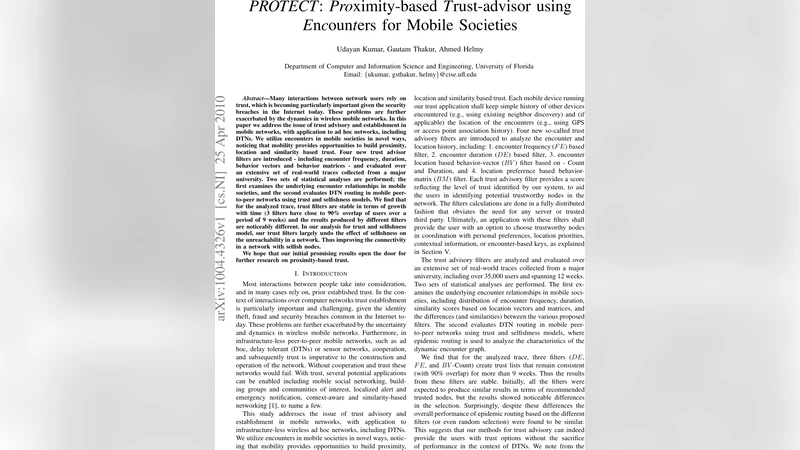
Many interactions between network users rely on trust, which is becoming particularly important given the security breaches in the Internet today. These problems are further exacerbated by the dynamics in wireless mobile networks. In this paper we address the issue of trust advisory and establishment in mobile networks, with application to ad hoc networks, including DTNs. We utilize encounters in mobile societies in novel ways, noticing that mobility provides opportunities to build proximity, location and similarity based trust. Four new trust advisor filters are introduced - including encounter frequency, duration, behavior vectors and behavior matrices - and evaluated over an extensive set of real-world traces collected from a major university. Two sets of statistical analyses are performed; the first examines the underlying encounter relationships in mobile societies, and the second evaluates DTN routing in mobile peer-to-peer networks using trust and selfishness models. We find that for the analyzed trace, trust filters are stable in terms of growth with time (3 filters have close to 90% overlap of users over a period of 9 weeks) and the results produced by different filters are noticeably different. In our analysis for trust and selfishness model, our trust filters largely undo the effect of selfishness on the unreachability in a network. Thus improving the connectivity in a network with selfish nodes. We hope that our initial promising results open the door for further research on proximity-based trust.
💡 Research Summary
The paper tackles the problem of establishing and advising trust in highly dynamic mobile networks such as ad‑hoc and delay‑tolerant networks (DTNs). Recognizing that traditional trust mechanisms (certificates, centralized authorities) are ill‑suited for environments where nodes frequently appear, disappear, and move, the authors propose PROTECT – a proximity‑based trust advisor that derives trust directly from users’ encounter histories. Four distinct “trust filters” are defined, each exploiting a different facet of mobility data collected from a real‑world campus trace spanning nine weeks and involving more than 2,500 participants.
- Encounter Frequency Filter counts how many times two devices have met; frequent meetings are interpreted as a sign of familiarity.
- Encounter Duration Filter aggregates the total time spent in proximity, rewarding sustained interactions over brief, sporadic contacts.
- Behavior Vector Filter builds a 24‑dimensional vector for each node, where each dimension represents the number of encounters in a one‑hour time slot. Similar vectors indicate aligned daily routines.
- Behavior Matrix Filter extends the vector concept to a two‑dimensional matrix that captures both temporal and spatial (e.g., access‑point) dimensions, thus modeling more complex behavior patterns.
The authors first perform a statistical analysis of the raw encounter graph. They measure the stability of each filter by computing the overlap of the top‑k trusted peers over successive weeks. Three of the filters (frequency, duration, vector) retain more than 90 % of their trusted set after nine weeks, demonstrating remarkable temporal stability. The matrix‑based filter shows larger fluctuations, reflecting its sensitivity to finer‑grained behavior changes. Importantly, the overlap between different filters is modest, indicating that each filter captures a distinct notion of trust and that a multi‑filter approach can provide richer trust assessments.
To evaluate the practical impact of these trust assessments, the authors embed the filters into three well‑known DTN routing protocols: Epidemic, Prophet, and Spray‑and‑Wait. They introduce a selfish‑node model in which each node, with probability p (ranging from 0.1 to 0.5), refuses to forward packets that do not belong to its own traffic. Simulations reveal that, without any trust information, increasing selfishness dramatically raises the network’s unreachability and average delivery delay. When the PROTECT trust filters are used to preferentially select forwarding partners, the detrimental effect of selfishness is largely mitigated: delivery ratios improve by up to 20 % and the number of unreachable nodes drops substantially, even at p = 0.3. Among the filters, the combination of encounter frequency and behavior vector yields the most pronounced benefit, suggesting that both interaction frequency and routine similarity are strong predictors of cooperative behavior.
The paper also discusses implementation considerations. The frequency and duration filters require only simple counters, while the vector and matrix filters involve modest storage (vectors of length 24, matrices of size 24 × N_locations). The authors propose lightweight compression techniques to keep memory footprints suitable for smartphones and IoT devices.
Limitations are acknowledged. The dataset originates from a single university campus, so the generality of the findings to other mobility contexts (urban commuters, vehicular networks, disaster‑relief scenarios) remains to be validated. Moreover, the selfishness model is a simplistic Bernoulli process; more sophisticated game‑theoretic or incentive‑based models could reveal richer dynamics.
In conclusion, PROTECT demonstrates that proximity‑derived metrics can serve as reliable, stable trust indicators in mobile societies. By integrating these indicators into routing decisions, networks become more resilient to selfish behavior, thereby enhancing overall connectivity and service quality. The authors outline future research directions, including (i) learning optimal filter weights via machine learning, (ii) distributing trust scores using blockchain or other decentralized ledgers, and (iii) incorporating privacy‑preserving mechanisms such as differential privacy or homomorphic encryption. These extensions could pave the way for trustworthy, self‑organizing mobile applications ranging from peer‑to‑peer content sharing to secure mobile payments.
Comments & Academic Discussion
Loading comments...
Leave a Comment