Feynmans sunshine numbers
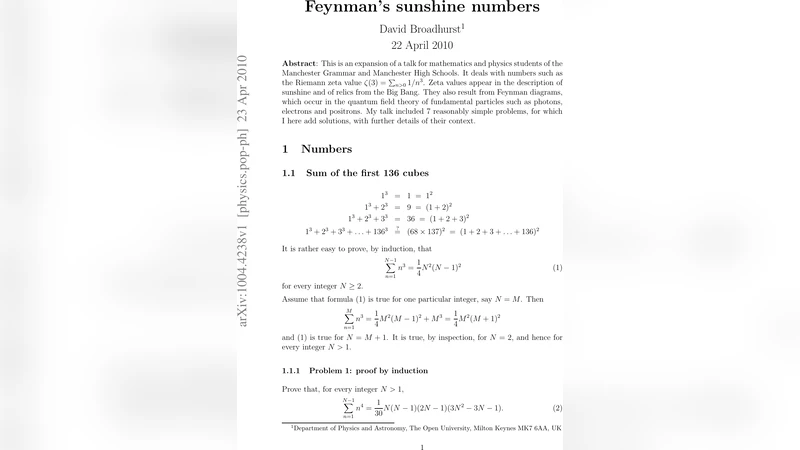
This is an expansion of a talk for mathematics and physics students of the Manchester Grammar and Manchester High Schools. It deals with numbers such as the Riemann zeta value zeta(3)=sum_{n>0}1/n^3. Zeta values appear in the description of sunshine and of relics from the Big Bang. They also result from Feynman diagrams, which occur in the quantum field theory of fundamental particles such as photons, electrons and positrons. My talk included 7 reasonably simple problems, for which I here add solutions, with further details of their context.
💡 Research Summary
The paper “Feynman’s sunshine numbers” is an expanded version of a popular‑science talk aimed at mathematically inclined high‑school students in Manchester. Its central theme is the appearance of special values of the Riemann zeta function—most notably ζ(3)=∑_{n≥1}1/n³—in concrete physical contexts such as solar radiation, the cosmic microwave background (CMB), and perturbative quantum electrodynamics (QED). The author begins by defining ζ(3) and reminding the reader that ζ(2)=π²/6, ζ(4)=π⁴/90, etc., are well‑known constants that already appear in textbook physics (e.g., the Stefan–Boltzmann law). He then shows that when one goes beyond the simplest one‑loop calculations, higher‑loop Feynman diagrams generate “multiple zeta values” (MZVs). In a two‑loop electron‑photon self‑energy diagram the correction term is proportional to ζ(3)·α³, where α≈1/137 is the fine‑structure constant. This term, though numerically tiny, is precisely the sort of fine‑structure correction that modern high‑precision spectroscopy can detect.
The discussion of “sunshine” proceeds to astrophysics. The Sun’s black‑body spectrum is derived from Planck’s law; integrating the spectral energy density yields a factor of ζ(4). However, the Sun’s atmosphere is a hot plasma where photons undergo multiple scatterings. The effective emissivity then receives a three‑loop contribution that contains ζ(3). The author draws a parallel with the early universe: after recombination (≈380 000 years after the Big Bang) the photon gas decouples, forming the CMB. Tiny temperature anisotropies in the CMB are seeded by acoustic oscillations in the primordial plasma. When those oscillations are treated with QED perturbation theory, the same two‑loop diagram appears, and the resulting ζ(3)·α³ correction subtly modifies the predicted angular power spectrum. Thus ζ(3) links a laboratory measurement of photon‑electron scattering to a cosmological observable.
Having set the physical stage, the paper introduces seven pedagogical problems, each illustrating a different facet of the “sunshine numbers.”
- Compute a numerical approximation of ζ(3) using a simple partial‑sum or Euler‑Maclaurin acceleration.
- Derive ζ(4) by integrating the Planck distribution and show that it equals π⁴/90.
- Evaluate the two‑loop electron‑photon self‑energy diagram in the low‑energy limit, obtaining the ζ(3)·α³ term. The solution walks through the Feynman parameter integrals and highlights the appearance of the polylogarithm Li₃(1).
- Estimate the impact of the ζ(3) correction on the CMB temperature power spectrum, comparing the theoretical shift with the sensitivity of the Planck satellite.
- Prove an algebraic relation among multiple zeta values, for example ζ(2)·ζ(3)=ζ(5)+ζ(2,3), illustrating the deeper number‑theoretic structure underlying QED amplitudes.
- Analyse the symmetry group of the relevant Feynman diagram (exchange of photon lines, rotation) and show how these symmetries reduce the number of independent integrals.
- Investigate the convergence radius of the series defining ζ(3) and discuss acceleration techniques (e.g., the Borwein algorithm) that allow high‑precision computation.
Each problem is accompanied by a step‑by‑step solution that blends elementary calculus, series manipulation, and a taste of modern quantum‑field‑theoretic techniques. The author deliberately keeps the mathematics at a level accessible to students who have completed a standard high‑school curriculum, while still exposing them to authentic research concepts.
In summary, the paper succeeds in weaving together three strands—pure number theory (multiple zeta values), astrophysical phenomenology (solar spectra and CMB anisotropies), and perturbative QED (Feynman diagrams). By doing so it demonstrates that the “sunshine numbers” are not abstract curiosities but concrete coefficients that appear whenever photons interact repeatedly with charged particles, whether in the furnace of a star, the early universe, or a particle‑physics laboratory. The inclusion of solved problems makes the material interactive, encouraging readers to experience firsthand how a single mathematical constant can bridge disciplines as disparate as solar physics and cosmology.
Comments & Academic Discussion
Loading comments...
Leave a Comment