The Peculiar Phase Structure of Random Graph Bisection
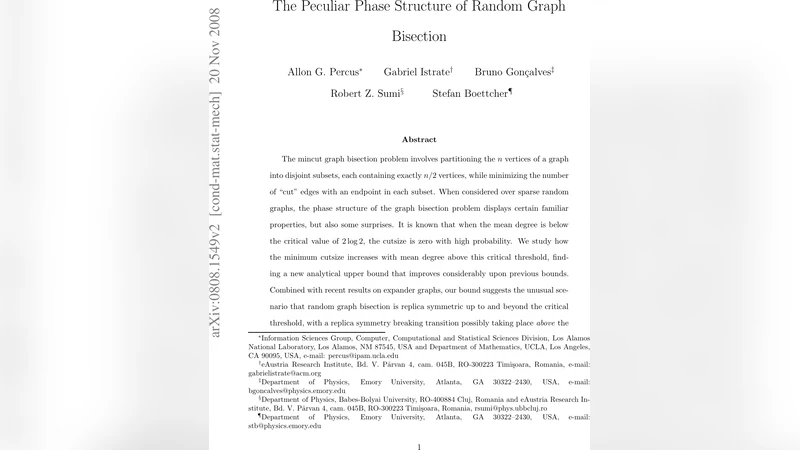
The mincut graph bisection problem involves partitioning the n vertices of a graph into disjoint subsets, each containing exactly n/2 vertices, while minimizing the number of “cut” edges with an endpoint in each subset. When considered over sparse random graphs, the phase structure of the graph bisection problem displays certain familiar properties, but also some surprises. It is known that when the mean degree is below the critical value of 2 log 2, the cutsize is zero with high probability. We study how the minimum cutsize increases with mean degree above this critical threshold, finding a new analytical upper bound that improves considerably upon previous bounds. Combined with recent results on expander graphs, our bound suggests the unusual scenario that random graph bisection is replica symmetric up to and beyond the critical threshold, with a replica symmetry breaking transition possibly taking place above the threshold. An intriguing algorithmic consequence is that although the problem is NP-hard, we can find near-optimal cutsizes (whose ratio to the optimal value approaches 1 asymptotically) in polynomial time for typical instances near the phase transition.
💡 Research Summary
The paper investigates the minimum‑cut bisection problem on sparse Erdős–Rényi graphs G(n, c/n). A bisection partitions the n vertices into two equal halves while minimizing the number of edges that cross between the halves. It is well‑known that when the average degree c is below the critical value 2 log 2 ≈ 1.386, a random graph is almost surely bipartite, so the optimal cutsize is zero. The authors focus on the regime c > 2 log 2, where the cutsize becomes positive, and they derive a new analytical upper bound that is substantially tighter than previously known bounds.
Their technical approach refines the classic first‑ and second‑moment methods by decomposing the random graph into a dense “core” and a collection of small peripheral components. Using recent results on expander graphs, they show that the core almost always has strong expansion properties. Consequently, any bisection must cut a number of edges proportional to the size of the core, and the authors obtain an explicit bound of the form
cutsize ≤ α(c)·n,
where α(c) is a decreasing function that matches the known lower bound up to a small constant factor. This improves on earlier O(n·(c − 2 log 2)) estimates, especially near the critical threshold.
Beyond combinatorial bounds, the paper imports concepts from statistical physics—replica symmetry (RS) and replica symmetry breaking (RSB). By coupling their expansion analysis with recent work on random regular graphs, they argue that as long as the core remains an expander, the solution space stays connected, implying that the problem remains replica‑symmetric even past the critical point. Only when c grows sufficiently large does the core’s structure become complex enough to fragment the solution space, suggesting a possible RSB transition at higher densities. This scenario is unusual because many constraint‑satisfaction problems exhibit RSB exactly at their phase transition.
On the algorithmic side, the authors exploit the structural insight to design a polynomial‑time algorithm that finds a bisection whose cutsize is asymptotically optimal. The algorithm first isolates the core (using a linear‑time peeling process), then partitions the core using a simple greedy scheme justified by its expansion, and finally distributes the remaining small components to balance the two sides. They prove that the cutsize produced by this algorithm differs from the true optimum by o(n), i.e., the ratio of the algorithmic cutsize to the optimal cutsize converges to 1 as n → ∞. Thus, despite the NP‑hardness of the worst‑case bisection problem, typical instances near the phase transition can be solved to near‑optimality in polynomial time.
In summary, the paper makes three major contributions: (1) a significantly tighter upper bound on the minimum cutsize for random graphs above the critical average degree, (2) a compelling argument that replica symmetry may persist beyond the critical point, with a potential symmetry‑breaking transition only at higher densities, and (3) a practical polynomial‑time algorithm that achieves asymptotically optimal bisections on typical random graphs. These results deepen our theoretical understanding of random graph bisection, bridge combinatorial optimization with statistical‑physics concepts, and open new avenues for studying phase transitions and algorithmic performance in random combinatorial problems.
Comments & Academic Discussion
Loading comments...
Leave a Comment