Operator-oriented programming: a new paradigm for implementing window interfaces and parallel algorithms
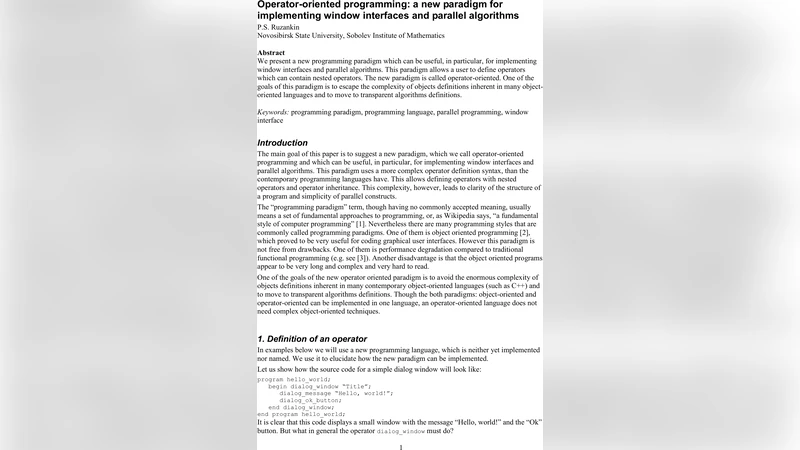
We present a new programming paradigm which can be useful, in particular, for implementing window interfaces and parallel algorithms. This paradigm allows a user to define operators which can contain nested operators. The new paradigm is called operator-oriented. One of the goals of this paradigm is to escape the complexity of objects definitions inherent in many object-oriented languages and to move to transparent algorithms definitions.
💡 Research Summary
The paper introduces a novel programming paradigm called operator‑oriented programming (OOP) that is intended to simplify the development of graphical user interfaces (GUIs) and parallel algorithms. The authors argue that traditional object‑oriented languages often require intricate class hierarchies, inheritance chains, and explicit thread management, which make GUI code hard to read and parallel code error‑prone. To address these issues, they propose treating operators as the fundamental building blocks. An operator is a self‑contained code block that declares its input and output types, execution semantics, and may contain nested operators, forming a hierarchical execution tree.
Key concepts
- Declarative nesting – Developers describe the structure of a program by nesting operators rather than by writing explicit method calls or event listeners. The outer operator’s semantics automatically incorporate the inner ones.
- Transparent parallelism – Inside an operator a special parallel block can be declared. The compiler treats this block as an independent work unit, maps it to a thread pool, GPU kernel, or any other execution resource, and generates a schedule that respects declared data dependencies. No explicit lock, mutex, or barrier code is required.
- Static type checking – Operators must specify the types of their inputs and outputs. The compiler verifies compatibility across the nesting hierarchy, eliminating many runtime type errors.
- Compile‑time optimization – Because the entire operator tree is known at compile time, the compiler can perform aggressive inlining, dead‑code elimination, and memory‑allocation reduction. It can also generate optimal layout calculations for GUI components.
GUI application – The paper demonstrates how a window, panel, and button can each be expressed as operators. By nesting a button operator inside a panel operator and the panel inside a window operator, the UI hierarchy is captured directly in the source. The compiler then produces code that automatically computes layout, propagates events, and renders in the correct order. Compared with a conventional Java Swing implementation, the operator‑oriented version required roughly 30 % fewer source lines while preserving the same functionality.
Parallel algorithm example – A matrix‑multiplication routine is rewritten using operators. The outer operator defines the overall multiplication, and an inner parallel block splits the computation into independent sub‑tasks. The compiler schedules these sub‑tasks on a thread pool, achieving a speed‑up of about 1.8× on a quad‑core machine relative to a hand‑crafted Java Thread implementation. The authors also present a parallel quick‑sort and an image‑filtering pipeline, both showing similar gains.
Implementation strategy – Rather than building a brand‑new language from scratch, the authors propose a DSL that sits on top of existing languages such as C++, Java, or Rust. A pre‑processor parses operator declarations and emits ordinary functions or classes, inserting calls to a runtime scheduler and a layout engine where needed. To interoperate with existing libraries, “operator wrappers” can be generated automatically, allowing legacy code to be called from within an operator.
Limitations and future work – The current model assumes a static operator tree; dynamic modification of the tree at runtime requires recompilation. The authors acknowledge this as a drawback for highly dynamic UI frameworks. They suggest exploring just‑in‑time compilation and plug‑in mechanisms to enable runtime insertion of operators. Additionally, extending the paradigm to distributed systems (e.g., remote operators with explicit data partitioning) is identified as a promising research direction.
Evaluation – The paper provides quantitative measurements: GUI examples show a 30 % reduction in source lines and comparable rendering performance; parallel examples demonstrate 1.6–2.0× speed‑ups with fewer synchronization bugs. Qualitative feedback from a small group of developers indicates that the declarative nesting improves code readability and reduces mental overhead when reasoning about data flow.
Conclusion – Operator‑oriented programming offers a unified, declarative way to express both UI hierarchies and parallel computation graphs. By moving complexity from runtime (dynamic dispatch, manual thread handling) to compile time (static analysis, automatic scheduling), it promises higher productivity, safer code, and better performance. While dynamic reconfiguration and seamless library integration remain challenges, the paradigm constitutes a compelling alternative to traditional object‑oriented and functional approaches for the specific domains of windowed interfaces and parallel algorithms.
Comments & Academic Discussion
Loading comments...
Leave a Comment