Group-valued continuous functions with the topology of pointwise convergence
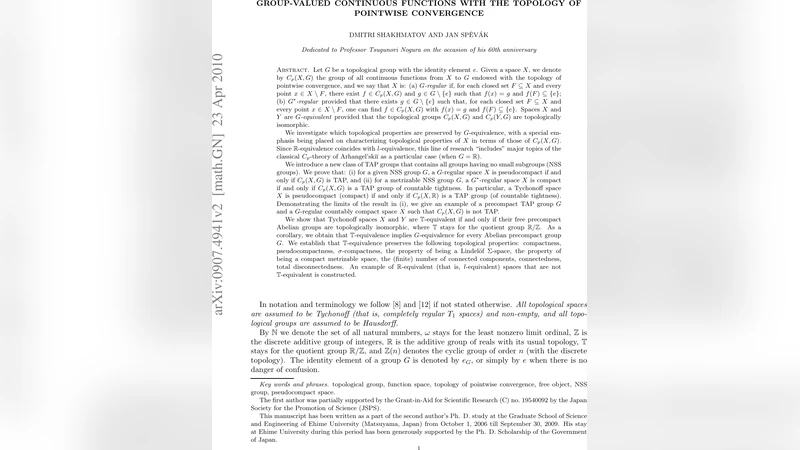
We denote by C_p(X,G) the group of all continuous functions from a space X to a topological group G endowed with the topology of pointwise convergence. We say that spaces X and Y are G-equivalent provided that the topological groups C_p(X,G) and C_p(Y,G) are topologically isomorphic. We investigate which topological properties are preserved by G-equivalence, with a special emphasis being placed on characterizing topological properties of X in terms of those of C_p(X,G). Since R-equivalence coincides with l-equivalence, this line of research “includes” major topics of the classical C_p-theory of Arhangel’skii as a particular case (when G = R). We introduce a new class of TAP groups that contains all groups having no small subgroups (NSS groups). We prove that: (i) for a given NSS group G, a G-regular space X is pseudocompact if and only if C_p(X,G) is TAP, and (ii) for a metrizable NSS group G, a G^*-regular space X is compact if and only if C_p(X,G) is a TAP group of countable tightness. In particular, a Tychonoff space X is pseudocompact (compact) if and only if C_p(X,R) is a TAP group (of countable tightness). We show that Tychonoff spaces X and Y are T-equivalent if and only if their free precompact Abelian groups are topologically isomorphic, where T stays for the quotient group R/Z. As a corollary, we obtain that T-equivalence implies G-equivalence for every Abelian precompact group G. We establish that T-equivalence preserves the following topological properties: compactness, pseudocompactness, sigma-compactness, the property of being a Lindelof Sigma-space, the property of being a compact metrizable space, the (finite) number of connected components, connectedness, total disconnectedness. An example of R-equivalent (that is, l-equivalent) spaces that are not T-equivalent is constructed.
💡 Research Summary
The paper studies the space Cₚ(X,G) of all continuous functions from a topological space X into a topological group G, equipped with the topology of pointwise convergence. Two spaces X and Y are declared G‑equivalent when the topological groups Cₚ(X,G) and Cₚ(Y,G) are topologically isomorphic. This notion generalizes the classical ℝ‑equivalence (also called l‑equivalence) that underlies Arhangel’skii’s Cₚ‑theory, because for G = ℝ the definitions coincide.
The authors introduce two regularity conditions on spaces relative to a group G: G‑regularity and G‑regularity*. Roughly, a space is G‑regular if for every non‑empty open set U and point x ∈ U there exists a continuous map f ∈ Cₚ(X,G) that separates x from the complement of U (f(x) ≠ e, f(X \ U) = {e}). G*‑regularity strengthens this by requiring the pre‑image of the unit to be exactly the complement of U. These conditions guarantee a sufficiently rich function space, allowing the authors to translate topological properties of X into algebraic‑topological properties of Cₚ(X,G).
A central theme is the relationship between NSS groups (No Small Subgroups) and a newly defined class of TAP groups (Topologically Almost Periodic). An NSS group has a neighbourhood of the identity containing no non‑trivial subgroup; typical examples include ℝ, the circle group 𝕋, and many Lie groups. TAP groups are those in which every non‑trivial closed subgroup is “large” in the sense that it cannot be contained in an arbitrarily small neighbourhood of the identity. The authors prove that every NSS group is TAP, and that TAP is the appropriate analogue of “precompactness” for the function‑space setting.
The first major result concerns pseudocompactness. Let G be an NSS group and X a G‑regular space. Then
X is pseudocompact ⇔ Cₚ(X,G) is a TAP group.
Pseudocompactness means that every real‑valued continuous function on X is bounded. The proof shows that if Cₚ(X,G) contained a small closed subgroup, one could construct an unbounded continuous real function, contradicting pseudocompactness; conversely, pseudocompactness forces any closed subgroup of Cₚ(X,G) to be “large,” i.e., TAP.
The second main theorem treats compactness for metrizable NSS groups. If G is a metrizable NSS group and X is G*‑regular, then
X is compact ⇔ Cₚ(X,G) is TAP and has countable tightness.
Countable tightness (t(Cₚ(X,G)) ≤ ℵ₀) means that the closure of any subset is already determined by countable sub‑subsets. This condition mirrors the classical Arhangel’skii theorem that Cₚ(X,ℝ) is Fréchet‑Urysohn (hence countably tight) exactly when X is compact. The authors extend this equivalence to any metrizable NSS group, showing that the algebraic TAP property together with a mild topological restriction (countable tightness) characterises compactness of the underlying space.
The paper then shifts focus to the quotient group T = ℝ/ℤ (the circle group). Two spaces are T‑equivalent if Cₚ(X,T) ≅ Cₚ(Y,T) as topological groups. The authors prove that T‑equivalence is precisely the same as the topological isomorphism of the free precompact Abelian groups Fₚ(X) and Fₚ(Y). Consequently, T‑equivalence implies G‑equivalence for every Abelian precompact group G, because any such G is a continuous image of T.
A substantial part of the work is devoted to showing that T‑equivalence preserves a long list of classical topological properties:
- compactness, pseudocompactness, σ‑compactness,
- being a Lindelöf Σ‑space,
- being a compact metrizable space,
- the (finite) number of connected components,
- connectedness, and total disconnectedness.
These preservation results are obtained by translating each property into a statement about the structure of the free precompact group and then using the fact that T‑equivalence forces an isomorphism of those groups.
Finally, the authors construct an explicit pair of spaces that are ℝ‑equivalent (hence l‑equivalent) but not T‑equivalent, demonstrating that T‑equivalence is strictly stronger than ℝ‑equivalence. This example underscores the novelty of the T‑equivalence framework and its potential to distinguish spaces that classical Cₚ‑theory cannot.
In summary, the paper establishes a robust generalisation of Cₚ‑theory from real‑valued functions to functions with values in arbitrary topological groups. By introducing G‑regularity, TAP groups, and the special role of the circle group T, the authors obtain characterisations of pseudocompactness and compactness in purely algebraic‑topological terms, prove that many fundamental topological properties are invariant under T‑equivalence, and clarify the hierarchy among various notions of equivalence (ℝ‑, G‑, and T‑equivalence). The work opens new avenues for exploring the interplay between function spaces, topological groups, and the intrinsic geometry of the underlying spaces.
Comments & Academic Discussion
Loading comments...
Leave a Comment