Stack semantics and the comparison of material and structural set theories
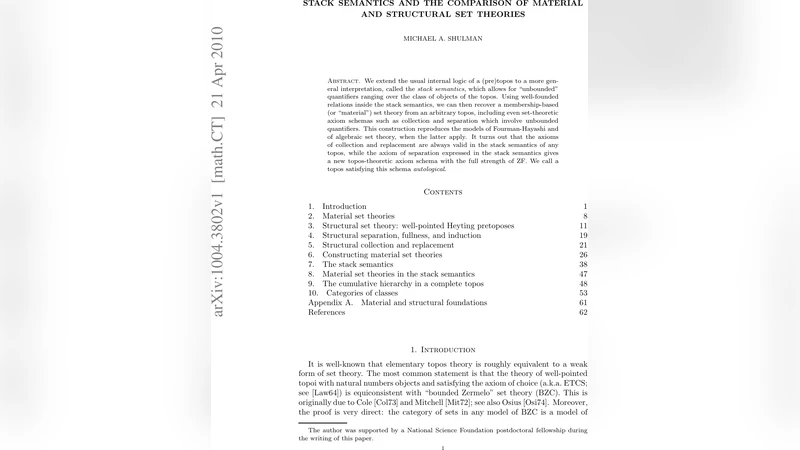
We extend the usual internal logic of a (pre)topos to a more general interpretation, called the stack semantics, which allows for “unbounded” quantifiers ranging over the class of objects of the topos. Using well-founded relations inside the stack semantics, we can then recover a membership-based (or “material”) set theory from an arbitrary topos, including even set-theoretic axiom schemas such as collection and separation which involve unbounded quantifiers. This construction reproduces the models of Fourman-Hayashi and of algebraic set theory, when the latter apply. It turns out that the axioms of collection and replacement are always valid in the stack semantics of any topos, while the axiom of separation expressed in the stack semantics gives a new topos-theoretic axiom schema with the full strength of ZF. We call a topos satisfying this schema “autological.”
💡 Research Summary
The paper introduces a novel interpretation of the internal logic of a (pre)topos called stack semantics, which extends the usual bounded quantifiers to unbounded quantifiers ranging over the entire class of objects of the topos. By treating the collection of objects as a “stack” and interpreting logical formulas on this stack, the authors obtain a semantics that can speak about all objects simultaneously, rather than being confined to subobjects.
A central technical device is the use of well‑founded relations inside the stack semantics. Such relations allow the definition of a membership predicate “∈” within the stack, thereby reconstructing a material (membership‑based) set theory inside any topos. With this machinery, the usual set‑theoretic axiom schemas—Collection, Replacement, and Separation—can be expressed and proved inside the topos. Notably, Collection and Replacement turn out to be automatically valid in the stack semantics of any topos, because the global quantifiers guarantee the existence of images of arbitrary functions and relations.
The treatment of Separation is more subtle. In ordinary internal logic, Separation is limited by bounded quantifiers and therefore weaker than the ZF Separation schema. In stack semantics, however, the unbounded quantifier permits a full‑strength Separation axiom that is equivalent in power to the ZF Separation schema. The authors isolate the resulting topos‑theoretic axiom schema and define a topos satisfying it as “autological.” An autological topos thus internalizes the entire ZF Separation principle, while already enjoying Collection and Replacement.
The framework subsumes two well‑known constructions. First, the Fourman‑Hayashi models, which build set‑theoretic universes inside certain complete Heyting algebras, appear as special cases when the underlying topos has the appropriate algebraic structure. Second, Algebraic Set Theory (AST), which uses small objects and covering morphisms to model set theory, is recovered when the AST axioms happen to hold; however, stack semantics does not require the small‑object axioms, making it strictly more general.
Beyond these technical achievements, the paper explores the meta‑theoretic significance of autological toposes. Because they validate the full ZF Separation schema, any autological topos can serve as a self‑contained model of ZF, with proofs carried out internally via stack semantics rather than externally. This suggests a deep unification: toposes are not merely categorical environments that can host set‑theoretic models; they can internalize material set theory in a way that matches the strength of classical ZF.
The authors conclude by outlining future directions: constructing explicit examples of autological toposes, investigating the interaction between autological toposes and traditional AST frameworks, and exploring whether additional set‑theoretic principles (e.g., Choice, Large Cardinals) can be captured within stack semantics. The work thus opens a promising avenue for bridging categorical logic and classical set theory, offering a robust, unified semantics that respects both structural and material perspectives.
Comments & Academic Discussion
Loading comments...
Leave a Comment