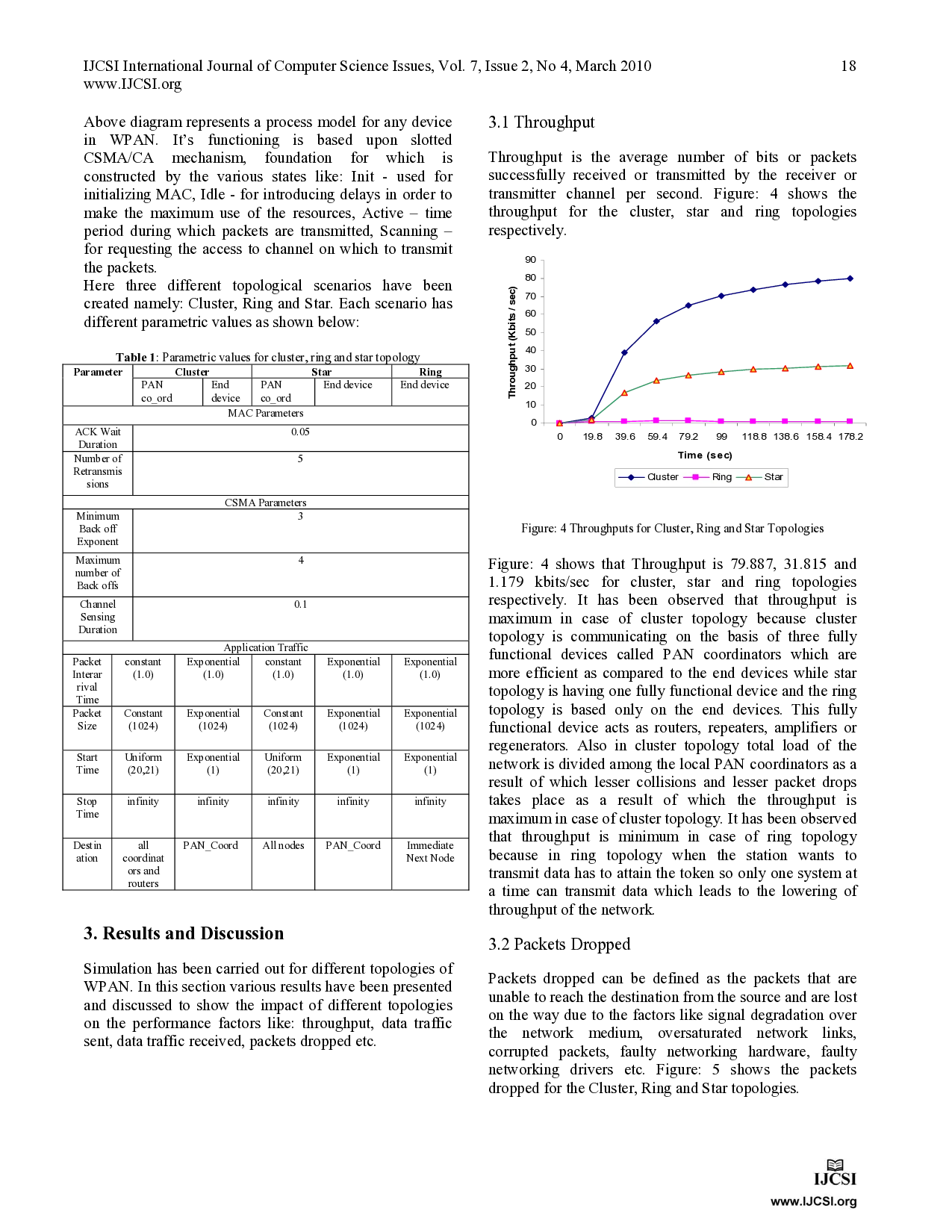
This paper investigates the performance of WPAN based on various topological scenarios like: cluster, star and ring. The comparative results have been reported for the performance metrics like: Throughput, Traffic sent, Traffic received and Packets dropped. Cluster topology is best in comparison with star and ring topologies as it has been shown that the throughput in case of cluster topology (79.887 kbits / sec) as compared to star (31.815 kbits / sec) and ring (1.179 kbits / sec).
Deep Dive into Comparative Performance Investigations of different scenarios for 802.15.4 WPAN.
This paper investigates the performance of WPAN based on various topological scenarios like: cluster, star and ring. The comparative results have been reported for the performance metrics like: Throughput, Traffic sent, Traffic received and Packets dropped. Cluster topology is best in comparison with star and ring topologies as it has been shown that the throughput in case of cluster topology (79.887 kbits / sec) as compared to star (31.815 kbits / sec) and ring (1.179 kbits / sec).
Brought up in 1990s, Wireless Personal Area Networks (WPANs) are the youngest members in the networking hierarchy. WPAN consists of number of nodes distributed in a given area, where a specific phenomenon must be measured and monitored. The construction of WPAN includes the physical deployment and the organization of its logical topology. In this framework, the formation of network topology is a research issue of increasing importance. Recently IEEE approved 802.15.4 standard defining the Medium Access Control sub layer (MAC) and the physical layer (PHY) for low-rate, Wireless Personal Area Networks (LR-WPAN). IEEE 802.15.4 devices typically operate in limited personal operating space.
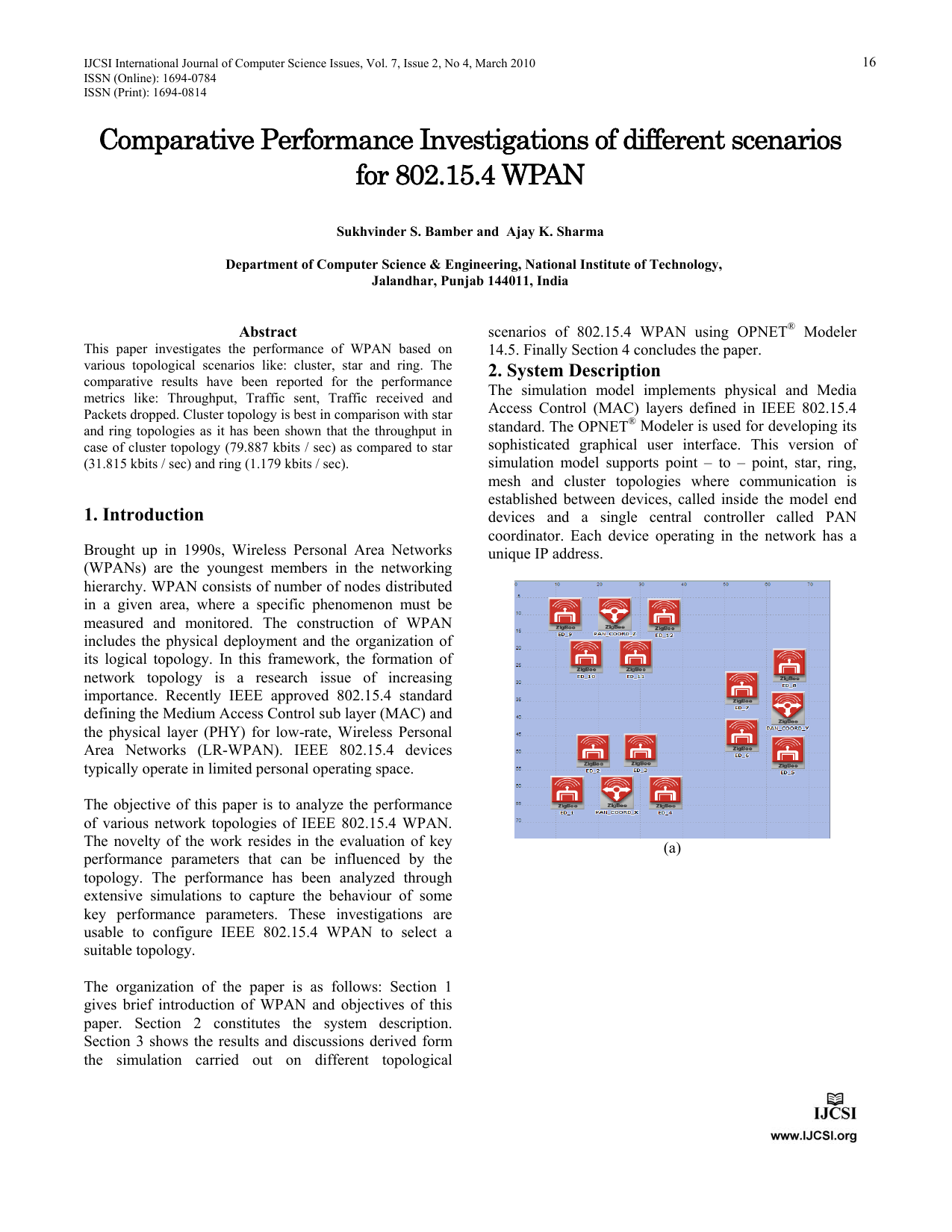
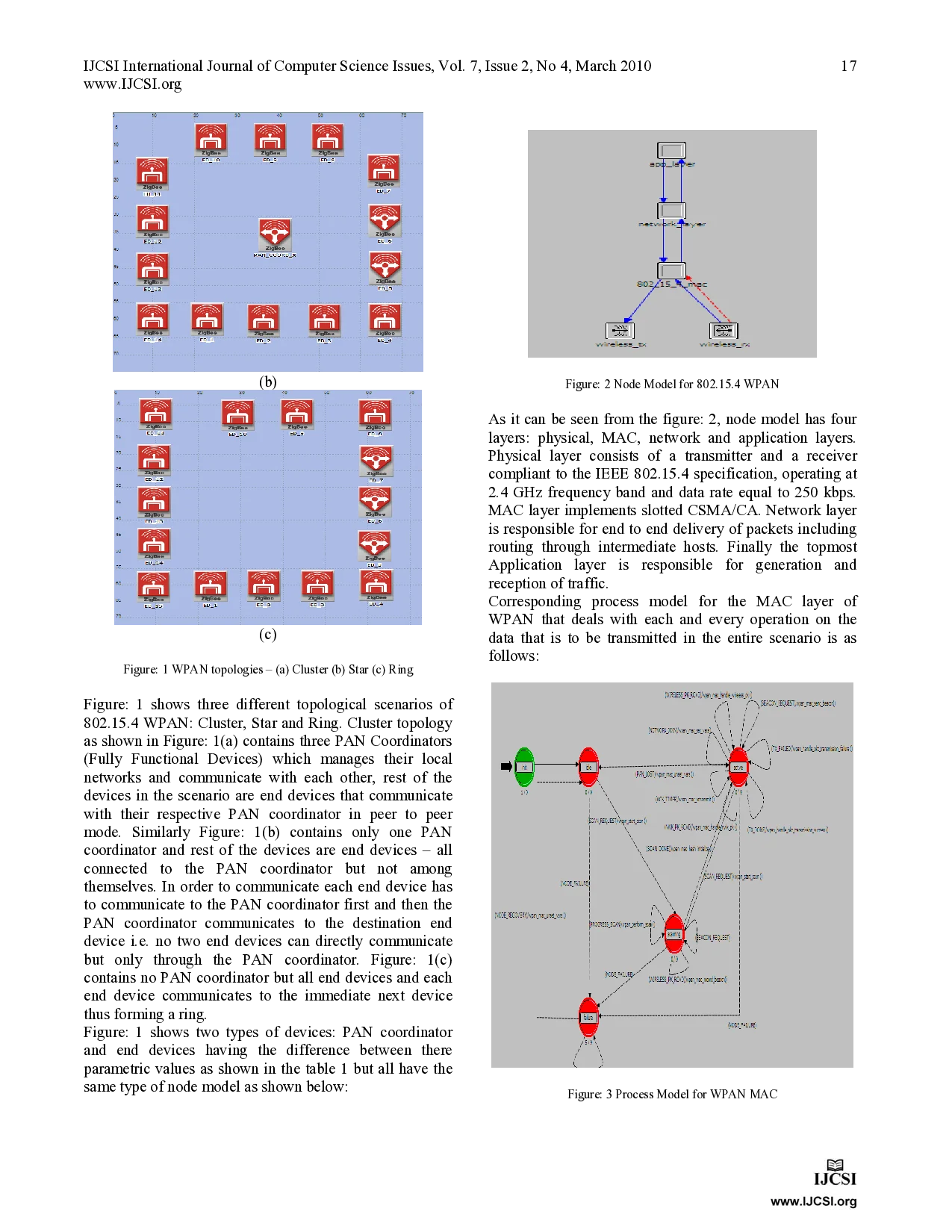
The objective of this paper is to analyze the performance of various network topologies of IEEE 802.15.4 WPAN. The novelty of the work resides in the evaluation of key performance parameters that can be influenced by the topology. The performance has been analyzed through extensive simulations to capture the behaviour of some key performance parameters. These investigations are usable to configure IEEE 802.15.4 WPAN to select a suitable topology.
The organization of the paper is as follows: Section 1 gives brief introduction of WPAN and objectives of this paper. Section 2 constitutes the system description. Section 3 shows the results and discussions derived form the simulation carried out on different topological scenarios of 802.15.4 WPAN using OPNET ® Modeler 14.5. Finally Section 4 concludes the paper. Corresponding process model for the MAC layer of WPAN that deals with each and every operation on the data that is to be transmitted in the entire scenario is as follows:
Simulation has been carried out for different topologies of WPAN. In this section various results have been presented and discussed to show the impact of different topologies on the performance factors like: throughput, data traffic sent, data traffic received, packets dropped etc.
Throughput is the average number of bits or packets successfully received or transmitted by the receiver or transmitter channel per second. 179 kbits/sec for cluster, star and ring topologies respectively. It has been observed that throughput is maximum in case of cluster topology because cluster topology is communicating on the basis of three fully functional devices called PAN coordinators which are more efficient as compared to the end devices while star topology is having one fully functional device and the ring topology is based only on the end devices. This fully functional device acts as routers, repeaters, amplifiers or regenerators. Also in cluster topology total load of the network is divided among the local PAN coordinators as a result of which lesser collisions and lesser packet drops takes place as a result of which the throughput is maximum in case of cluster topology. It has been observed that throughput is minimum in case of ring topology because in ring topology when the station wants to transmit data has to attain the token so only one system at a time can transmit data which leads to the lowering of throughput of the network.
Packets dropped can be defined as the packets that are unable to reach the destination from the source and are lost on the way due to the factors like signal degradation over the network medium, oversaturated network links, corrupted packets, faulty networking hardware, faulty networking drivers etc. .56 packets for ring, star and cluster topologies respectively. It has been observed that packets dropped are maximum in case of Ring topology because it works on the basis of token system i.e. only that system is allowed to transmit packets that is having the control of token, after the packet has been transmitted with IP address of the destination, the packets goes from one system to another system till the IP address matches and that particular system receives the packet, this is a bit time consuming process and leads to the increase of traffic in the network as a result of which the packets get lost in the network because of the oversaturated network links, collisions, delays etc.
Data traffic received can be defined as number of bits of the data received per unit time. Figure: 6 depict the data traffic received for the cluster, star and ring topologies respectively in WPAN. Also it is observed that data traffic received is minimum in case of ring topology as it makes use of all end devices and no PAN coordinator also it works on the basis of token system which leads to more collisions and packet losses which ultimately reduces traffic received.
It is also observed that packets dropped are minimum in case of cluster topology as the cluster topology is communicating through the PAN coordinators. Each PAN coordinator manages the data of its networks locally as a result of which lesser collisions take place while communicating. Also being fully functional devices they are better routers, regenerators of the data as compared to the
…(Full text truncated)…
This content is AI-processed based on ArXiv data.