Improved Inapproximability For Submodular Maximization
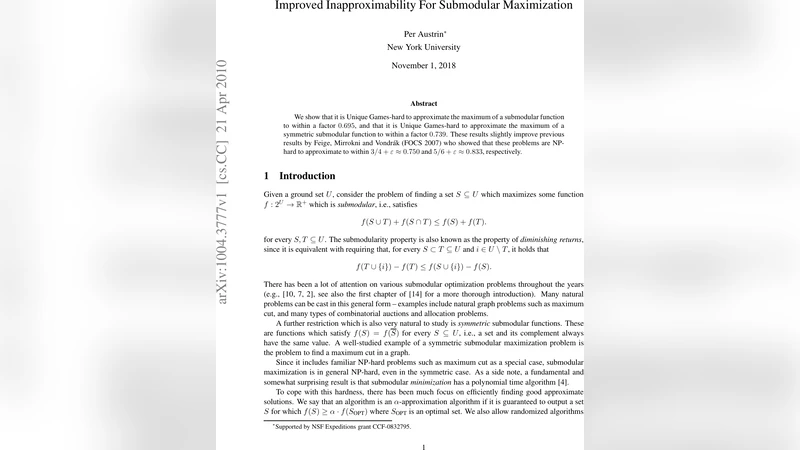
We show that it is Unique Games-hard to approximate the maximum of a submodular function to within a factor 0.695, and that it is Unique Games-hard to approximate the maximum of a symmetric submodular function to within a factor 0.739. These results slightly improve previous results by Feige, Mirrokni and Vondr'ak (FOCS 2007) who showed that these problems are NP-hard to approximate to within $3/4 + \epsilon \approx 0.750$ and $5/6 + \epsilon \approx 0.833$, respectively.
💡 Research Summary
The paper investigates the hardness of approximating the maximum of a submodular function and its symmetric variant, strengthening previous NP‑hardness results by leveraging the Unique Games Conjecture (UGC). The authors prove two main theorems: (1) it is UGC‑hard to approximate the optimum of a general submodular function within any factor better than 0.695, and (2) it is UGC‑hard to approximate the optimum of a symmetric submodular function within any factor better than 0.739. These constants improve upon the earlier bounds of 0.75 (for general submodular) and 0.833 (for symmetric submodular) established by Feige, Mirrokni, and Vondrák (FOCS 2007).
The technical approach follows a three‑step reduction. First, the authors construct a “dictatorship test” tailored to submodular functions. This test distinguishes between dictator assignments (functions depending on a single variable) and non‑dictator assignments, while preserving submodularity and creating a noticeable gap in expected objective values. Second, they embed this test into a gadget reduction that transforms an instance of a Unique Games problem into a submodular maximization instance. The reduction carefully maps variables and constraints to elements and weights of a submodular set function so that a satisfiable Unique Games instance yields a submodular instance with objective value close to 1, whereas any unsatisfiable instance forces the objective to be at most the target constant (0.695 or 0.739). Third, they analyze completeness and soundness. Completeness follows from the existence of a dictator assignment that achieves near‑optimal value. Soundness relies on Fourier analysis and Gaussian noise stability results (including Borell’s inequality) to bound the acceptance probability of any non‑dictator function, thereby establishing the desired approximation gap.
For the symmetric case, the reduction must respect the additional requirement that the function value be invariant under complementing the input set. The authors achieve this by employing pairwise‑independent distributions and constructing “balanced” gadgets that enforce symmetry while still enabling the same completeness‑soundness gap. This extra layer of construction makes the proof more intricate but is essential for handling symmetric submodular functions.
The paper contains no empirical experiments; all claims are proven theoretically. In the discussion, the authors note that while the constants 0.695 and 0.739 are the best known under UGC, they may not be optimal. They suggest that more refined dictatorship tests, alternative noise‑stability analyses, or reductions based on related conjectures (e.g., Small Set Expansion) could potentially raise these hardness thresholds. Moreover, they propose extending the framework to submodular functions with bounded curvature, partially symmetric functions, or functions defined on restricted matroid families as promising future directions.
Overall, the work provides a significant step forward in understanding the limits of approximation for submodular maximization. By upgrading NP‑hardness to Unique Games‑hardness and tightening the inapproximability factors, it sets a new benchmark for algorithm designers and deepens the theoretical connection between submodular optimization and hardness of approximation.
Comments & Academic Discussion
Loading comments...
Leave a Comment