Consensus over a Random Network Generated by i.i.d. Stochastic Matrices
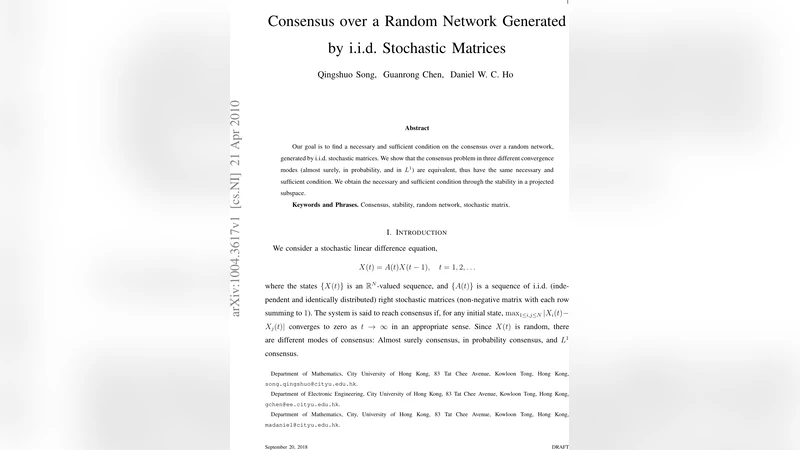
Our goal is to find a necessary and sufficient condition on the consensus over a random network, generated by i.i.d. stochastic matrices. We show that the consensus problem in three different convergence modes (almost surely, in probability, and in L1) are equivalent, thus have the same necessary and sufficient condition. We obtain the necessary and sufficient condition through the stability in a projected subspace.
💡 Research Summary
The paper investigates consensus formation in multi‑agent systems whose interaction topology changes randomly over time. At each discrete time step (t), the agents update their states according to a stochastic matrix (W(t)); the rows of (W(t)) are non‑negative and sum to one, so each agent computes a weighted average of its own state and those of its neighbors. Crucially, the sequence ({W(t)}_{t\ge0}) is assumed to be independent and identically distributed (i.i.d.), which is the only statistical assumption imposed on the network dynamics.
Three standard notions of convergence are considered: (i) almost‑sure (a.s.) convergence, meaning that for every pair of agents (i,j) the difference (x_i(t)-x_j(t)) tends to zero with probability one; (ii) convergence in probability, i.e., for any (\varepsilon>0) the probability that (|x_i(t)-x_j(t)|>\varepsilon) vanishes as (t\to\infty); and (iii) convergence in (L^1), i.e., (\mathbb{E}|x_i(t)-x_j(t)|\to0). The main theoretical contribution is to prove that these three modes are equivalent for the i.i.d. model, and that they share a single necessary and sufficient condition.
The analysis hinges on decomposing the state vector (x(t)) into the consensus subspace spanned by the all‑ones vector (\mathbf{1}) and its orthogonal complement (\mathcal{H}={v\in\mathbb{R}^n:\mathbf{1}^\top v=0}). Because each stochastic matrix preserves the average ((\mathbf{1}^\top W(t)=\mathbf{1}^\top)), the dynamics on the consensus subspace are trivial; the whole problem reduces to studying the evolution of the projected state (z(t)=P x(t)) where (P=I-\frac{1}{n}\mathbf{1}\mathbf{1}^\top) is the orthogonal projector onto (\mathcal{H}). The projected dynamics obey
\
Comments & Academic Discussion
Loading comments...
Leave a Comment