Finsler Black Holes Induced by Noncommutative Anholonomic Distributions in Einstein Gravity
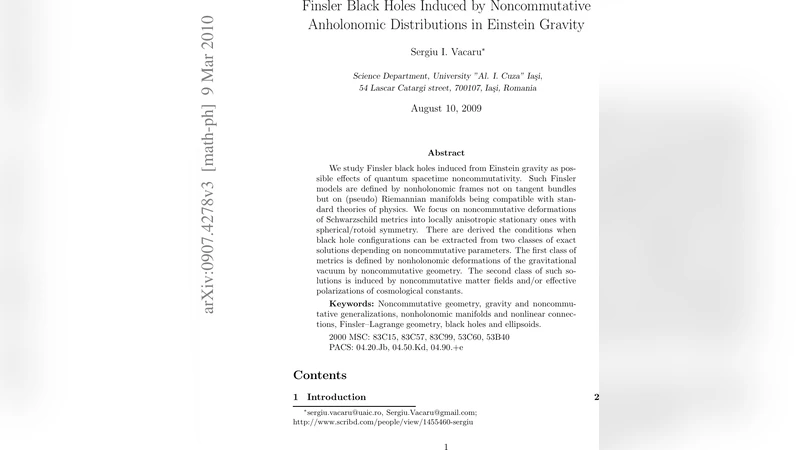
We study Finsler black holes induced from Einstein gravity as possible effects of quantum spacetime noncommutativity. Such Finsler models are defined by nonholonomic frames not on tangent bundles but on (pseudo) Riemannian manifolds being compatible with standard theories of physics. We focus on noncommutative deformations of Schwarzschild metrics into locally anisotropic stationary ones with spherical/rotoid symmetry. There are derived the conditions when black hole configurations can be extracted from two classes of exact solutions depending on noncommutative parameters. The first class of metrics is defined by nonholonomic deformations of the gravitational vacuum by noncommutative geometry. The second class of such solutions is induced by noncommutative matter fields and/or effective polarizations of cosmological constants.
💡 Research Summary
The paper investigates how noncommutative geometry, when combined with non‑holonomic (anholonomic) distributions, can generate Finsler‑like anisotropic black‑hole solutions within the framework of Einstein gravity. The authors start by introducing a noncommutative deformation of spacetime coordinates (
Comments & Academic Discussion
Loading comments...
Leave a Comment