It has recently been pointed out that particles falling freely from rest at infinity outside a Kerr black hole can in principle collide with arbitrarily high center of mass energy in the limiting case of maximal black hole spin. Here we aim to elucidate the mechanism for this fascinating result, and to point out its practical limitations, which imply that ultra-energetic collisions cannot occur near black holes in nature.
Deep Dive into Spinning Black Holes as Particle Accelerators.
It has recently been pointed out that particles falling freely from rest at infinity outside a Kerr black hole can in principle collide with arbitrarily high center of mass energy in the limiting case of maximal black hole spin. Here we aim to elucidate the mechanism for this fascinating result, and to point out its practical limitations, which imply that ultra-energetic collisions cannot occur near black holes in nature.
Bañados, Silk and West (BSW) [1] recently showed that particles falling freely from rest outside a Kerr black hole can collide with arbitrarily high center of mass energy in the limiting case of maximal black hole spin. They proposed that this might lead to signals from ultra high energy collisions, for example of dark matter particles. In this letter we aim to elucidate the mechanism for this result, and to point out its practical limitations given that extremal black holes do not exist in nature. In particular, we clarify why infinite collision energy can only be attained at the horizon, and with a maximally spinning black hole. We also show that the maximum center of mass energy grows very slowly as the black hole spin approaches its maximal value, so it will not be so high for astrophysical black holes. Finally we calculate the upper bound for the energy of the ejecta of the collision and find that to be only slightly above the mass of the particles, even in the extremal limit. We use units with G = c = M = 1, where M is the black hole mass, and metric signature (+---).
While one can theoretically extract 100% of the rest energy of a mass by lowering it into a nonrotating black hole, and one can extract even more energy using a Penrose process lowering it into a rotating black hole, neither of these possibilities suggests that just by falling in freely from far away, a pair of particles can experience an infinite collision energy in their center of mass frame. If this is indeed possible then although the debris would be redshifted on the way out, it might still reveal features of the S-matrix at arbitrarily high energies. This is surprising since one seems to get an infinite energy boost-despite conservation of energy-from the finite process of falling into the black hole. But this is a misconception, as we will explain, since it takes in fact an infinite time to access the infinite collision energy.
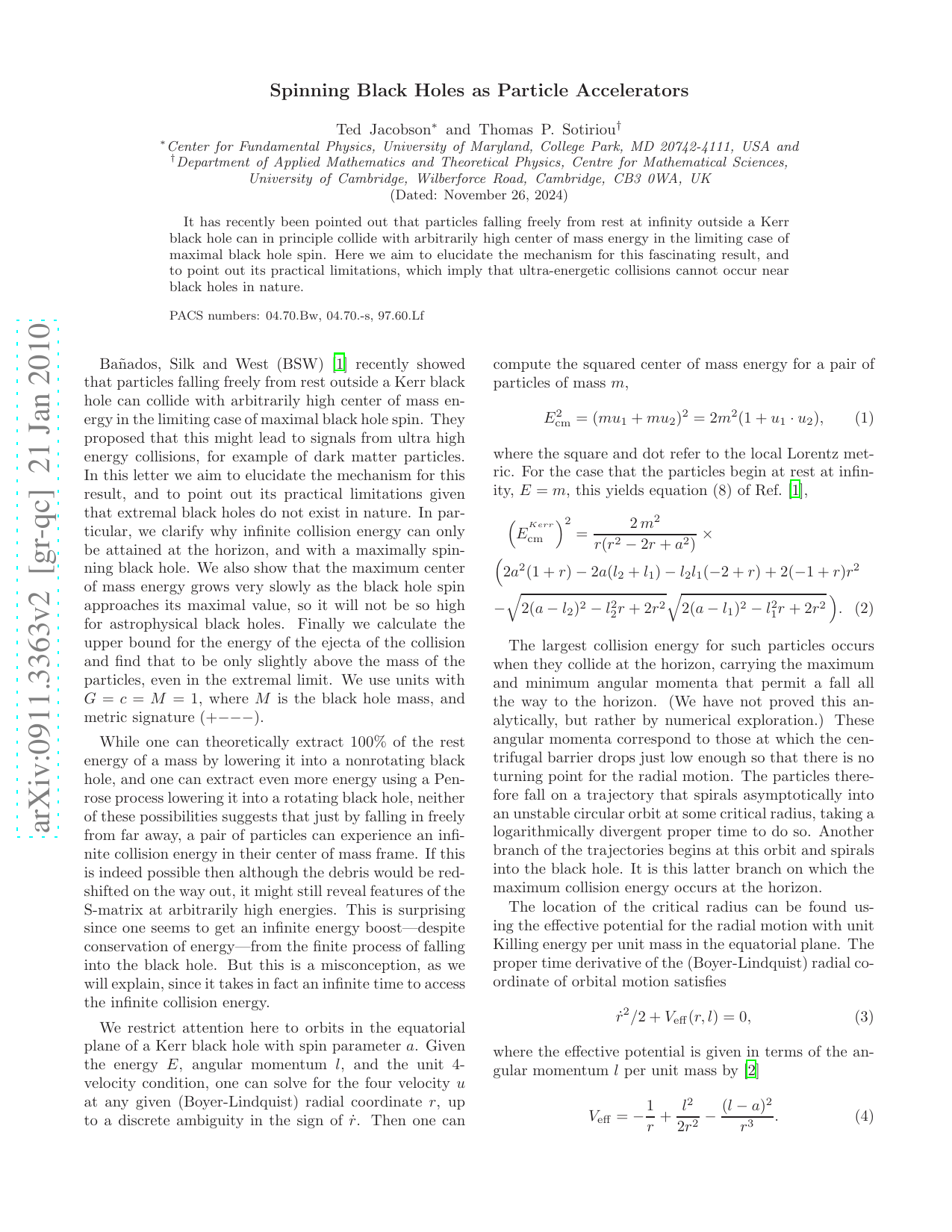
We restrict attention here to orbits in the equatorial plane of a Kerr black hole with spin parameter a. Given the energy E, angular momentum l, and the unit 4velocity condition, one can solve for the four velocity u at any given (Boyer-Lindquist) radial coordinate r, up to a discrete ambiguity in the sign of ṙ. Then one can compute the squared center of mass energy for a pair of particles of mass m,
where the square and dot refer to the local Lorentz metric. For the case that the particles begin at rest at infinity, E = m, this yields equation ( 8) of Ref. [1],
The largest collision energy for such particles occurs when they collide at the horizon, carrying the maximum and minimum angular momenta that permit a fall all the way to the horizon. (We have not proved this analytically, but rather by numerical exploration.) These angular momenta correspond to those at which the centrifugal barrier drops just low enough so that there is no turning point for the radial motion. The particles therefore fall on a trajectory that spirals asymptotically into an unstable circular orbit at some critical radius, taking a logarithmically divergent proper time to do so. Another branch of the trajectories begins at this orbit and spirals into the black hole. It is this latter branch on which the maximum collision energy occurs at the horizon.
The location of the critical radius can be found using the effective potential for the radial motion with unit Killing energy per unit mass in the equatorial plane. The proper time derivative of the (Boyer-Lindquist) radial coordinate of orbital motion satisfies
where the effective potential is given in terms of the angular momentum l per unit mass by [2] V
The critical point we are looking for is defined by
and is found to occur with angular momenta
and at radius
In the nonspinning case this yields l ± = ±4 and r ± = 4, which lies well-separated from the horizon. With these values, ( 2) gives E Kerr cm = 2 √ 2m, while at the horizon these same angular momenta give E Kerr cm = 2 √ 5m [3]. In the maximally spinning case it yields l ± = 2, 2(1 + √ 2) and r ± = 1, (3 + 2 √ 2). The horizon lies at
), so that in the extremal case a = 1, the critical radius r + = 1 coincides with the horizon.
In the maximally spinning case the corotating critical orbit is thus asymptotically tangent to the horizon. Its 4-velocity therefore tends to the null direction generating the horizon, since any other direction in the horizon is spacelike. In other words, the particle is moving at the speed of light, so the center of mass energy with any particle not on this horizon generator is infinite. This makes clear why infinite collision energy can only be attained at the horizon, and with a maximally spinning black hole. Since the particle never crosses the horizon, an infinite proper time passes for the particle as it spirals asymptotically onto the horizon. The nature of the divergence can be seen from the radial equation ṙ = -2V eff (r). At the critical orbit radius r ± the effective potential has
…(Full text truncated)…
This content is AI-processed based on ArXiv data.