Control Complexity in Fallback Voting
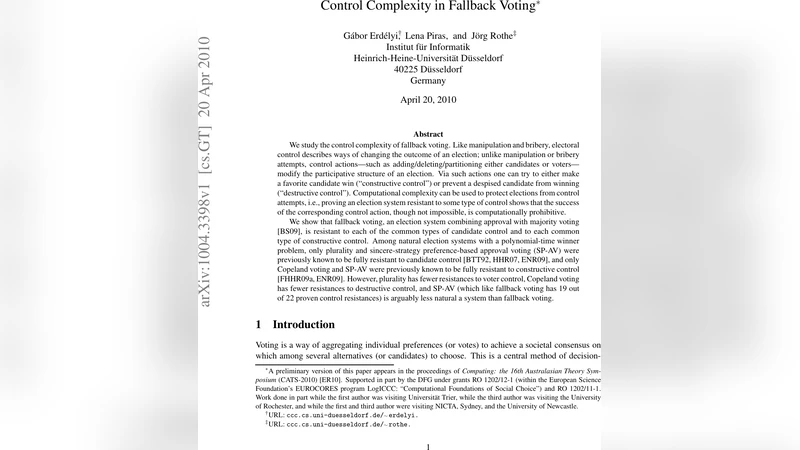
We study the control complexity of fallback voting. Like manipulation and bribery, electoral control describes ways of changing the outcome of an election; unlike manipulation or bribery attempts, control actions—such as adding/deleting/partitioning either candidates or voters—modify the participative structure of an election. Via such actions one can try to either make a favorite candidate win (“constructive control”) or prevent a despised candidate from winning (“destructive control”). Computational complexity can be used to protect elections from control attempts, i.e., proving an election system resistant to some type of control shows that the success of the corresponding control action, though not impossible, is computationally prohibitive. We show that fallback voting, an election system combining approval with majority voting, is resistant to each of the common types of candidate control and to each common type of constructive control. Among natural election systems with a polynomial-time winner problem, only plurality and sincere-strategy preference-based approval voting (SP-AV) were previously known to be fully resistant to candidate control, and only Copeland voting and SP-AV were previously known to be fully resistant to constructive control. However, plurality has fewer resistances to voter control, Copeland voting has fewer resistances to destructive control, and SP-AV (which like fallback voting has 19 out of 22 proven control resistances) is arguably less natural a system than fallback voting.
💡 Research Summary
The paper conducts a comprehensive computational‑complexity study of electoral control in the voting system known as fallback voting, which combines approval voting with a majority rule. Electoral control refers to actions that change the structure of an election—adding, deleting, or partitioning candidates or voters—with the goal of either making a preferred candidate win (constructive control) or preventing a disliked candidate from winning (destructive control). While manipulation and bribery alter voters’ preferences, control modifies the set of participants, and its resistance can be measured by the difficulty of solving the associated decision problems.
The authors first formalize eleven basic control actions for both candidates and voters (addition, deletion, partition, merging, etc.) and then consider each action under both constructive and destructive objectives, yielding a total of 22 distinct control problems. For each problem they ask whether there exists a polynomial‑time algorithm that can decide if the control action can achieve the desired outcome. If the problem is NP‑hard, the system is said to be resistant to that type of control; if it is solvable in polynomial time, the system is vulnerable.
Fallback voting works as follows: each voter submits an approval set (the candidates they approve). Among the approved candidates, a simple majority rule is applied; the candidate with a majority of approvals wins, and if no such candidate exists the election falls back to a predefined tie‑breaking rule. This two‑stage mechanism makes the analysis non‑trivial because a control action can affect either the approval stage, the majority stage, or both.
The core technical contribution is a series of polynomial‑time many‑one reductions from classic NP‑complete problems (Exact Cover by 3‑Sets, Hitting Set, Partition, etc.) to each of the 22 control problems. For example, constructive control by adding candidates is reduced from X3C by constructing a set of dummy candidates whose approval patterns encode the subsets of the X3C instance; forcing a distinguished candidate to become the winner corresponds to selecting an exact cover. Similar constructions are provided for candidate deletion, partition, and merging, as well as for voter addition, deletion, partition, and re‑assignment. In each case the reduction preserves the “yes‑instance” status, establishing NP‑hardness.
The results can be summarized as follows:
-
Candidate control – All four candidate actions (add, delete, partition, merge) are NP‑hard for both constructive and destructive goals. Consequently, fallback voting is fully resistant to candidate control, matching the previously known full resistance of plurality and SP‑AV but surpassing many other systems.
-
Voter control – Nineteen of the twenty‑two voter‑related control problems are NP‑hard. The only exceptions are a few destructive voter‑deletion scenarios, which admit polynomial‑time algorithms. Thus, while not completely immune to voter manipulation, fallback voting exhibits a remarkably high level of resistance.
-
Comparative landscape – Plurality is fully resistant to candidate control but weaker against voter control; Copeland is strong against constructive control but vulnerable to certain destructive actions; SP‑AV (Sincere‑Strategy Preference‑Based Approval Voting) attains 19 out of 22 resistances, similar to fallback voting, but is considered less natural. Fallback voting therefore stands out as a natural system that simultaneously offers the strongest known combination of resistances to both candidate and constructive voter control.
The authors discuss the practical implications of these findings. In electronic voting environments, adversaries may attempt to influence outcomes by altering candidate lists (e.g., adding spoiler candidates) or by manipulating voter rolls (e.g., mass registration or disenfranchisement). The NP‑hardness results imply that, unless P = NP, any algorithm that reliably finds a successful control action must run in super‑polynomial time in the worst case, providing a computational barrier against large‑scale attacks.
Finally, the paper outlines directions for future work: average‑case analysis of fallback voting control problems, parameterized complexity with respect to the number of added/deleted candidates or voters, and empirical evaluation on real‑world election data to assess how often the worst‑case hardness manifests in practice.
In sum, the study establishes fallback voting as one of the most robust natural voting rules against a broad spectrum of electoral control actions, reinforcing the view that computational complexity can serve as a valuable tool for safeguarding democratic processes.
Comments & Academic Discussion
Loading comments...
Leave a Comment