United sight to an algebraic operations and convergence
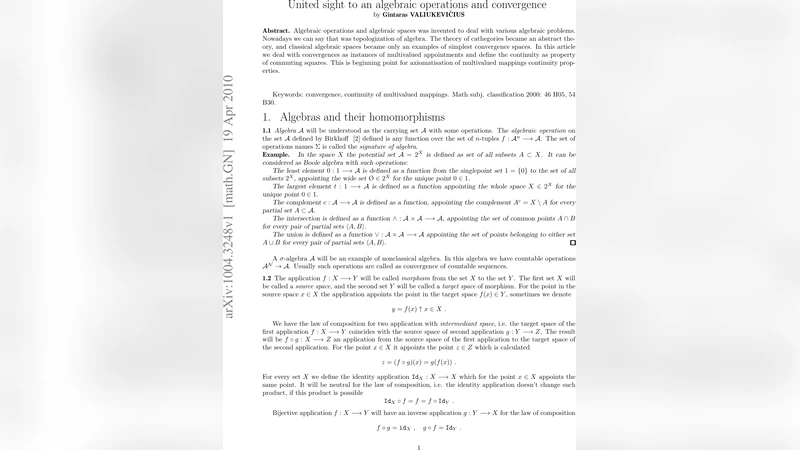
Algebraic operations are understood as topologiztion of algebra. They become an example of simplest convergence space. In our article the convergence is a arbitrary multivalued appointment. The continuity of some mapping between two convergence spaces is defined as a property of commuting squares. The adherence space is defined as a special convergence. The continuity in such spaces is understood as a local property, in contrary to the global continuity property in topological spaces. Possible bounded mappings in bornological spaces is also introduced, without deeper investigation. The local counterpart of bornological space is defined as proximity space. The new notions of continuity are non trivially also for a functional mappings, therefore they got their own names in English.
💡 Research Summary
The paper attempts to recast algebraic operations as a special case of convergence structures, thereby offering a unified perspective that goes beyond the classical topological treatment of algebraic maps. The author begins by redefining “convergence” in an extremely general way: a point may be assigned a multivalued set of possible limits, which the author calls an “arbitrary multivalued appointment.” This notion is meant to extend the familiar filter‑ or net‑based convergence of topology, allowing several simultaneous “limit candidates” for a single point.
With this generalized convergence in hand, the central definition of continuity is introduced. Instead of the usual global condition that the pre‑image of every open set is open (or equivalently that the image of every convergent filter is convergent), continuity is defined via the commutativity of a square diagram linking the convergence structures of the domain and codomain. Concretely, a map f : X → Y is continuous if, for every point x∈X, the multivalued convergence at x is carried by f into the multivalued convergence at f(x) in such a way that the diagram formed by the two convergence relations and f commutes. This formulation makes continuity a purely local property: it only concerns the behavior of the map in the infinitesimal neighborhoods determined by the convergence structure, not the global topology of the spaces.
The paper then introduces the concept of an “adherence space” as a particular instance of a convergence space. An adherence relation captures the idea that a point is “adherent” to a set, generalizing the closure operator of topology. By allowing multivalued limits, the adherence operator can assign a point to a set even when several distinct limit filters converge simultaneously, thereby providing a richer, more flexible closure‑like operation.
Next, the author turns to bornological spaces, which abstract the notion of boundedness. Rather than treating boundedness globally, the paper proposes a local counterpart called a “proximity space.” A proximity space is defined by a binary relation δ(A,B) indicating that two subsets A and B are “close.” This relation is weaker than a metric or a topology but is sufficient to describe how bounded sets interact locally. By coupling proximity with the previously defined convergence, the author obtains a notion of “local proximity continuity,” which requires that a map preserve the closeness of sets in the vicinity of each point.
Finally, the paper addresses functional mappings (i.e., maps between spaces of functions) and assigns them new continuity labels. For example, a map that preserves every multivalued convergent filter is termed “convergence‑preserving continuity,” while a map that respects the local proximity relation is called “local proximity continuity.” These names are deliberately distinct from classical terms such as uniform continuity or strong continuity, reflecting the author’s intention to build a fresh taxonomy based on the underlying convergence and proximity structures.
While the ideas are conceptually intriguing, the manuscript suffers from several serious shortcomings. The definition of “multivalued appointment” is left vague; it is unclear whether the author intends a family of filters, an ultrafilter system, or some novel multivalued filter construct. Consequently, readers cannot readily map the new definitions onto established frameworks in convergence theory. Moreover, the commutative‑square condition for continuity is presented without concrete examples or a proof of equivalence (or non‑equivalence) to classical continuity in familiar settings such as metric spaces. The lack of illustrative cases makes it difficult to assess the practical relevance of the proposed notions.
The treatment of adherence spaces also raises questions. Although the author claims that adherence generalizes closure, no axioms are provided to guarantee properties like idempotence, monotonicity, or preservation of finite unions—properties essential for a well‑behaved closure operator. Similarly, the transition from bornology to proximity is abrupt; the paper does not explain how a bornology induces a proximity relation, nor does it discuss the compatibility conditions required for the two structures to coexist coherently.
From a categorical perspective, the paper hints at a possible enrichment of the category of convergence spaces but stops short of formalizing functorial relationships, natural transformations, or adjunctions that would clarify the theoretical landscape. A comparison with existing literature on convergence spaces (e.g., Kent’s convergence spaces, Beattie–Butzmann’s convergence structures) and proximity spaces (e.g., Efremovich proximity) is absent, leaving the reader uncertain about the novelty of the contributions.
In summary, the manuscript proposes a bold re‑interpretation of algebraic operations, continuity, and boundedness through the lens of highly generalized convergence and proximity. The central ideas—multivalued convergence, commutative‑square continuity, adherence as a special convergence, and locally defined proximity—are original and could, if properly developed, enrich the theory of generalized topologies. However, the current exposition lacks precise definitions, rigorous proofs, and illustrative examples. To make the work publishable, the author would need to (1) formalize the multivalued convergence structure, (2) demonstrate how the new continuity notion relates to classical continuity in standard spaces, (3) provide concrete examples (e.g., in metric, uniform, or function spaces), (4) clarify the construction of proximity from bornology, and (5) situate the results within the broader context of existing convergence and proximity theories. Only then can the proposed “new names” for continuity be justified as meaningful contributions to the field.
Comments & Academic Discussion
Loading comments...
Leave a Comment