Properties D and aD are different
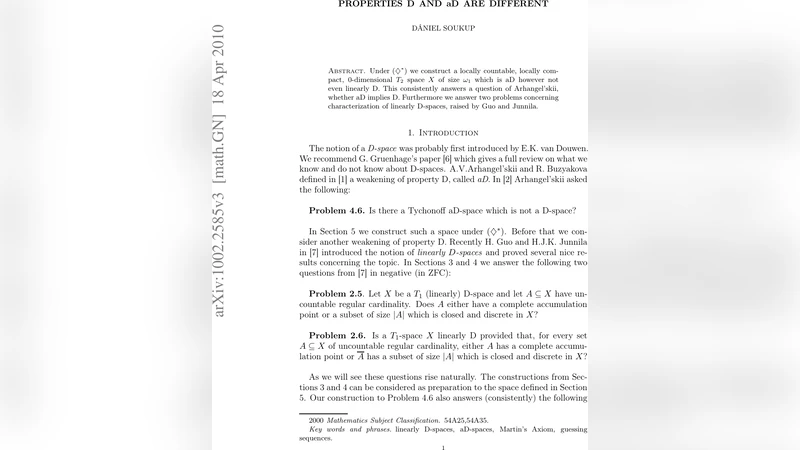
Under $(\diamondsuit^*)$ we construct a locally countable, locally compact, 0-dimensional $T_2$ space $X$ of size $\omg$ which is aD however not even linearly D. This consistently answers a question of Arhangel’skii, whether aD implies D. Furthermore we answer two problems concerning characterization of linearly D-spaces, raised by Guo and Junnila.
💡 Research Summary
**
The paper investigates the relationship between three covering properties of topological spaces: the D‑property, its weaker variant aD, and the linearly D‑property. A space X is called a D‑space if for every open cover 𝒰 there exists a closed‑discrete set D such that every member of 𝒰 meets D and the union of those members equals X. An aD‑space is one in which every closed subspace is a D‑space; thus aD is a relaxation of D. A linearly D‑space is a D‑space with the additional requirement that the open cover can be arranged in a linear (typically ω‑indexed) order. The long‑standing question of Arhangel’skii asked whether the aD‑property automatically implies the D‑property.
Working under the combinatorial principle $\diamondsuit^{}$, the author constructs a concrete counterexample. First an almost‑disjoint family $\mathcal A={A_{\alpha}:\alpha<\omega_{1}}$ of countable subsets of $\omega$ is obtained by the predictive power of $\diamondsuit^{}$. For each $A_{\alpha}$ a distinguished point $p_{\alpha}$ is added, and the basic neighborhoods of $p_{\alpha}$ consist of $A_{\alpha}$ together with finitely many points from other $A_{\beta}$ that intersect $A_{\alpha}$ only finitely. This yields a zero‑dimensional Hausdorff space $X$ of size $\omega_{1}$ that is locally countable and locally compact.
To show that $X$ is aD, the paper proves that any closed subset $F\subseteq X$ is a D‑space. Using the $\diamondsuit^{*}$‑prediction function, for each $\alpha$ the intersection $F\cap A_{\alpha}$ is approximated by a finite set. Selecting the corresponding $p_{\alpha}$ whenever this approximation is non‑empty produces a closed‑discrete set $D_{F}$ that meets every member of any open cover of $F$ and therefore witnesses the D‑property for $F$. Since $F$ was arbitrary, $X$ is an aD‑space.
The failure of the linearly D‑property is demonstrated by constructing a specific ω‑indexed increasing open cover $\mathcal U={U_{n}:n\in\omega}$ of $X$. The cover is designed so that any closed‑discrete set $D$ either misses infinitely many distinguished points $p_{\alpha}$ (hence does not intersect all $U_{n}$) or, if it contains such a point, ceases to be closed‑discrete because the almost‑disjoint structure forces accumulation. Consequently no closed‑discrete set can serve as a D‑witness for this linear cover, and $X$ is not linearly D.
Thus the paper provides a consistent example where aD does not imply D, answering Arhangel’skii’s question in the negative. Moreover, it resolves two problems posed by Guo and Junnila concerning the characterization of linearly D‑spaces: (1) a linearly D‑space need not be aD, and (2) an aD‑space need not be linearly D. The construction shows that the distinction between these properties can be witnessed in a locally compact, locally countable, zero‑dimensional $T_{2}$ space of size $\omega_{1}$.
In the concluding discussion the author reflects on the role of $\diamondsuit^{*}$, noting that the counterexample relies heavily on this strong guessing principle. The paper raises the open question of whether a similar separation can be achieved in ZFC alone, or whether weaker combinatorial hypotheses suffice. It also suggests further investigation into the hierarchy of covering properties, the possible existence of “minimal” aD‑spaces that are not D, and the impact of additional set‑theoretic assumptions (such as MA or PFA) on the landscape of D‑type properties.
Comments & Academic Discussion
Loading comments...
Leave a Comment