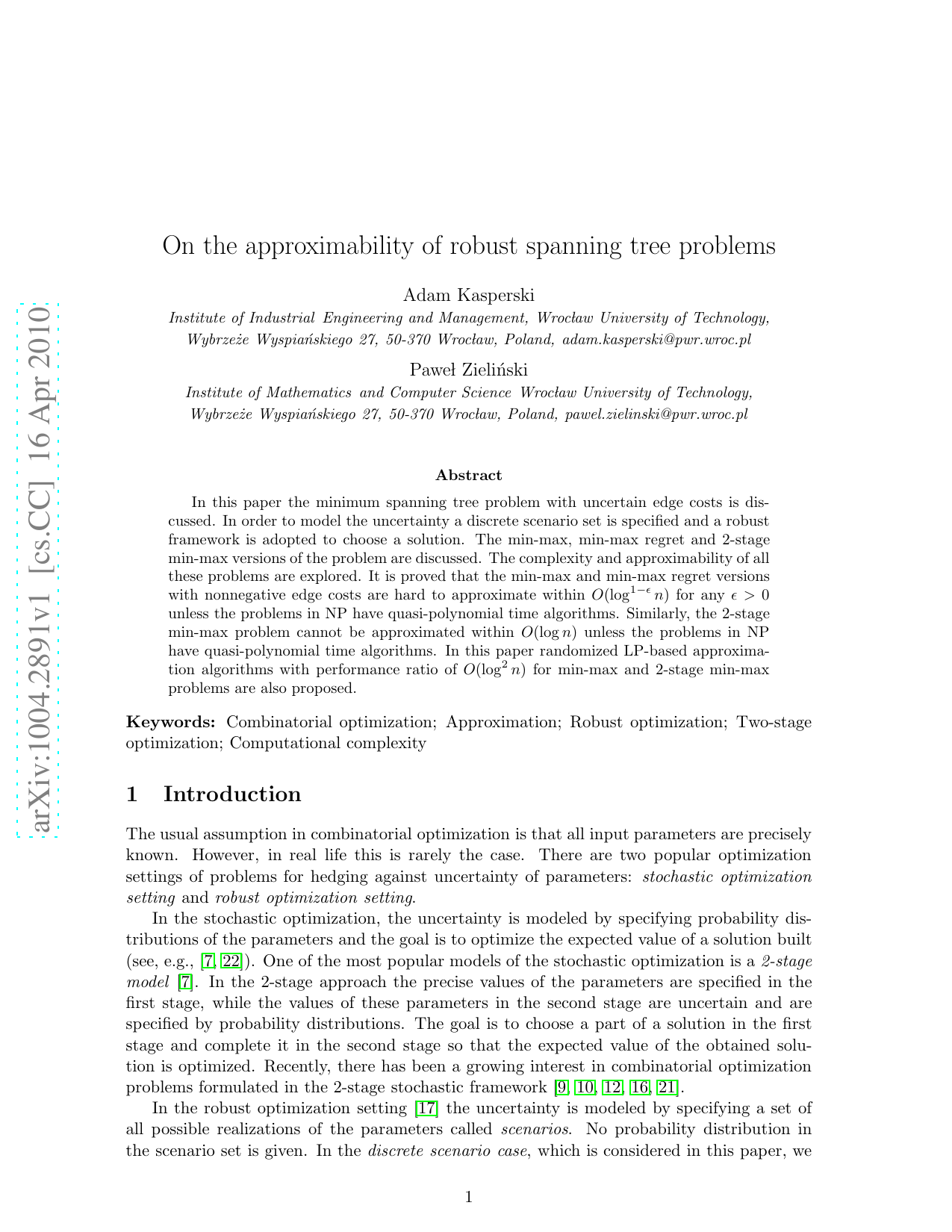
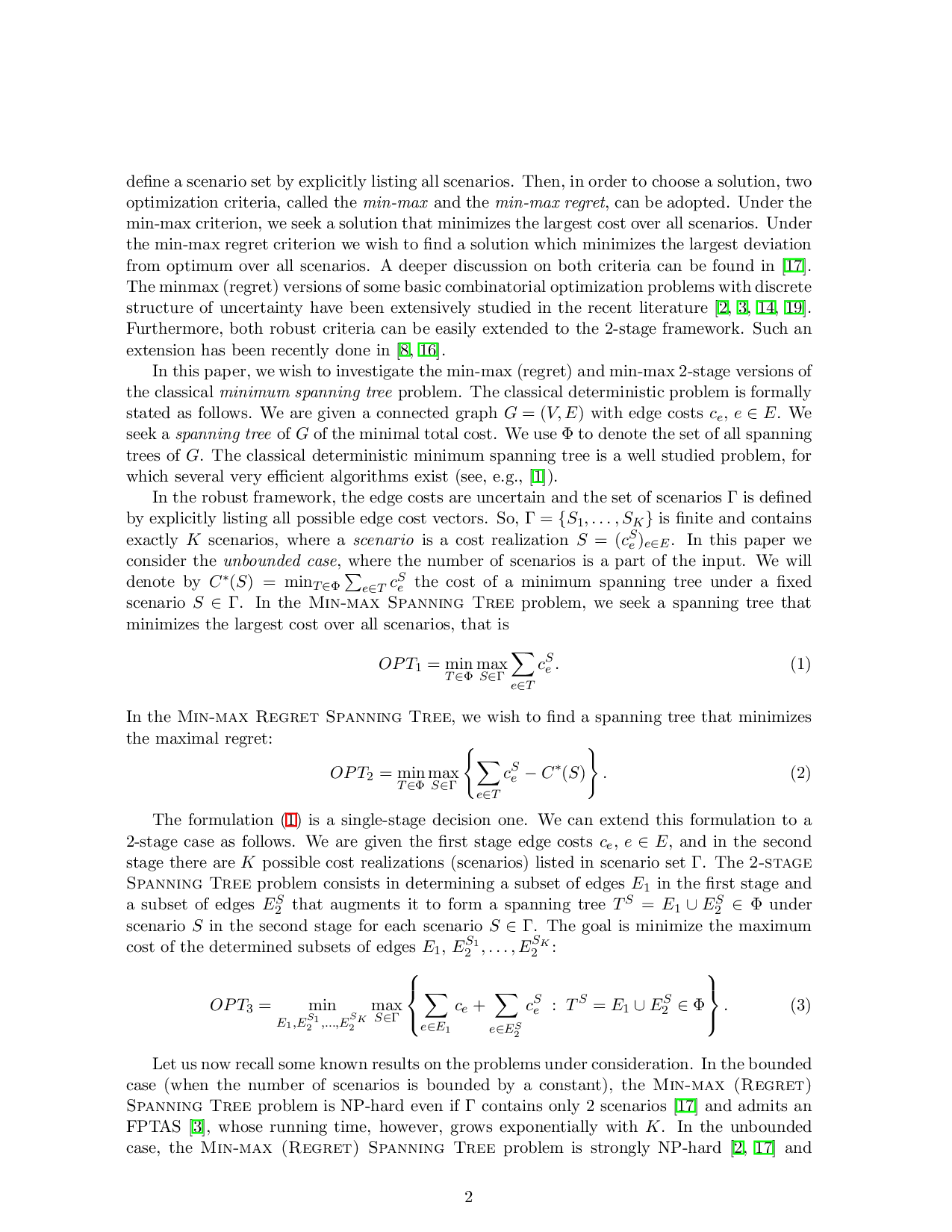
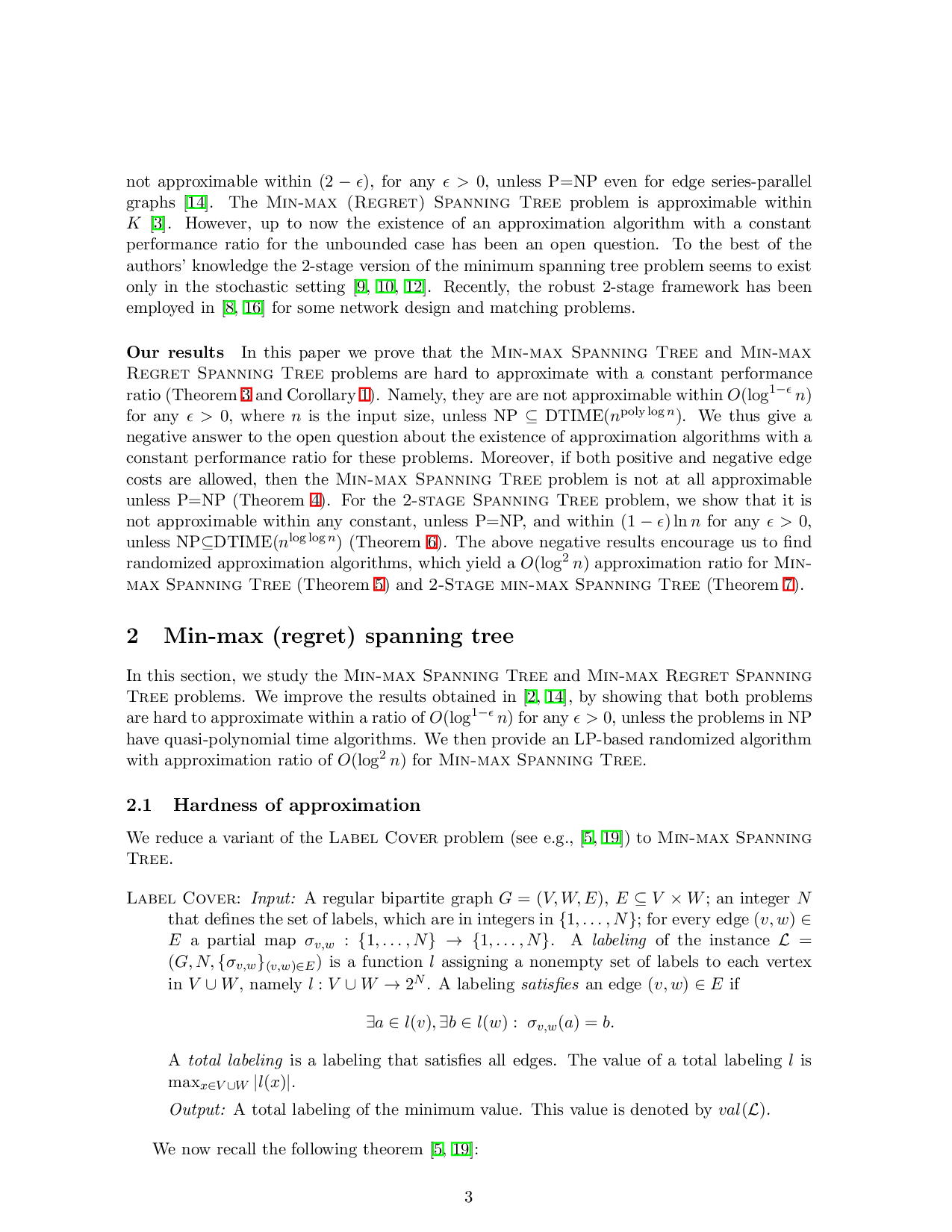
In this paper the minimum spanning tree problem with uncertain edge costs is discussed. In order to model the uncertainty a discrete scenario set is specified and a robust framework is adopted to choose a solution. The min-max, min-max regret and 2-stage min-max versions of the problem are discussed. The complexity and approximability of all these problems are explored. It is proved that the min-max and min-max regret versions with nonnegative edge costs are hard to approximate within $O(\log^{1-\epsilon} n)$ for any $\epsilon>0$ unless the problems in NP have quasi-polynomial time algorithms. Similarly, the 2-stage min-max problem cannot be approximated within $O(\log n)$ unless the problems in NP have quasi-polynomial time algorithms. In this paper randomized LP-based approximation algorithms with performance ratio of $O(\log^2 n)$ for min-max and 2-stage min-max problems are also proposed.
Deep Dive into On the approximability of robust spanning tree problems.
In this paper the minimum spanning tree problem with uncertain edge costs is discussed. In order to model the uncertainty a discrete scenario set is specified and a robust framework is adopted to choose a solution. The min-max, min-max regret and 2-stage min-max versions of the problem are discussed. The complexity and approximability of all these problems are explored. It is proved that the min-max and min-max regret versions with nonnegative edge costs are hard to approximate within $O(\log^{1-\epsilon} n)$ for any $\epsilon>0$ unless the problems in NP have quasi-polynomial time algorithms. Similarly, the 2-stage min-max problem cannot be approximated within $O(\log n)$ unless the problems in NP have quasi-polynomial time algorithms. In this paper randomized LP-based approximation algorithms with performance ratio of $O(\log^2 n)$ for min-max and 2-stage min-max problems are also proposed.
arXiv:1004.2891v1 [cs.CC] 16 Apr 2010
On the approximability of robust spanning tree problems
Adam Kasperski
Institute of Industrial Engineering and Management, Wroc law University of Technology,
Wybrze˙ze Wyspia´nskiego 27, 50-370 Wroc law, Poland, adam.kasperski@pwr.wroc.pl
Pawe l Zieli´nski
Institute of Mathematics and Computer Science Wroc law University of Technology,
Wybrze˙ze Wyspia´nskiego 27, 50-370 Wroc law, Poland, pawel.zielinski@pwr.wroc.pl
Abstract
In this paper the minimum spanning tree problem with uncertain edge costs is dis-
cussed. In order to model the uncertainty a discrete scenario set is specified and a robust
framework is adopted to choose a solution. The min-max, min-max regret and 2-stage
min-max versions of the problem are discussed. The complexity and approximability of all
these problems are explored. It is proved that the min-max and min-max regret versions
with nonnegative edge costs are hard to approximate within O(log1−ǫ n) for any ǫ > 0
unless the problems in NP have quasi-polynomial time algorithms. Similarly, the 2-stage
min-max problem cannot be approximated within O(log n) unless the problems in NP
have quasi-polynomial time algorithms. In this paper randomized LP-based approxima-
tion algorithms with performance ratio of O(log2 n) for min-max and 2-stage min-max
problems are also proposed.
Keywords: Combinatorial optimization; Approximation; Robust optimization; Two-stage
optimization; Computational complexity
1
Introduction
The usual assumption in combinatorial optimization is that all input parameters are precisely
known. However, in real life this is rarely the case.
There are two popular optimization
settings of problems for hedging against uncertainty of parameters: stochastic optimization
setting and robust optimization setting.
In the stochastic optimization, the uncertainty is modeled by specifying probability dis-
tributions of the parameters and the goal is to optimize the expected value of a solution built
(see, e.g., [7, 22]). One of the most popular models of the stochastic optimization is a 2-stage
model [7]. In the 2-stage approach the precise values of the parameters are specified in the
first stage, while the values of these parameters in the second stage are uncertain and are
specified by probability distributions. The goal is to choose a part of a solution in the first
stage and complete it in the second stage so that the expected value of the obtained solu-
tion is optimized. Recently, there has been a growing interest in combinatorial optimization
problems formulated in the 2-stage stochastic framework [9, 10, 12, 16, 21].
In the robust optimization setting [17] the uncertainty is modeled by specifying a set of
all possible realizations of the parameters called scenarios. No probability distribution in
the scenario set is given. In the discrete scenario case, which is considered in this paper, we
1
define a scenario set by explicitly listing all scenarios. Then, in order to choose a solution, two
optimization criteria, called the min-max and the min-max regret, can be adopted. Under the
min-max criterion, we seek a solution that minimizes the largest cost over all scenarios. Under
the min-max regret criterion we wish to find a solution which minimizes the largest deviation
from optimum over all scenarios. A deeper discussion on both criteria can be found in [17].
The minmax (regret) versions of some basic combinatorial optimization problems with discrete
structure of uncertainty have been extensively studied in the recent literature [2, 3, 14, 19].
Furthermore, both robust criteria can be easily extended to the 2-stage framework. Such an
extension has been recently done in [8, 16].
In this paper, we wish to investigate the min-max (regret) and min-max 2-stage versions of
the classical minimum spanning tree problem. The classical deterministic problem is formally
stated as follows. We are given a connected graph G = (V, E) with edge costs ce, e ∈E. We
seek a spanning tree of G of the minimal total cost. We use Φ to denote the set of all spanning
trees of G. The classical deterministic minimum spanning tree is a well studied problem, for
which several very efficient algorithms exist (see, e.g., [1]).
In the robust framework, the edge costs are uncertain and the set of scenarios Γ is defined
by explicitly listing all possible edge cost vectors. So, Γ = {S1, . . . , SK} is finite and contains
exactly K scenarios, where a scenario is a cost realization S = (cS
e )e∈E. In this paper we
consider the unbounded case, where the number of scenarios is a part of the input. We will
denote by C∗(S) = minT∈Φ
P
e∈T cS
e the cost of a minimum spanning tree under a fixed
scenario S ∈Γ. In the Min-max Spanning Tree problem, we seek a spanning tree that
minimizes the largest cost over all scenarios, that is
OPT1 = min
T∈Φ max
S∈Γ
X
e∈T
cS
e .
(1)
In the Min-max Regret Spanning Tree, we wish to find a spanning tree that minimizes
the maximal regret:
OPT2 = min
T∈Φ max
S∈Γ
(X
e∈T
…(Full text truncated)…
This content is AI-processed based on ArXiv data.