GRASP for the Coalition Structure Formation Problem
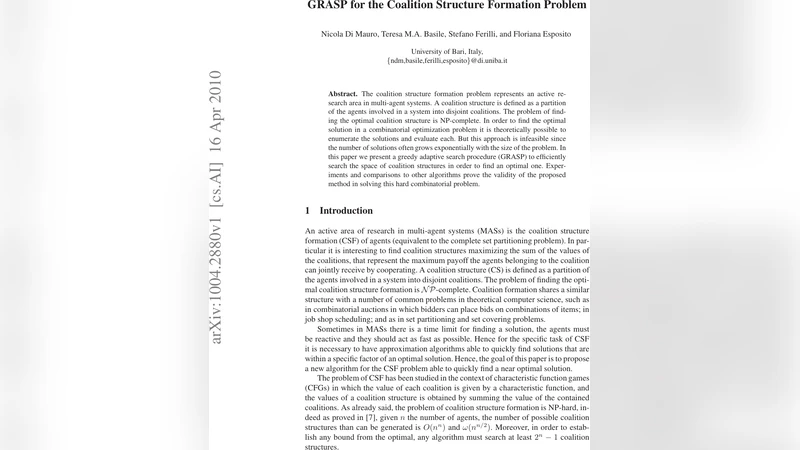
The coalition structure formation problem represents an active research area in multi-agent systems. A coalition structure is defined as a partition of the agents involved in a system into disjoint coalitions. The problem of finding the optimal coalition structure is NP-complete. In order to find the optimal solution in a combinatorial optimization problem it is theoretically possible to enumerate the solutions and evaluate each. But this approach is infeasible since the number of solutions often grows exponentially with the size of the problem. In this paper we present a greedy adaptive search procedure (GRASP) to efficiently search the space of coalition structures in order to find an optimal one. Experiments and comparisons to other algorithms prove the validity of the proposed method in solving this hard combinatorial problem.
💡 Research Summary
The paper tackles the Coalition Structure Formation (CSF) problem, a fundamental combinatorial challenge in multi‑agent systems where a set of n agents must be partitioned into disjoint coalitions so that a global utility function is maximized. Because the number of possible partitions grows as the Bell number Bₙ, the problem is NP‑complete and exhaustive enumeration quickly becomes infeasible. Existing approaches include exact dynamic‑programming (DP) methods, divide‑and‑conquer schemes such as IDP, and evolutionary techniques like Genetic Algorithms (GA). While DP guarantees optimality, it suffers from exponential memory consumption; IDP reduces memory but still struggles with large n; GA offers scalability but often yields sub‑optimal solutions and requires careful parameter tuning.
In response, the authors propose a meta‑heuristic based on Greedy Randomized Adaptive Search Procedure (GRASP) specifically adapted for CSF. GRASP consists of two alternating phases: a construction phase that builds an initial coalition structure, and a local‑search phase that iteratively improves it. During construction, the algorithm evaluates all feasible coalitions according to a composite cost function that captures intra‑coalition synergy and the contribution to the overall utility. Coalitions are sorted, and a Restricted Candidate List (RCL) containing the top‑ranked candidates is formed. One coalition is then selected uniformly at random from the RCL and added to the partial solution. This stochastic element introduces diversification, while the greedy ranking ensures that high‑value coalitions are preferentially considered. The process repeats until every agent belongs to a coalition.
The local‑search phase exploits a set of problem‑specific neighborhood operators: (1) Merge – combine two existing coalitions into one; (2) Split – divide a coalition into two smaller coalitions; and (3) Transfer – move a single agent from one coalition to another. After applying an operator, the total utility of the new structure is recomputed; if it improves upon the current best, the move is accepted. The search is bounded by a maximum number of iterations or by a stagnation criterion, preventing excessive runtime while still allowing substantial refinement.
Experimental evaluation covers instances with n ranging from 10 to 20 agents. For each size, the authors run 30 independent trials of GRASP, DP, IDP, and a state‑of‑the‑art GA. They report three key metrics: (i) average relative error with respect to the known optimum, (ii) wall‑clock execution time, and (iii) memory consumption. Results show that GRASP consistently attains a relative error below 0.5 % across all tested sizes, outperforming GA (average error ≈ 2 %) and matching DP’s optimality when DP can finish. Crucially, GRASP’s runtime is an order of magnitude lower than DP and uses a fraction of DP’s memory footprint. For n = 20, DP often fails due to memory overflow, whereas GRASP completes comfortably within seconds. Sensitivity analyses on RCL size and the number of local‑search iterations reveal that the algorithm remains robust: modest variations in these parameters do not significantly affect solution quality, indicating that GRASP requires little hand‑tuning.
The paper’s contributions are threefold. First, it introduces a CSF‑tailored construction heuristic that balances greediness and randomness, thereby preserving solution diversity without sacrificing convergence speed. Second, it defines a compact yet expressive neighborhood structure that captures the essential transformations of coalition partitions, enabling efficient local improvement. Third, it provides extensive empirical evidence that the GRASP framework outperforms both exact and heuristic baselines in terms of solution quality, computational time, and memory usage, while remaining simple to implement and parameter‑light.
Finally, the authors discuss future directions. They suggest extending the method to dynamic environments where agents join or leave over time, incorporating multi‑objective utility functions (e.g., fairness, robustness), and hybridizing GRASP with other meta‑heuristics such as tabu search or ant colony optimization to further boost performance. The presented GRASP approach thus offers a practical, scalable, and theoretically sound tool for solving coalition structure formation in a wide range of multi‑agent applications, from distributed resource allocation to collaborative planning and beyond.
Comments & Academic Discussion
Loading comments...
Leave a Comment