Complexity of Propositional Proofs under a Promise
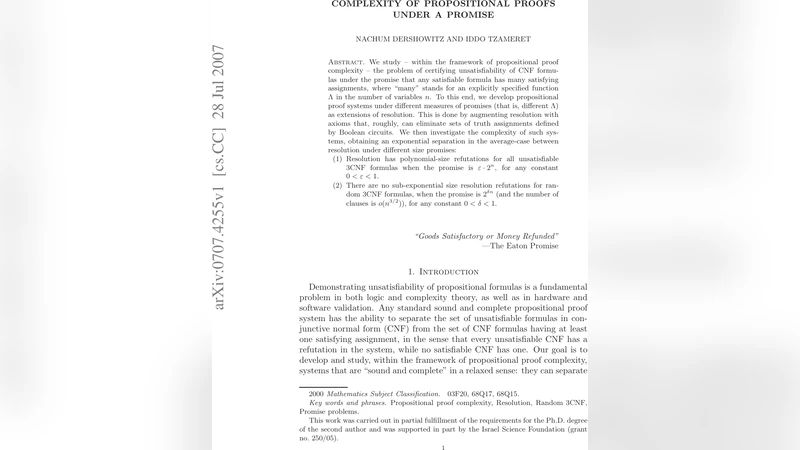
We study – within the framework of propositional proof complexity – the problem of certifying unsatisfiability of CNF formulas under the promise that any satisfiable formula has many satisfying assignments, where ``many’’ stands for an explicitly specified function $\Lam$ in the number of variables $n$. To this end, we develop propositional proof systems under different measures of promises (that is, different $\Lam$) as extensions of resolution. This is done by augmenting resolution with axioms that, roughly, can eliminate sets of truth assignments defined by Boolean circuits. We then investigate the complexity of such systems, obtaining an exponential separation in the average-case between resolution under different size promises: 1. Resolution has polynomial-size refutations for all unsatisfiable 3CNF formulas when the promise is $\eps\cd2^n$, for any constant $0<\eps<1$. 2. There are no sub-exponential size resolution refutations for random 3CNF formulas, when the promise is $2^{\delta n}$ (and the number of clauses is $o(n^{3/2})$), for any constant $0<\delta<1$.
💡 Research Summary
The paper introduces a novel “promise” framework into propositional proof complexity, focusing on the task of certifying unsatisfiability of CNF formulas under the assumption that any satisfiable formula possesses at least Λ(n) distinct satisfying assignments, where Λ is an explicitly given function of the number of variables n. To capture this setting, the authors extend the classic resolution proof system by adding a family of axioms—called circuit‑elimination axioms—that can simultaneously eliminate whole sets of truth assignments described by Boolean circuits. These axioms are sound precisely because the promise guarantees that the eliminated set cannot contain all satisfying assignments of a satisfiable formula; if it did, the promise would be violated.
Two regimes of the promise function are studied. In the “large‑promise” regime, Λ(n)=ε·2ⁿ for any constant 0<ε<1, meaning that a satisfiable formula must have a constant‑fraction of the total assignment space. In the “small‑promise” regime, Λ(n)=2^{δ n} for a constant 0<δ<1, i.e., the formula must have an exponential but sub‑full fraction of assignments.
Upper bound (large promise).
The authors show that under the ε·2ⁿ promise, every unsatisfiable 3‑CNF admits a polynomial‑size refutation in the extended system. The construction proceeds by iteratively fixing a small set of variables, using the promise to argue that after each fixing the residual formula still has many satisfying assignments if it were satisfiable. Consequently, the remaining formula can be reduced to a bounded‑width (in fact width‑2) CNF after a bounded number of steps. The circuit‑elimination axioms are employed to prune away the large blocks of assignments that would otherwise cause the width to blow up. The result is a refutation whose size is O(n^c) for some constant c independent of the formula, establishing that the promise dramatically strengthens resolution.
Lower bound (small promise).
In contrast, when the promise is only 2^{δ n}, the authors prove that no sub‑exponential‑size resolution refutation exists for random 3‑CNF formulas with clause count o(n^{3/2}). The proof adapts the classical width‑lower‑bound technique of Ben‑Sasson and Wigderson to the promise setting. They show that any resolution refutation must contain a clause of width at least Ω(n), because the limited promise does not allow the circuit‑elimination axioms to remove enough assignments to keep the width low. By the width‑to‑size trade‑off, this yields a size lower bound of 2^{Ω(n)}. Hence, even with the additional axioms, the system cannot beat the known hardness of random 3‑CNF in this regime.
Implications and future directions.
The two results together give an exponential separation in average‑case complexity between resolution under different promise sizes. They demonstrate that the amount of “guaranteed redundancy” in the solution space (as quantified by Λ) is a decisive parameter: a constant‑fraction promise collapses the hardness of unsatisfiability for 3‑CNF, while a merely exponential promise leaves the problem essentially as hard as without any promise. The paper also discusses how the circuit‑elimination axioms could be adapted to other proof systems such as Cutting‑Planes or Polynomial Calculus, suggesting a broader research program on promise‑based proof complexity. Open questions include characterizing the exact threshold function Λ* where the transition from polynomial to exponential proof size occurs, and exploring whether stronger or different types of axioms could further narrow the gap.
Comments & Academic Discussion
Loading comments...
Leave a Comment